I used to think the word “hauz” was just some archaic term until I stood at Lyabi Hauz in Bukhara and realized it literally means pool—and there it was, shimmering under the Central Asian sun like someone had dropped a piece of sky into the city center.
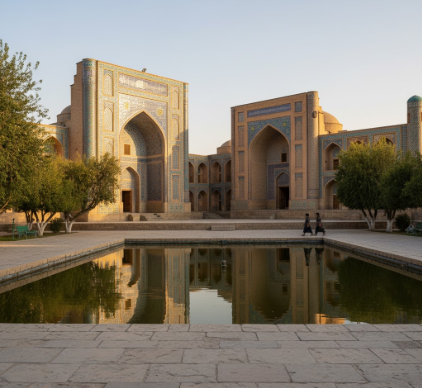
The Lyabi Hauz complex dates back to 1620, give or take a few years, when the vizier Nadir Divan-Beghi decided Bukhara needed a public square that didn’t feel like every other dusty marketplace along the Silk Road. He commissioned a massive rectangular pool—roughly 42 by 36 meters, though I’ve seen slightly different measurements depending on who you ask—surrounded by ancient mulberry trees that are so old they seem to lean into the water like they’re checking their reflection. The pool itself was fed by an intricate canal system that pulled water from the Shakhrud Canal, and honestly, the engineering still impresses me when I think about how they maintained water quality in the 17th century without modern filtration. Around this central hauz, three major structures define the space: the Kukeldash Madrasah to the north (built in 1568-1569, so technically it predates the pool), the Nadir Divan-Beghi Madrasah to the east, and the Nadir Divan-Beghi Khanqah to the west—both of the latter constructed in the 1620s as part of the same ambitious urban project.
Wait—maybe the most striking thing isn’t the architecture itself but how the reflecting pool turns everything upside down. The Nadir Divan-Beghi Madrasah’s facade, with its famous mosaic depicting two phoenixes chasing white deer under a human-faced sun (which, turns out, was a bit controversial since Islamic art typically avoids figural representation), gets this second life in the water. I’ve watched tourists try to photograph the reflection for hours, adjusting angles like they’re trying to capture something that refuses to hold still.
The Madrasah That Started As a Caravanserai and Other Architectural Accidents of History
Here’s the thing about the Nadir Divan-Beghi Madrasah: it wasn’t supposed to be a madrasah at all. Originally designed as a caravanserai—basically a roadside inn for Silk Road merchants—the building got an identity crisis when the ruling khan showed up for the opening ceremony and loudly proclaimed it a madrasah instead. Nadir Divan-Beghi, not wanting to contradict royalty, just went with it and awkwardly converted the structure into an Islamic school. The interior courtyard, with its hujras (student cells) arranged around the perimeter, still feels a bit off if you know the backstory—like the rooms are slightly too large for students and suspiciously well-suited for merchants with pack animals. The tilework, though, is genuinley stunning: intricate geometric patterns in cobalt blue, turquoise, and gold leaf that took artisans years to complete using techniques passed down from Timurid masters.
When a Reflecting Pool Becomes the City’s Living Room for Five Centuries
Anyway, the pool does more than look pretty.
For centuries, Lyabi Hauz functioned as Bukhara’s social nucleus—locals would gather on the stepped edges to gossip, conduct business, or escape the brutal summer heat that regularly pushes past 40°C (104°F). The mulberry trees provided shade dense enough that even midday felt tolerable, and the water cooled the air through evaporation in a way that pre-dated modern climate control by several hundred years. Soviet authorities nearly filled in the pool during their Central Asian urban renewal campaigns in the 1960s, arguing it was unsanitary and outdated, but local resistance was fierce enough that they backed down—one of the rare instances where community pushback actually worked against Soviet infrastructure plans. Today, the chaikhanas (tea houses) that ring the plaza serve endless pots of green tea while elderly men play backgammon on wooden boards worn smooth by decades of use, and honestly, the scene probably hasn’t changed much since the 1700s except for the occasional smartphone.
The Kukeldash Madrasah’s Brutal Second Act As a Fortress When Everything Went Wrong
The Kukeldash Madrasah has a darker history that doesn’t always make it into the tourist brochures. Built by Kulbaba Kukeldash, a high-ranking official under Abdullah Khan II, it’s the largest madrasah in Bukhara—160 student cells arranged around a central courtyard that once housed up to 320 students studying Quran, mathematics, and astronomy. But in the 18th century, when Bukhara’s political stability collapsed into a series of brutal khanate conflicts, the madrasah got repurposed as a fortress and, even worse, as a caravanserai again—this time with a warehouse vibe that saw centuries of scholarly tilework covered in soot and grime. By the early 20th century, parts of the structure were crumbling so badly that restoration crews basically had to rebuild entire sections, which raises uncomfortable questions about how much of what we see today is “authentic” versus reconstructed. I guess it makes sense that a building survives by adapting, even if adaptation means becoming something you weren’t meant to be.
The pool still reflects everything, though—unchanged, indifferent, patient.