I used to think madrasahs were all the same—just austere religious schools with intimidating calligraphy and stern teachers.
Then I actually stood in the courtyard of Kutlug Murad Inak Madrasah in Khiva, Uzbekistan, and realized how wrong I’d been. Built around 1804-1812 (the exact dates are fuzzy, honestly), this wasn’t just another Islamic school churning out theologians. It was a complex social institution where astronomy met theology, where travelers found shelter, and where the Khan’s own relatives studied alongside merchant sons. The madrasah sits in Itchan Kala, the walled inner city of Khiva, and it’s named after Kutlug Murad Inak—a military commander and nephew of the Khivan Khan Muhammad Rahim Khan I. Here’s the thing: Kutlug Murad never actually saw the building completed. He died in 1812, right around when construction wrapped up, which gives the whole place this weird melancholic energy. The structure follows classic Central Asian madrasah design—a rectangular courtyard surrounded by two stories of hujras (student cells), roughly 60-70 of them, give or take. The portal faces south, decorated with majolica tiles in blues and whites that have faded unevenly over two centuries.
When you walk through that main entrance, the first thing that hits you is the scale. The courtyard is maybe 30 by 40 meters, and during its operational years, it would’ve been packed—students debating Quranic interpretation, math tutors sketching geometric proofs in the dust, travelers sleeping in corner cells. The madrasah functioned until the 1920s when Soviet authorities shut down most religious schools in Central Asia. Wait—maybe “shut down” is too clean. They repurposed them, turned them into warehouses and community centers. This one became a hospital for a while, then storage.
The Architecture That Somehow Balanced Austerity and Showmanship
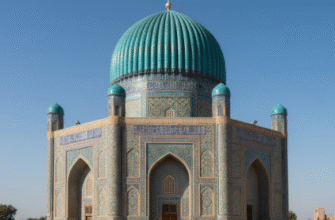
The exterior is where things get interesting. The portal—about 15 meters high—has this almost aggressive geometric pattern work. Majolica tiles form stars within stars, interlocking polygons that mathematicians still study. But the tiles are cracking, and some panels have been replaced with obviously modern reproductions that don’t quite match the original cobalt blue. Inside the courtyard, the cells are tiny—maybe 3 by 4 meters each. Students lived, studied, and slept in these spaces, sometimes two or three to a room. The acoustics are strange too. If you stand in the center of the courtyard and speak normally, your voice bounces off the walls in this echoey, disorienting way. I guess it made sense for a place designed around oral recitation and memorization. The second floor has a wooden gallery that’s been rebuilt multiple times—the original wood rotted out decades ago.
Anyway, the building materials tell their own story.
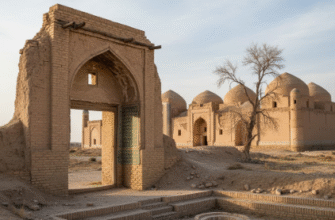
The walls are mud brick—pakhsa, the traditional Central Asian technique where you mix clay, straw, and sometimes camel dung for binding. These walls are thick, maybe 80-100 centimeters in places, which kept the interiors cool during Khiva’s brutal summers (temperatures regularly hit 45°C). The foundation sits on wooden beams laid directly into the ground, a technique that works surprisingly well in Khiva’s dry climate but would be disastrous anywhere with groundwater. Over the decades, parts of the foundation have settled unevenly, giving some doorways a slightly drunken tilt. The domes over the corner rooms use squinches—those triangular architectural elements that transition from square room to round dome—and they’re constructed without any metal reinforcement. Just brick and mortar and geometry. Some of the squinches have visible cracks now, held together by twentieth-century cement patches that stand out like dental fillings.
What Actually Happened Inside Those Walls Beyond Prayer and Memorization
The curriculum wasn’t just religious studies, turns out. Students—who ranged from about 12 to 25 years old—studied Arabic grammar, Islamic law, logic, mathematics, astronomy, and medicine. The more advanced students would recieve instruction in falsafa (philosophy), though that was controversial. Teaching schedules were brutal: classes started before dawn and continued until late evening, with breaks for the five daily prayers. Students financed their education through family support, endowments (waqf), or by working—some taught younger students, others did calligraphy commissions for wealthy families. The madrasah had a small library, though most books have been relocated to museums in Tashkent and elsewhere.
Here’s what gets me, though.
The madrasah also functioned as a caravanserai—a traveler’s inn. Merchants passing through Khiva on the Silk Road could rent empty hujras when students were away or when cells weren’t filled. This wasn’t unusual; madrasahs throughout Central Asia blurred the lines between sacred and commercial space. The institution needed income, travelers needed shelter, and students benefited from exposure to people who’d seen the world beyond Khiva’s walls. Some scholars argue this mixing of functions actually enriched the educational experience—students learned practical geography, trade languages, and cultural negotiation skills that pure religious education wouldn’t provide.
The Soviet Years and the Slow Forgetting That Followed
After 1924, when the Khorezm People’s Soviet Republic was absorbed into the Uzbek SSR, religious education was systematically dismantled. The madrasah’s library was confiscated—books deemed “religiously extremist” were destroyed, others sent to state archives. The building itself became a hospital, then a tuberculosis clinic, then storage for cotton and grain. By the 1960s, it was semi-abandoned, used by local kids as a playground. I’ve seen photographs from that era: graffiti on the majolica tiles, animals sheltering in the hujras, the wooden gallery partially collapsed. Restoration began in the 1970s as part of broader Soviet efforts to preserve “historical monuments” (stripped of religious context, of course). Workers replaced damaged bricks, re-did some of the tilework, and stabilized the domes.
The work was uneven, honestly.
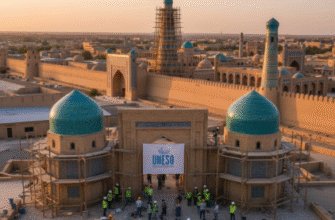
Some sections got meticulous attention—the portal was almost entirely re-tiled—while other areas were left to crumble. Post-independence in 1991, Uzbekistan’s government invested more resources into heritage sites as part of building national identity. Kutlug Murad Inak Madrasah became a museum, though “museum” is generous. It’s more like a preserved shell you can walk through. There are a few informational plaques, some display cases with historical artifacts (ceramic fragments, old manuscripts), but mostly it’s just the architecture itself. Tourism has picked up—Khiva gets maybe 100,000 visitors annually, give or take—and the madrasah is on most tour itineraries.
Standing in the Courtyard Now and Feeling the Weight of Discontinuity
When you visit today, the place feels suspended between identities. It’s not a functioning school anymore, but it’s not quite a museum either. Local guides will tell you stories—some historically accurate, others embellished for effect—about students who became famous scholars or about Kutlug Murad’s military exploits. The tiles catch afternoon light in this particular way that makes the geometric patterns seem to vibrate. You can climb the wooden stairs to the second floor (carefully—the handrail is loose), and from up there, you can see over the courtyard walls to Khiva’s other monuments: the Kalta Minor minaret, the Kuhna Ark fortress. It’s quieter than you’d expect. Maybe a dozen tourists wander through on a busy day, taking photos, reading guidebook entries.
I guess what strikes me most is the discontinuity.
For roughly 120 years, this was a living institution—students arguing, teachers lecturing, travelers negotiating room rates. Then it stopped, abruptly, and became something else entirely. The building remains, but the social ecosystem that gave it meaning is gone. You can study the architecture, read about the curriculum, imagine the daily rhythms, but there’s an unbridgeable gap between the madrasah as it functioned and the madrasah as tourist site. Some restoration experts argue we should do more to recreate the original appearance—replace all the damaged tiles, rebuild the rotted wooden elements exactly as they were. Others say the decay is part of the story, that over-restoration erases historical layers. Standing in that courtyard, looking at the mix of original 19th-century tiles and obviously modern replacements, I’m not sure which approach is right. Maybe both. Maybe neither. The place just sits there, beautiful and broken and definately more complicated than I expected when I first read the name in a guidebook.