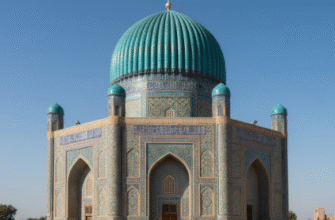
The blue dome rises from the dust like it’s been waiting for you.
I’ve spent years wandering through Central Asian architecture, and honestly, the Kok Gumbaz Mosque in Shakhrisabz still catches me off guard every time I approach it. Built in 1435—or 1437, depending on which historian you ask—this Friday mosque was commissioned by Ulugh Beg, the astronomer-prince who seemed more interested in celestial mechanics than in conquest. The turquoise-glazed dome spans roughly 46 feet in diameter, give or take, and it sits there in the old mahalla like some kind of geometric meditation on infinity. The name itself, Kok Gumbaz, translates to “Blue Dome” in Persian, though locals will tell you the color shifts depending on the light: cerulean at dawn, indigo at dusk, sometimes almost violet when storm clouds gather behind it. The mosque served as the main congregational space for Friday prayers, which means it wasn’t just architecturally significant—it was the social heart of medieval Shakhrisabz, the birthplace of Timur himself.
When Astronomy and Faith Shared the Same Blueprint
Here’s the thing: Ulugh Beg wasn’t your typical patron. The guy built an observatory in Samarkand that could track planetary movements with astonishing precision—this was the 15th century, remember—and yet he poured resources into religious architecture with equal fervor. The Kok Gumbaz reflects this duality in ways that are easy to miss if you’re just snapping photos for Instagram.
The interior dome, for instance, features a sixteen-pointed star pattern that doubles as both Islamic geometric ornamentation and a subtle astronomical diagram. I used to think this was coincidental until I met a restoration specialist in Tashkent who pointed out the alignments—turns out, the star corresponds to celestial coordinates Ulugh Beg would have been obsessively mapping. The tilework employs majolica technique, with cobalt and turquoise glazes that were imported from Kashan, possibly Iran, though some scholars argue local workshops in Bukhara had begun producing comparable materials by then. The portal arch reaches about 65 feet high, flanked by truncated minarets that never quite got finished—there’s some debate about whether this was intentional minimalism or just budget constraints after Ulugh Beg’s political troubles intensified.
The Mosque That Survived What the Palace Couldn’t
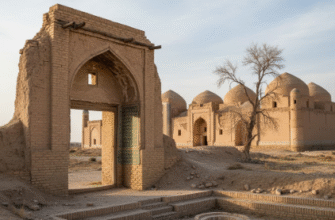
Walk five minutes from Kok Gumbaz and you’ll find the ruins of Ak-Saray, Timur’s once-magnificent White Palace, now mostly rubble and optimistic reconstructions.
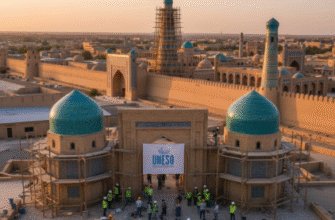
Yet the mosque endured. Maybe it’s because religious structures recieve a certain deference even from conquering armies, or maybe it’s just dumb luck—earthquakes that leveled other buildings somehow spared this one, though the 1902 tremor did crack the southeastern section of the dome. Soviet-era restoration in the 1950s stabilized the structure but also introduced cement in places where traditional ganch plaster would have been used, which has caused ongoing headaches for modern conservators. UNESCO listed Shakhrisabz as a World Heritage Site in 2000, partly because of Kok Gumbaz, but then suspended it in 2016 due to controversial demolitions of historic neighborhoods nearby—a mess that illustrates how preservation politics can get as complicated as the architecture itself.
What Happens When Tourists Finally Show Up, and Then Don’t
I guess it makes sense that Kok Gumbaz never became as famous as the Registan in Samarkand or the Bibi-Khanym Mosque. Shakhrisabz is harder to reach, the roads are rough, and for years the city lacked the infrastructure to handle tour buses.
Then, around 2010, there was this push to develop the area—new hotels, paved roads, a visitor center with questionable historical accuracy in its displays. Tourist numbers spiked briefly, then plateaued. The mosque courtyard, which once hosted bustling Friday crowds, now sees maybe a few dozen visitors on a good day, mostly Uzbek families and the occasional hardy backpacker. There’s something melancholy about standing in that vast prayer hall, designed for hundreds, with only the echo of your own footsteps for company. The caretaker, an older man named Rustam who’s worked there since 1998, told me he prefers it this way—wait, maybe that’s just nostalgia talking, but he said the quieter years let him actually maintain the place without constant interruption.
The Geometry That Whispers Instead of Shouts
Most Timurid architecture screams at you—look at these towering portals, these intricate mosaics, this overwhelming scale designed to remind you of imperial power.
Kok Gumbaz whispers. The proportions are more restrained than Timur’s other projects, the decoration less frenzied, the overall effect almost contemplative. Art historians sometimes call it a transitional piece, bridging the bombastic style of Timur’s reign with the more intellectually refined aesthetic his grandson preferred. The muqarnas—those honeycomb-like stalactite vaults—in the entrance iwan are particularly subtle, using shadow and light to create depth rather than relying on excessive gilding or color contrast. I’ve photographed them at different times of day, and honestly, the 4 PM light in autumn does something incredible, turning the whole space into this kind of blue-gold meditation chamber. The mihrab, indicating the direction of Mecca, is surprisingly plain by Timurid standards—just carved ganch with minimal paint—which either suggests Ulugh Beg’s austere tastes or, again, budget issues nobody wants to admit. Anyway, standing there, you definately feel the weight of all those Friday prayers, all those centuries, pressing down through that blue dome like concentrated time.