I used to think madrasahs were all austere study halls, sterile and quiet.
Then I stumbled into the Khoja Gaukushon Complex in Bukhara one October afternoon, jet-lagged and vaguely annoyed at my guidebook’s vague directions, and realized how wrong I’d been. Built in 1570—though some sources say 1562, the records from that era being what they are—this isn’t just a madrasah or just a mosque. It’s both, crammed together in a way that feels almost defiant, like someone said “why choose?” and just built everything at once. The complex sits near what was once a massive cattle market, which is where the name comes from: “Gaukushon” translates roughly to “slaughter of bulls,” a detail that feels weirdly visceral for a sacred space. The juxtaposition still gets me. Scholars studying theology while cattle merchants haggled outside, the smell of blood and incense mixing in the summer heat.
Anyway, the architecture does something unusual here.
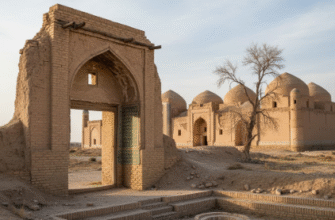
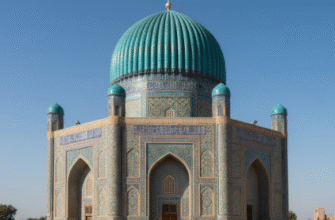
Most Bukharan madrasahs follow a strict courtyard plan—you’ve seen it if you’ve been to Ulugh Beg or Abdulaziz Khan. Four iwans, symmetrical cells, everything balanced. Khoja Gaukushon breaks that mold, or at least bends it. The madrasah section has the traditional layout, sure, but the mosque attached to its western side feels like an afterthought, except it clearly isn’t. The mosque’s dome, covered in those signature turquoise tiles that Central Asia does better than anywhere else, catches light differently depending on the hour. I’ve seen it look almost green at dawn, then blazing blue by midday—wait, maybe that’s just the way my memory works, compressing time. The tilework itself uses a technique called mosaic faience, where artisans cut glazed tiles into geometric shapes and fit them together like a massive, fragile puzzle. It’s labor-intensive to the point of absurdity, and you can see places where tiles have fallen away over the centuries, leaving raw brick exposed like bone through skin.
The Patron Nobody Remembers (But Probably Should)
Here’s the thing: we don’t actually know much about Khoja Kalon, the guy who commissioned this whole complex.
He was wealthy, obviously—you don’t build something like this on a merchant’s salary. Some historians think he was a high-ranking official under Abdullah Khan II, the Shaybanid ruler who transformed Bukhara into a regional powerhouse during the late 16th century. Others suggest he was a religious figure, possibly a Sufi sheikh, which would explain the complex’s dual religious-educational function. The historical record is frustratingly sparse, just a few scattered references in chronicles that focus more on wars and dynastic drama. What we do know is that he wanted his legacy tied to learning and prayer, and he had the resources to make it happen. The madrasah once housed maybe 30 to 40 students—I’ve seen estimates ranging from 25 to 50, depending on who’s counting and how—living in those tiny hujras (cells) that ring the courtyard. Imagine spending your teenage years in a space barely larger than a closet, memorizing the Quran and studying astronomy and mathematics, the sound of cattle being driven to slaughter drifting through the windows.
When Sacred Spaces Become Something Else (And Then Back Again)
The Soviet era didn’t treat Khoja Gaukushon kindly, though it fared better than some.
Religious education got banned outright in the 1920s, and the madrasah transformed into housing for local families. I met an old woman in Bukhara—this was years ago, I forget her name—who told me her grandmother lived in one of the hujras during the 1950s, raising three kids in that cramped space, hanging laundry across the courtyard where students once debated theology. The mosque kept functioning sporadically, secretly, because Soviet authorities were inconsistent about enforcement. Sometimes they’d crack down, sometimes they’d look the other way. By the 1980s, the whole complex was crumbling, tiles falling, wooden beams rotting. Independence in 1991 changed things. Restoration efforts started slowly, then picked up momentum in the 2000s when Uzbekistan began marketing its Silk Road heritage to tourists. Now the complex is clean, maybe too clean—there’s something unsettling about restoration that erases all the wear, all the evidence of actual human use.
Why This Place Feels Different From the Famous Ones Nearby
Bukhara has bigger, flashier monuments—the Kalyan Minaret, the Ark Fortress, Lyab-i Hauz.
Tourists flock to those, and I get it. They’re spectacular. But Khoja Gaukushon occupies this weird middle ground: important enough to be preserved, not famous enough to be overrun. When I visited last, there were maybe five other people there, compared to the crowds at Poi Kalyan. You can actually sit in the courtyard and think, which sounds cheesy but turns out to matter. The proportions feel human-scaled in a way the grander complexes don’t. The courtyard is small enough that you can imagine the students who lived here as actual people, not just historical abstractions. I guess what I’m trying to say is that the intimacy of the space does something the spectacular can’t—it makes the past feel close enough to touch, even if that past is messy and incompletely understood. The mosque still functions for prayers, which adds a layer of continuity that’s easy to overlook until you hear the call to prayer echo off those worn tiles, the same acoustic space it’s occupied for roughly 450 years, give or take a few decades of Soviet interruption. Honestly, I think that’s what keeps drawing me back—not the perfection, but the persistence despite imperfection.