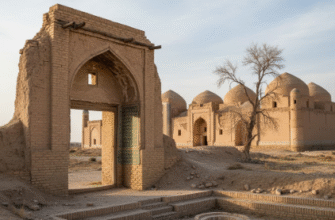
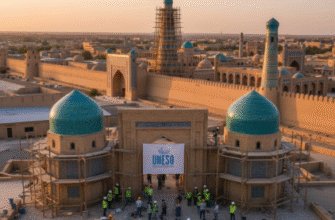
I used to think shopping in ancient cities meant dodging tourist traps with mass-produced junk stamped “authentic.”
Then I spent three days wandering Khiva’s Ichan-Kala—the walled inner city where artisans have been working the same trades for, what, maybe five centuries?—and realized the real challenge isn’t avoiding fakes. It’s choosing between so many legitimate crafts that your suitcase weight limit becomes an actual crisis. The silk suzanis folded in dim workshops carry patterns passed down through grandmothers who never wrote them down. The ceramic plates stacked in courtyards near the Kalta Minor minaret still use glazes mixed from minerals dug out of nearby deserts. I watched a guy named Rustam spend forty minutes carving a single wooden spoon, his hands moving with the kind of muscle memory that makes you wonder if craftsmanship is partly genetic. Here’s the thing: every shop claims authenticity, but your fingers know the difference when you touch hand-knotted wool versus machine-printed cotton pretending to be silk.
The Textile Obsession That Definitely Makes Sense If You Ignore Luggage Fees
Suzani embroidery hits different when you see women stitching in the corner of a courtyard, their needles pulling silk threads through cotton backing in patterns that look like pomegranates exploded into mandalas. These textile panels—used traditionally as wedding dowries or wall hangings—run anywhere from $50 for small pieces to $800 for museum-quality antiques. I got weirdly fixated on a burgundy-and-gold piece at a shop near the Juma Mosque, partly because the colors shifted in different light, partly because the seller, Malika, explained how natural dyes from madder root and walnut husks create shades synthetic dyes can’t replicate.
Wait—maybe I should mention the ikat fabric too. Those blurred, flame-like patterns come from resist-dyeing threads before weaving, a process so labor-intensive it feels illegal to pay only $30 per meter. The silk versions shimmer. The cotton versions last forever. Both will make your friends ask where you bought that scarf, and you’ll get to sound annoyingly well-traveled.
Carpets deserve their own paragraph because they’re heavy and expensive and I bought one anyway. Khiva’s carpet workshops produce both Turkmen-style geometric designs and Persian-influenced floral motifs, all hand-knotted with wool that smells faintly of lanolin and desert dust. A small prayer rug (roughly one meter by one-point-five) starts around $200; room-sized pieces climb past $2,000. The knot density matters—dealers will flip carpets to show you the underside, where tighter knots mean sharper patterns and longer lifespan. I spent an embarrassing amount of time lying on workshop floors comparing knot counts like some kind of textile detective. Honestly, it’s exhausting but necessary.
Ceramics, Metalwork, and Why Your Kitchen Needs More Central Asian Blue
Khiva’s ceramics glow with that specific cobalt blue you see in Timurid architecture, the color that makes you think “medieval Islamic empire” even if you can’t name which one. Plates, bowls, and vases come hand-painted with geometric or floral motifs—some workshops near the Islam Khoja complex let you watch painters apply designs freehand, no stencils, just decades of practice. Prices range wildly: $10 for a small bowl, $150 for a large platter that’ll definitely break in your luggage unless you wrap it like a newborn. I bought three bowls and imediately regretted not buying six.
Metalwork here leans into copper and brass.
Teapots, trays, and those long-spouted vessels called kumgans get hammered and engraved with arabesques that catch light in ways flat surfaces don’t. A medium-sized engraved tray runs about $40—not cheap, but consider that some artisan spent hours hunched over a bench, tapping tiny chisels to create patterns you’ll stare at during boring Zoom calls. The copper develops a patina over time, which dealers insist adds character but really just means you’ll never polish it because patina sounds fancier than tarnish. I guess it makes sense.
Wooden items—spoons, jewelry boxes, miniature doors carved with the same motifs you see on actual historic doors—offer lighter alternatives for those of us who’ve already exceeded baggage weight. Prices start low ($5 for a spoon) and climb based on intricacy. Walnut and mulberry wood dominate, both dense enough to survive years of use. I met a carver who showed me a box he’d spent two weeks on, every surface covered in vines and geometric stars, asking $120. I didn’t buy it. I think about it weekly, which probably means I should’ve bought it. Turns out regret weighs nothing but lingers forever.