I used to think restoration meant making things look new again.
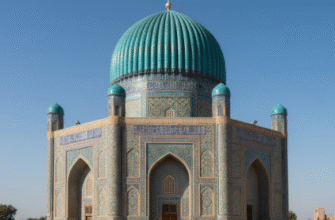
Then I spent three days in Khiva watching a master craftsman named Rustam Yusupov argue with a Soviet-era blueprint, and I realized how profoundly wrong I’d been. Khiva—this walled city in western Uzbekistan that’s been standing since roughly 500 CE, give or take a century depending on which archeologist you ask—doesn’t want to look new. It wants to look like itself, which is a much harder problem to solve. Yusupov was restoring a section of the Kalta Minor minaret’s majolica tiles, those luminous turquoise-and-cobalt geometric patterns that make the whole structure look like it’s been dipped in liquid sky. He kept stopping, squinting at his work, then deliberately chipping away pieces to make them look more weathered. “Too perfect is not real,” he told me in Russian, and I think about that sentence probably once a week now.
Here’s the thing about historic preservation in Khiva: it’s happening in layers that contradict each other. The Soviet restoration projects of the 1960s and 70s did save buildings from collapse, but they also sometimes replaced intricate hand-carved woodwork with concrete replicas. Now the current generation of restorers has to decide whether to preserve the Soviet preservation or strip it back to find whatever’s underneath.
The Architectural Archeology Problem That Nobody Warned Me About
Anyway, turns out when you start peeling back layers of a 400-year-old madrasah, you find things. The Mukhammad Amin Khan Madrasah restoration—which started in 2019 and is still ongoing, much to everyone’s exhaustion—uncovered at least six distinct construction phases. There were wooden beams from the original 1850s structure, Soviet-era steel reinforcements from 1972, patches from what appeared to be a quick 1920s repair job, and underneath one section, inexplicably, fragments of what specialists think might be 14th-century pottery. Dr. Malika Akhmedova from the Uzbekistan Academy of Sciences told me they had to stop work for three months just to document everything, and you could hear the fatigue in her voice when she said “three months” like it was both nothing and everything.
The budget for these projects comes from a mix of UNESCO World Heritage funds, Uzbek government allocations, and tourism revenue that’s been growing steadily since the country opened up visa requirements in 2018. Roughly $12 million has been allocated for preservation work between 2020 and 2025, though those numbers shift depending on which ministry you ask.
Wait—maybe I should mention the color problem.
Every restoration team I met was obsessed with color in this way that felt almost religious. The majolica tile workshops in Khiva’s old town employ maybe thirty artisans now, all trying to recreate glazes that match 16th-century originals. The chemistry is documented but also somehow not—the old masters didn’t write down ratios, they wrote down metaphors. One recipe I saw translated literally said “blue like a traveler’s dream of water.” So contemporary ceramicists are doing spectrographic analysis on original tiles, trying to reverse-engineer the mineral content, then adjusting for the fact that modern cobalt oxide doesn’t behave exactly like whatever semi-pure pigment traders brought along the Silk Road five centuries ago. It’s equal parts chemistry and divination, and honestly, I find the whole process quietly devastating in ways I can’t quite articulate.
What Happens When Tourism Preservation and Actual Preservation Don’t Perfectly Align
I guess it makes sense that Khiva’s UNESCO status (granted in 1990) created this weird dual mandate. The city needs to stay historically authentic enough to justify its World Heritage designation, but also functional enough to accomodate roughly 300,000 tourists annually. So you get these compromises: modern electrical wiring hidden inside historic walls, climate control systems for museum spaces that didn’t exist in the original structures, accessibility ramps that have to be designed to look like they’ve always been there. The Juma Mosque restoration included installing a subtle drainage system because tourist foot traffic was causing water damage that the building never experienced when it was just a functioning mosque with a congregation of two hundred locals.
Some preservationists hate this. Others think it’s the only practical path forward.
The wood carving restoration might be the most labor-intensive piece of all this. Khiva’s madrasahs and mosques contain thousands of square meters of carved wooden columns, doors, and ceiling panels—intricate geometric and floral patterns that were done entirely by hand. Master carver Jahongir Karimov, who’s been doing this work for forty-one years, told me it takes aproximately 160 hours to restore one square meter of complex pattern work. His workshop has trained seventeen apprentices in the last decade, which sounds promising until you realize the previous generation had maybe sixty active master carvers in the city. The math doesn’t quite work out, and everyone knows it, but nobody wants to say it directly.
I keep thinking about what Yusupov said about perfection.
Restoration in Khiva isn’t about returning to some imagined pristine origin point—it’s about carrying forward a messy, layered, complicated history where Soviet pragmatism and Silk Road aesthetics and modern tourism economics all exist in the same physical space. The tiles will never look exactly like they did in 1556, and maybe that’s fine. Maybe the goal is just to make sure they’re still there in 2125, still luminous, still imperfect, still real.