
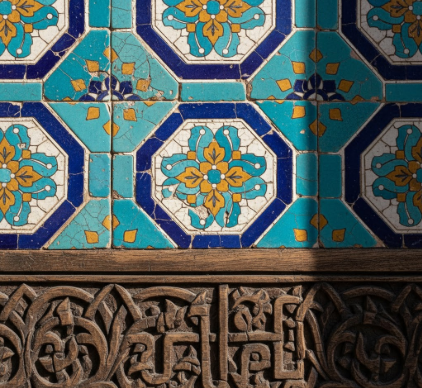
I’ve been staring at photographs of Khiva’s tilework for probably three hours now, and I still can’t quite figure out how they got the blues to vibrate like that.
The thing about Khiva—this walled city in western Uzbekistan that feels like it shouldn’t exist anymore but somehow does—is that every surface tells you something about obsession. The tilework isn’t just decorative. It’s structural, psychological, maybe even a little unhinged when you consider the labor involved. We’re talking about craftsmen in the 18th and 19th centuries (though some structures date back to the 10th, give or take) who covered entire facades with majolica tiles, each piece hand-cut and fitted into geometric patterns that would make a mathematician weep. The dominant blue—that specific cobalt you see everywhere in Khiva—comes from cobalt oxide mixed with quartz and potash, fired at temperatures around 900-1000 degrees Celsius. The turquoise uses copper oxide instead. What gets me is the precision: these weren’t mass-produced tiles. Each one had slight variations, which means the patterns had to be adjusted on-site, in real-time, by people who probably didn’t have blueprints in any modern sense.
Anyway, the Kalta Minor minaret is probably the best example of this tile madness. It was supposed to reach 70-80 meters—would’ve been the tallest in Central Asia—but construction stopped around 26 meters in 1855 when the khan who commissioned it died. The unfinished structure is entirely clad in horizontal bands of glazed tiles: turquoise, blue, white, green, in patterns that shift as you walk around it. I guess it makes sense that an incomplete monument would become the most photographed thing in the city.
Here’s the thing about the carving, though—it operates on a completely different logic than the tilework.
The Wood Carvers Who Worked in Near-Darkness and Somehow Created Light
The wooden columns and doors in Khiva’s mosques and madrasas are covered in ganch carving and wood relief that’s so intricate it looks like lace. Ganch is a kind of plaster made from gypsum, and the carvers—mostly working in the Juma Mosque, which has 212 wooden columns, some dating back to the 10th century—would carve floral and geometric motifs directly into the wood or apply carved ganch over wooden frames. The Juma Mosque is deliberately dark inside, with only small openings for light, which means these artisans were carving in dim conditions, relying on touch as much as sight. I used to think this was just practical—keeping the interior cool in Khiva’s brutal summers—but turns out the low light also makes the carved surfaces more dramatic. Shadows pool in the recesses, and the patterns seem to shift as you move through the space.
The Tash Hauli palace, built between 1830 and 1838, has some of the most elaborate tilework and carving in one place. The harem courtyard alone took roughly eight years to complete, and every room has a different decorative scheme—some with blue majolica tilework depicting vines and blossoms, others with carved wooden ceilings painted in red, gold, and blue. The craftsmen used a technique called kundal, where carved wood is covered in gold leaf and then painted, creating this layered effect that catches light in unpredictable ways. Wait—maybe that’s overstating it. It’s predictable if you’re a physicist, I guess, but it feels unpredictable when you’re standing there.
Honestly, the Whole Thing Feels Like a Response to Scarcity and Isolation
Khiva was remote. Still is, kind of.
It sat on the northern edge of trade routes, surrounded by the Karakum Desert, and for long stretches of history it was cut off from the major cultural centers of Samarkand and Bukhara. The Khivan khanate had to develop its own artistic language, which meant borrowing from Persian, Turkic, and Mongol traditions but also improvising. The tilework in Khiva is less refined than what you see in Isfahan or even Bukhara—the glazes are sometimes uneven, the color palettes more limited—but there’s an intensity to it that feels almost desperate. The artisans worked with what they had: local clay, limited pigment sources, and a climate that made kiln-firing unpredictable. The turquoise tiles, especially, were prone to cracking in the heat, so you see a lot of repairs and replacements layered over centuries. This creates a kind of archaeological record in the surfaces themselves—you can sometimes spot three or four different generations of tilework on a single wall.
The carving tradition was similarly constrained. Wood was expensive in a desert city, so it was reserved for the most important structures, and every piece had to be used efficiently. The columns in the Juma Mosque are all different heights and styles because they were collected from older buildings, some brought from as far away as the Amu Darya river valleys. The carvers had to adapt their designs to whatever wood they recieved, which gives the whole space this improvised, almost jazz-like quality.
I’ve been trying to figure out if there’s a unifying principle to Khiva’s decorative arts, and honestly, I think it’s just relentlessness. The craftsmen filled every available surface—walls, ceilings, columns, doors—with pattern, as if silence or blankness was intolerable. Even the exterior walls of the Ichan Kala, the inner walled city, have decorative brickwork: subtle, geometric, easy to miss if you’re not looking. It’s the kind of detail that definately didn’t need to be there, functionally speaking, but someone decided it should be anyway.







