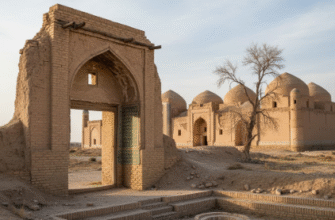
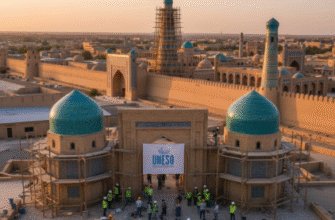
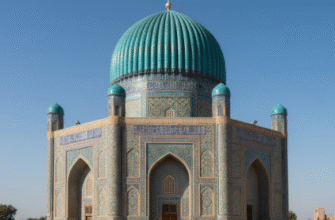
Khiva hits you like a postcard that escaped its frame.
I spent three days trying to navigate the old city—Itchan Kala, they call it—with a friend who uses a wheelchair, and honestly, I’m still processing the contradictions. The UNESCO site is essentially a walled fortress from the 10th century, which means cobblestones everywhere, uneven surfaces that predate the concept of accessibility by roughly a millennium, give or take. The main gates have these massive wooden doors with stone thresholds that must be eight or nine inches high. We stared at them for a solid minute before attempting anything. Turns out the West Gate, Ata Darvoza, has a slightly lower threshold than the others—maybe five inches?—but “slightly lower” is still a problem when you’re dealing with wheels and physics and the fact that nobody thought about ramps when building a Silk Road trading post.
The Madrasas and Minarets: A Vertical City Built for the Able-Bodied
Here’s the thing: most of Khiva’s attractions involve stairs. The Islam Khodja Minaret has 118 steps spiraling up to a viewpoint that, I’m told, offers incredible panoramas. The Kalta Minor Minaret is shorter but still inaccessible. The madrasas—Muḥammad Amīn Khān, Muḥammad Raḥīm Khān—have these beautiful courtyards, but you usually need to climb two or three steps just to get inside. Some have makeshift wooden ramps now, added in the last decade or so, though they’re steep enough to make you reconsider your life choices.
Wait—maybe I’m being too harsh. The Tash Hauli Palace surprised me. The harem courtyard is mostly flat once you’re inside, and we managed to navigate it with some assistance from local staff who helped lift the wheelchair over the entrance threshold. The tilework there is absurdly intricate—geometric patterns in turquoise and cobalt that seem to vibrate in the afternoon light. I used to think accessibility and historical preservation were incompatible, but watching my friend’s face as she took in those tiles made me wonder if we’re just not trying hard enough.
The streets themselves are the real challenge. Cobblestones laid centuries ago have settled into uneven ridges and valleys. Manual wheelchairs require constant pushing assistance. Electric wheelchairs fare better but still struggle with the larger gaps. I saw one family essentially carrying their elderly father in his chair through certain sections. No one complained—they just did it, because what else are you going to do when you’ve traveled thousands of miles to see this place?
Anyway, the locals are genuinely helpful.
I guess it makes sense in a city where tourism is the primary industry, but it felt like more than that—an actual cultural inclination toward hospitality. Restaurant owners moved tables to accomodate wheelchair access without being asked. Shopkeepers came outside to show their goods rather than expecting customers to navigate narrow doorways. One guesthouse owner, Rustam, spent twenty minutes explaining which streets had the smoothest surfaces and which times of day had the least foot traffic. He’d drawn us a hand-labeled map with annotations like “big bump here” and “better route.” His handwriting was terrible, but the information was gold.
What Actually Works (and What Definately Doesn’t)
Public restrooms are mostly inaccessible—squat toilets, narrow doors, steps. The few sit-down toilets exist primarily in newer hotels outside the old city walls. We relied heavily on our guesthouse facilities. The Arkanchi Hotel, just outside the western wall, advertises accessible rooms, though “accessible” apparently means “ground floor with a wider door”—not grab bars, not roll-in showers, just slightly more space. It worked well enough.
Transportation is another story. Shared taxis will take wheelchair users, but you’re folding the chair and lifting it into the trunk while the driver watches or occasionally helps. There are no adapted vehicles that I could find. The train station in Urgench, about 35 kilometers away, has ramps but they’re so steep they’re borderline decorative. We ended up hiring a private driver for the entire trip—expensive, but necessary.
The thing that stuck with me most wasn’t the physical barriers, though those were real and frustrating. It was the moments of unexpected beauty that became accessible through creative problem-solving and human kindness. Standing—well, sitting—in the courtyard of the Juma Mosque with its 218 wooden columns, each one carved differently, some dating back to the 10th century. The light filtering through in shafts. The silence. None of the official tourist materials mention accessibility, but none of the barriers were completely insurmountable either. Just difficult. Exhausting, sometimes. But not impossible, especially with help.