I used to think Khiva was just another dot on the Silk Road map.
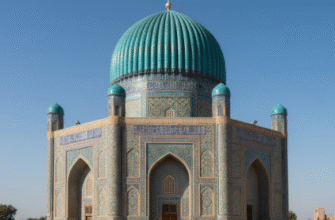
Turns out, this ancient Uzbek city has become something of an unlikely laboratory for academic researchers over the past two decades—and honestly, the reasons why are messier than you’d expect. The city’s medieval madrasas, those stunning Islamic schools with their turquoise-tiled facades, have attracted anthropologists, historians, and even urban planners trying to understand how educational institutions functioned in pre-modern Central Asia. What’s fascinating, or maybe just strange, is that many of these scholars aren’t actually studying the religious curriculum at all. They’re looking at architectural acoustics, the way sound moved through those courtyards during lectures. One team from Leiden University spent roughly three years, give or take, measuring echo patterns in the Muhammad Amin Khan Madrasa, trying to reconstruct how oral transmission of knowledge actually worked when you had 200 students packed into a space designed for maybe 80. The data they collected—wait, I’m getting ahead of myself here.
Here’s the thing about Khiva’s appeal to researchers: it’s absurdly well-preserved compared to other Silk Road cities.
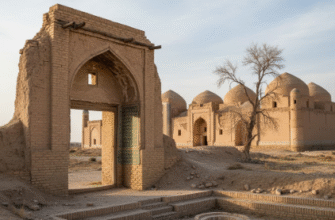
Unlike Samarkand or Bukhara, which modernized significantly during the Soviet era, Khiva’s inner city (Itchan Kala) remained largely frozen in time, partly because it was so isolated and partly because local authorities just didn’t have the resources for major reconstruction projects. This accidental preservation created what some scholars call a “living archaeological site”—though I guess that term bothers certain purists who argue nothing about a UNESCO World Heritage Site filled with tourists is particularly “living.” Anyway, the accessibility of intact 18th and 19th century structures has enabled everything from materials science studies (analyzing traditional brick-making techniques) to sociological research on how communities maintain cultural identity when their entire city becomes essentially a museum. A 2019 study from the University of Bologna examined household economics in historical Khiva by analyzing grain storage structures, and found that families could survive approximately 14-16 months on stored reserves, which definately contradicts earlier assumptions about Central Asian food security.
The manuscript collections are another draw entirely.
Khiva’s libraries contain thousands of documents in Chagatai Turkic, Persian, and Arabic—medical treatises, astronomical observations, legal records—that haven’t been fully catalogued, let alone translated. I’ve seen researchers describe it as both exhilarating and exhausting: you might discover a 16th century pharmacological text one day, only to realize the next day that someone already published a partial translation in a obscure Soviet journal from 1967 that nobody bothered to digitize. The fragmentation of this scholarly work reflects broader problems in Central Asian studies, where Cold War politics meant Western and Soviet researchers often duplicated efforts without knowing it. Now teams from Tashkent, Oxford, and Seoul are trying to create unified digital archives, but the process is slow, underfunded, and complicated by questions about cultural ownership. Who should control access to these manuscripts—Uzbek institutions, international consortiums, or some hybrid model?
There’s also this weird trend of interdisciplinary chaos.
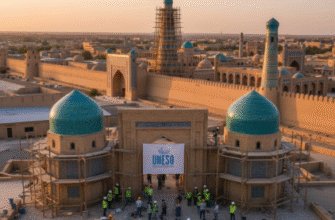
Climate scientists have started using Khiva’s irrigation systems to model historical water management in arid regions, while linguists analyze the city’s multilingual graffiti to track language shift over centuries. A team I read about recently was studying износ patterns—wear patterns, I mean—on stone steps to estimate foot traffic in different areas of the city across different time periods. It sounds almost silly until you realize this kind of data helps us understand urban density and social hierarchies in ways written records just don’t capture. Meanwhile, conservation scientists are in a low-key panic about how tourism and climate change are accelerating deterioration of the city’s mud-brick architecture. The irony, of course, is that increased academic interest has driven more visitors, which creates the very problems researchers are now scrambling to document before everything crumbles. I guess it makes sense in a depressing kind of way—we study things most intensely when we’re about to lose them.