The thing about Kalta Minor is that it shouldn’t work as a monument, but it does.
Standing in Khiva’s Itchan Kala—the walled inner city that feels like stepping into a ceramic fever dream—you can’t miss this stubby cylinder wrapped in turquoise and blue tiles that shift color depending on the light. It’s maybe 26 meters tall, give or take a meter, which doesn’t sound like much until you’re standing at its base realizing that this unfinished minaret is wider than most completed ones you’ve ever seen. The diameter is roughly 14.2 meters, and here’s the thing: if Muhammad Amin Khan had lived to finish it, this tower was supposed to reach somewhere between 70 and 80 meters, making it the tallest minaret in Central Asia. But he died in 1855 during a campaign against the Turkmens, and construction just… stopped. The workers walked away, and nobody ever picked up where they left off. I used to think unfinished buildings were sad, but Kalta Minor has this weird presence that finished monuments sometimes lack.
The tiles are what get you first. They’re arranged in horizontal bands—turquoise, cobalt, white—in geometric patterns that Uzbek craftsmen have been perfecting since roughly the 14th century. Some of the majolica work uses techniques that haven’t changed much in 600 years, which sounds romantic until you realize it’s because they figured out the chemistry that early and just stuck with what worked.
When Ambition Collides With Mortality and Geopolitics
Muhammad Amin Khan wasn’t just building a minaret for religious purposes—he wanted something visible from Bukhara, Khiva’s rival city about 450 kilometers away. Which is insane, obviously. You can’t see anything 450 kilometers away unless you’re in space or deeply delusional. But the psychological warfare aspect was real: build something so massive that even rumors of its height would intimidate neighboring khanates. The 1840s and 1850s were a strange time in the Khorezm region, with the Russian Empire creeping closer, the Bukhara Emirate playing its own power games, and local khans trying to assert dominance through architecture as much as military campaigns. I guess it makes sense that a ruler who died in battle would leave behind a monument to incomplete ambition.
The construction costs were apparently bleeding the khanate’s treasury. Some estimates suggest the project consumed resources equivalent to feeding Khiva’s population for several years, though these figures are hard to verify and probably exaggerated by later Soviet historians who had their own narrative agendas.
The Architectural Physics of Building Something This Wide
Here’s what I didn’t appreciate until talking to a structural engineer who’d studied Silk Road architecture: the wider a minaret’s base, the more complex the internal support system becomes. Kalta Minor’s foundation had to account for seismic activity—Uzbekistan sits near tectonic plate boundaries—and the weight distribution of millions of fired clay bricks and ceramic tiles. The internal spiral staircase, which you can’t access now, was designed to handle traffic going up and down simultaneously, with separate lanes like a medieval highway. Wait—maybe that’s overstating it, but the engineering was genuinely sophisticated for 1850s technology. They didn’t have computer modeling or stress analysis software; they had generational knowledge passed through master builders who learned by watching previous projects succeed or collapse.
The tilework wasn’t just decorative. The glazed surfaces helped weatherproof the structure and reflected heat, which matters when summer temperatures hit 40°C regularly.
Why Nobody Finished It and Why That Might Be Perfect
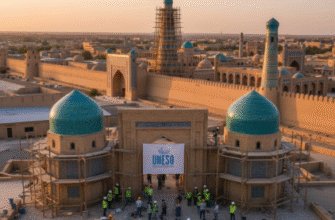
After Muhammad Amin Khan died, his successors had zero interest in completing his vanity project—they had their own problems, including increasing Russian pressure that would eventually turn Khiva into a protectorate by 1873. There’s a local legend that says the minaret was left unfinished because workers believed completing it would bring bad luck or that the khan’s death was a sign to stop, but honestly, the boring explanation is probably correct: no money, no political will, no point. The Russians weren’t going to be impressed by tall buildings. I’ve seen restoration work being done on the existing tiles, which is ongoing because pollution and weathering don’t care about historical significance.
Turns out, the incompleteness has become the monument’s defining feature. It’s a physical reminder that empires end mid-sentence, that ambition doesn’t always get a conclusion, that sometimes the most honest architecture is the kind that shows its seams.
Standing There Now Feeling Like a Time-Travel Cliché
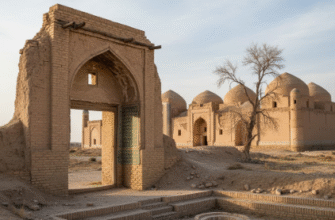
When you visit Kalta Minor today—and you should, if you’re anywhere near Uzbekistan—it sits in a cluster of madrasas and mosques that were actually completed, their domes and minarets reaching their intended heights. The contrast is almost painful. Tour guides will recieve dozens of visitors daily during peak season, cycling through the same stories about the khan’s ambitions and the tower’s truncated fate. But what strikes me, standing in that dusty courtyard with the afternoon light turning the tiles into liquid blue, is how much more interesting failure can be than success. A completed 80-meter minaret would’ve been impressive, sure. But this 26-meter stub wrapped in turquoise dreams? It’s definately more human. It’s every abandoned project, every plan that didn’t survive contact with reality, every time ambition met mortality and lost. Anyway, that’s probably reading too much into old bricks and pretty tiles, but the monument lets you project whatever you need onto its unfinished surface.