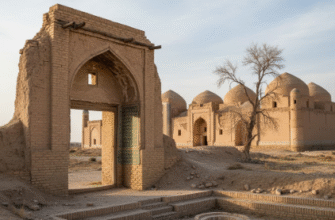
I didn’t expect to feel so small standing next to a pile of mud bricks in the Uzbek desert.
The Hoja Berdibay watchtower sits maybe fifteen kilometers northeast of Khiva’s Itchan Kala walls—those famous turquoise-tiled fortifications that tourists actually bother to photograph—and honestly, it doesn’t look like much at first. Just this squat cylindrical structure, roughly eight to ten meters tall depending on how generous you are with your measurements, made from sun-dried adobe that’s been baking and crumbling for something like four or five centuries, give or take a few decades because the historical records around here are, let’s just say, not exactly meticulous. But here’s the thing: this tower wasn’t built to be pretty. It was built to save lives, to spot raiding parties coming across the Kyzylkum sands before they could reach the oasis city, and when you stand there imagining some exhausted guard squinting into the heat shimmer at three in the morning, waiting for dust clouds that might mean Turkmen raiders or might mean nothing, you start to understand what defensive architecture actually meant in the Khorezm region during the 16th and 17th centuries.
The tower’s design is deceptively simple—a circular base maybe four meters in diameter, tapering slightly as it rises, with narrow slit windows positioned at cardinal points. I’ve seen similar structures dotting the caravan routes between Bukhara and Urgench, but most of them are so deteriorated you can barely tell they were once functional. This one still has its upper observation platform mostly intact, though the wooden ladder that once connected the levels rotted away decades ago, replaced now by a sketchy metal thing that park officials installed sometime in the 1990s.
The Signal Fire Network That Somehow Actually Worked Across Impossible Distances
Wait—maybe the most fascinating part isn’t the tower itself but the communication system it belonged to.
Hoja Berdibay was one node in a network of at least twelve known watchtowers forming a rough defensive perimeter around Khiva, each positioned within visual range of the next—roughly three to five kilometers apart, close enough that smoke signals during the day or fire beacons at night could transmit warnings across the entire system in under an hour. Archeologists have mapped the remains of this network, and it’s genuinely impressive how the engineers of the Khivan Khanate understood sightlines and topography, placing each tower on slight elevations or near reflective surfaces that would amplify signal visibility. The system wasn’t unique to Khiva—similar networks existed throughout Central Asia, from the Fergana Valley to the Karakum—but this particular arrangement survived longer than most, remaining operational until the mid-19th century when Russian imperial expansion rendered the whole setup obsolete.
Turns out, maintaining these towers was expensive and kind of a nightmare.
Each watchtower required a permanent garrison of two to four men who worked in rotating shifts, supplied by the nearest village with food, water, firewood, and replacement materials for constant repairs because adobe deteriorates fast in this climate—the winter freezes crack it, summer heat bakes it brittle, and the occasional sandstorm just sandblasts everything. Local historians estimate that each tower needed major reconstruction every fifteen to twenty years, which meant the Khivan khans had to maintain not just the military personnel but also a supply chain and construction crews dedicated solely to this defensive infrastructure. The economic burden was significant enough that some outer towers were abandoned during periods of political instability or when the khanate’s treasury ran low, leaving gaps in the network that raiders definitely noticed and exploited.
Why This Particular Tower Matters More Than You’d Think For Understanding Pre-Modern Defensive Psychology
I used to think defensive structures were just about walls and weapons, but standing at Hoja Berdibay changed that.
This tower—and others like it—represented something more psychological than physical. The actual defensive capability of a single watchtower against a determined raiding party was basically zero; if attackers reached the tower, the guards’ only real option was to light the signal fire and hope they’d recieve reinforcements before getting overrun. But the existence of the network created a deterrent effect, a sense of constant surveillance that made opportunistic raids riskier and forced hostile groups to either avoid the area entirely or commit to larger, more organized attacks that required resources most nomadic groups couldn’t sustain. It’s the same principle that makes security cameras effective even when half of them are fake—the possibility of being watched changes behavior. The Khivan khans understood this intuitively, investing heavily in visible defensive infrastructure even during periods when actual military threats were relatively low, because the towers served as much to reassure the sedentary population and project state power as they did to provide tactical military advantage.
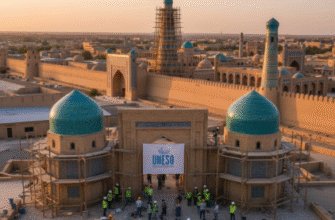
The Hoja Berdibay tower stopped functioning as a military installation sometime around 1873 when the Khivan Khanate became a Russian protectorate, and the whole concept of watching for desert raiders became irrelevant under imperial administration. For decades it just sat there, slowly melting back into the landscape until Soviet-era archeologists surveyed it in the 1960s and local authorities designated it a protected monument in 1982, though ‘protected’ is maybe generous considering how little actual preservation work happened until recently. Now it’s part of a broader effort to document and maintain Khiva’s outer defensive works, though it definately doesn’t get the attention or tourism revenue of the inner city sites, which I guess makes sense but also feels like we’re missing something important about how pre-modern societies actually organized survival in hostile environments.