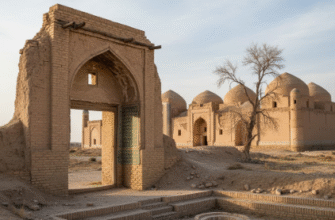
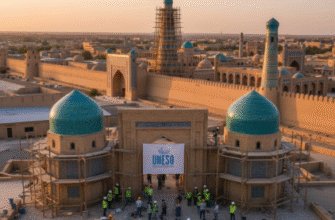
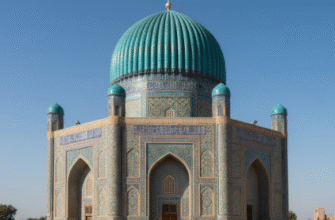
I’ve visited a lot of religious sites, but the Hazrati Imam Complex in Tashkent hit differently.
The complex sprawls across roughly 40 hectares in the old city—wait, maybe it’s smaller than that, I can’t quite remember—but what matters is how it feels when you’re standing there. The main mosque, Tillya Sheikh, rebuilt in the 2000s after the original got wrecked by an earthquake back in 1966, dominates the skyline with these massive turquoise domes that catch sunlight in ways that seem almost engineered for Instagram, except they were designed centuries before anyone cared about likes. There’s the Barak Khan Madrasah from the 16th century, which now houses the Spiritual Administration of Muslims of Uzbekistan, and honestly the juxtaposition of ancient Islamic scholarship with modern bureaucracy is kind of fascinating if you think about it. The whole place got this major facelift starting around 2007, and while some purists complained about the renovations being too polished, too sanitized, I guess it makes sense that a functioning religious center needs to actually function for contemporary worshippers, not just tourists with cameras.
Turns out the complex also includes the Muyi Mubarak Library, which sounds modest until you realize what’s inside. The library holds roughly 23,000 manuscripts and early printed books, some dating back centuries, covering everything from theology to astronomy to poetry.
The Uthman Quran That Definitely Changed How I Think About Historical Artifacts
Here’s the thing: the complex houses what’s believed to be the world’s oldest existing Quran, the Uthman Quran, also called the Samarkand Kufic Quran.
This manuscript—written on deer parchment, not paper, because paper wasn’t really a thing yet—supposedly dates to the mid-7th century, maybe around 655 CE, give or take a decade. According to tradition, it was commissioned by Uthman ibn Affan, the third caliph, and legend says it still bears his bloodstains from when he was assassinated while reading it in 656 CE. Whether that’s literally true or just a powerful story that’s accreted meaning over 1,400 years is honestly hard to say. Carbon dating and paleographic analysis suggest it’s definitely ancient, probably 8th or 9th century at the latest, which would still make it one of the oldest Qurans in existance. The manuscript spent centuries in Samarkand, then got taken to Saint Petersburg by Russian colonial forces in 1869, returned to Uzbekistan in 1924, moved to Tashkent in 1989, and finally found its home in the Hazrati Imam Complex in 2007.
I used to think ancient religious texts would feel distant, locked behind glass and context I couldn’t access.
Why This Particular Manuscript Keeps Scholars Up at Night and Also Kind of Obsessed
The Uthman Quran is written in Kufic script, this early angular Arabic calligraphy that looks almost geometric compared to later flowing styles. What makes scholars lose sleep—or get excited, depending on their disposition—is how the text compares to modern Quranic recensions. There are minor orthographic variations, differences in diacritical marks and verse divisions, which sounds boring until you realize these tiny differences illuminate how the Quranic text was standardized, transmitted, and preserved across vast distances and centuries. Some researchers argue these variations prove the text wasn’t perfectly fixed in the 7th century; others say they’re trivial copying differences that don’t affect meaning. Both groups write very long papers about it. The manuscript originally contained about 250 pages, but only 353 folios survive today—wait, that math doesn’t work, does it? I mean, many pages have been lost over time, scattered to collections in Tashkent, Cairo, and elsewhere.
Anyway, the complex also hosts regular prayers, Friday sermons, and major Islamic holidays.
The Uncomfortable Reality of Religious Tourism and What It Does to Sacred Spaces Over Time
Visiting the Hazrati Imam Complex means navigating this weird tension between pilgrimage and tourism, between reverence and selfies. The Uzbek government has invested heavily in promoting the site—it’s part of this broader nation-building project that positions Uzbekistan as a center of Islamic scholarship and heritage, which is complicated given the country’s Soviet past and current secular governance. Non-Muslims can visit most areas, but there are rules: modest dress, remove shoes in certain spaces, no touching the manuscripts obviously. When I was there, I watched a tour group shuffle through the library viewing area in maybe eight minutes, snapping photos of the Uthman Quran’s display case without really looking at it, and I felt this surge of irritation mixed with self-awareness because wasn’t I doing the same thing, just slower? The complex receives thousands of visitors daily during peak season, and there’s this ongoing debate about whether tourism revenue justifies the inevitable wear on the site, the way sacred spaces get flattened into checkboxes on itineraries. But then again, without visitors and funding, would these manuscripts be preserved at all? The Soviet period wasn’t exactly kind to religious heritage, and the complex itself was partially demolished before being rebuilt. So maybe this compromise—letting people like me gawk at a 1,300-year-old Quran for a few minutes—is what allows it to survive into the next century. I’m still not sure how I feel about that, honestly.