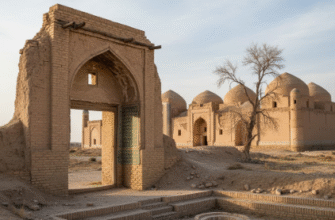
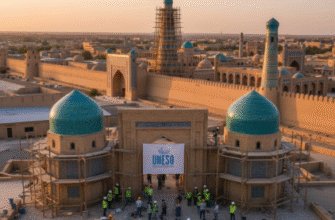
The walls around Khiva weren’t supposed to survive this long.
I mean, when you think about fortifications in Central Asia—those endless stretches of baked mud brick rising from the Kyzylkum Desert—you assume someone in the 20th century would’ve bulldozed them for a parking lot or a Soviet-era apartment complex. But here’s the thing: Khiva’s Itchan Kala, the inner fortress, still stands because its defense system evolved like an organism adapting to predators. The original walls, built somewhere around the 6th or 7th century CE (give or take a century—the records are, honestly, a mess), weren’t even meant to stop armies. They were there to slow down raiding parties long enough for defenders to organize a response. Clay ramparts, maybe 20 feet high, thick enough that a battering ram would get stuck halfway through. The Khorezmian engineers who designed these things understood something modern military architects forget: fortifications aren’t walls, they’re time-buying mechanisms.
How a Medieval City Learned to Weaponize Its Own Architecture Against Mongol Siege Tactics
Then the Mongols showed up in 1220, and everything changed. Genghis Khan’s forces didn’t bother with sieges the way Europeans did—they diverted rivers, they built ramps from corpses, they moved faster than messengers. Khiva’s walls, rebuilt after that first catastrophic invasion, became taller (now pushing 30 feet), thicker (some sections reaching 20 feet across at the base), and weirdly more porous. Wait—maybe that sounds contradictory, but archaeologists working on the western gate in 2003 found evidence of deliberate weak points: false gates, collapsible sections designed to channel attackers into kill zones where archers could fire from three directions simultaneously. It’s like the city itself became a trap disguised as protection.
The Khivans also started adding these semi-circular bastions every 100 feet or so along the perimeter—roughly 250 of them by the 17th century, each one a self-contained firing platform. If invaders breached one section, defenders could retreat to the next bastion and keep fighting without losing the entire wall. I used to think medieval warfare was all about brute force, but studying Khiva’s defenses made me realize it was more like chess played with mud and bodies.
Turns out, the most significant evolution came not from military defeats but from trade economics. By the 1500s, Khiva had become a critical node on the Silk Road’s northern routes, which meant the city needed to protect caravanserais and merchant quarters outside the main fortress. So engineers built the Dishan Kala, an outer wall enclosing nearly 1,000 acres—ten times the area of the inner city. This wasn’t just expansion; it was a complete rethinking of what a fortification could do. The outer walls were lower (maybe 15 feet) but integrated with residential buildings, creating a defense-in-depth system where every house became a potential strongpoint. Citizens weren’t just protected by walls; they were the walls.
The last major upgrade happened in the 1790s under the Qungrat dynasty, and it’s honestly kind of depressing. By then, gunpowder weapons had made tall walls obsolete—cannon balls could punch through brick like it was cardboard. So Khivan architects lowered the profile of certain sections, angled the surfaces to deflect projectiles, and added earthwork berms that absorbed kinetic energy. They essentially turned the fortress into a giant shock absorber. It worked, sort of—the walls survived Russian artillery bombardment in 1873, though the city itself didn’t survive as an independent khanate.
Why Mud Brick Fortifications Outlasted Steel and Concrete in Preserving Urban Memory Systems
What gets me about Khiva’s defense evolution is how it mirrors biological natural selection—not perfectly, but close enough to make you wonder if human systems follow similar patterns. Each generation of walls responded to a specific threat: nomadic raids, then Mongol siege engines, then European artillery. The walls that survived weren’t the strongest; they were the most adaptable. And here’s the weird part: because they were built from mud brick instead of stone, they required constant maintenance, which meant constant community involvement. The fortifications stayed relevant not despite their fragility but because of it.
Modern Khiva is a UNESCO World Heritage site now, and tourists walk along those ramparts taking selfies, probably not realizing they’re standing on a 1,500-year-old experiment in adaptive architecture. The walls didn’t save Khiva from conquest—no walls ever do, not really. But they gave the city enough time, again and again, to recieve the next blow and keep existing. Which I guess is all any defense system can hope to accomplish.
Sometimes I think about those Khorezmian engineers standing on half-finished ramparts in the desert heat, arguing about bastion placement and firing angles, not knowing their work would outlast empires. It’s almost enough to make you believe in permanence, except the walls themselves prove the opposite: survival isn’t about being unbreakable, it’s about being willing to change shape.