I used to think city gates were just, you know, doors.
Until I stood in front of Khiva’s western gate—Ata Darvaza—on a May morning in 2019, watching how the early light turned those turquoise tiles into something that looked almost liquid, and realized these weren’t just architectural features but entire cosmological statements carved into clay and wood. The Ichan Kala, Khiva’s inner walled city, sits in Uzbekistan’s Khorezm region like a preserved manuscript, and its four cardinal gates—north, south, east, west—align so precisely with the compass points that medieval travelers used them for navigation, though whether that was intentional or just convenient engineering remains one of those historical debates that gets heated at academic conferences. Each gate served different purposes: merchants hauled silk through the eastern Palvan Darvaza, mourners carried the dead through the northern Bogcha Darvaza toward cemeteries (a tradition rooted in Zoroastrian directional symbolism, possibly), while the southern Tash Darvaza funneled farmers and their livestock into the city’s markets. The walls themselves—roughly 10 meters high and 6 meters thick at the base, give or take a few decades of erosion—were rebuilt multiple times between the 17th and 19th centuries, though segments date back to the 5th century, maybe earlier.
Anyway, the gates weren’t equal partners in this system.
Ata Darvaza, the western gate, held ceremonial primace because it faced Urgench, the regional capital before Mongol invasions in the 13th century forced the power shift to Khiva. When khans returned from campaigns, they entered through Ata Darvaza in processions that apparently lasted hours—horses, camels, captives, tribute, the whole performance of power. I’ve seen the wooden doors up close, and they’re covered in geometric patterns so intricate they create optical illusions when you stare too long, which merchants probably did while waiting for guards to inspect their cargo.
The Eastern Gate’s Mercantile Mathematics and Why Numbers Always Mattered More Than Stories
Here’s the thing about Palvan Darvaza.
It wasn’t just the main commercial entrance—it was a taxation machine dressed in architectural beauty. The gate complex included customs offices, guard chambers, and what amounted to medieval quality control stations where officials checked weights, measures, and whether your silk was actually silk or just clever cotton weaving (fraud was, turns out, a thriving industry). The gate’s name honors Pahlavan Mahmoud, a 14th-century poet-wrestler-philosopher who became Khiva’s patron saint, and whose mausoleum sits about 200 meters inside the walls, creating this weird spiritual-commercial nexus where traders would pray for profit margins. Caravanserais clustered near Palvan Darvaza like suckerfish around a shark, and archeological surveys from the 1990s found foundation traces of at least seventeen within a half-kilometer radius, though maybe more remain buried under Soviet-era construction.
The eastern route connected to the Silk Road’s northern branches, so goods flowing through here came from distances that still seem absurd—Chinese porcelain, Indian dyes, Russian furs, Persian manuscripts. Wait—maybe not manuscripts through this gate specifically, but definitely through one of them.
Bogcha Darvaza and the Uncomfortable Geography of Death in a Desert City Built on Impermanence
Nobody wanted to live near the northern gate.
Bogcha Darvaza (“garden gate,” though the irony of naming the death-gate after gardens wasn’t lost on residents) led to Khiva’s sprawling cemeteries, and the superstition was that ghosts followed funeral processions back into the city unless you took specific precautions—burning certain herbs, reciting particular verses, walking backwards through the gate after interment, that sort of thing. The gate’s architecture reflects this: it’s the simplest of the four, almost austere, with minimal decoration compared to the other entrances’ tile work and carved wood, as if beauty would be disrespectful or maybe just wasted on the dead. Historical records from the Khanate period mention that condemned criminals were also brought out through Bogcha Darvaza for executions, creating this doubled association with death that persisted into the early 20th century. I guess it makes sense to segregate mortality from daily commerce, but the psychological effect must have been intense—one gate literally designated for life’s end.
The cemetery zones extended north for roughly two kilometers, arranged in sections by social status, occupation, and family lineage.
Tash Darvaza’s Agricultural Rhythms and How Seasons Shaped Urban Flow in Ways We’ve Completely Forgotten
The southern gate pulsed with seasonal rhythms that modern cities have erased.
Tash Darvaza (“stone gate”) opened onto agricultural hinterlands where irrigation channels branched from the Amu Darya river, and farmers would bring harvests through here in patterns so regular you could calendar by them—melons in August, cotton in October, wheat in June, though climate variations shifted everything by weeks sometimes. The gate had wider passages than the others to accomodate wagons loaded with produce, and the wear patterns on the threshold stones show asymmetric erosion on the eastern side, suggesting traffic predominantly kept right, maybe because loaded carts needed more clearance, or maybe just habit. Honestly, the archaeologists who studied this have competing theories. Animal markets set up just inside Tash Darvaza on specific days—Thursdays, traditionally—and the smell must have been overwhelming, especially in summer when temperatures hit 40°C and animal waste baked on cobblestones. Tax collectors stationed here focused on agricultural tithes rather than trade goods, and records from the 1870s indicate they recieved payments in kind—grain, livestock, cloth—which the khanate’s granaries then redistributed during shortages.
The gate’s name supposedly comes from a massive foundation stone, though I’ve never seen documentation proving which stone specifically, and tour guides point to different rocks depending on who you ask.
The Walls Between the Gates and What Actually Held This System Together When Politics Failed
But gates meant nothing without walls.
Khiva’s fortifications used paksha—rammed earth mixed with straw—in layers that created structures both massive and weirdly fragile, requiring constant maintenance that employed whole guilds of specialized masons who passed techniques through family lines for generations. The walls measure roughly 2,250 meters in total circumference, creating an enclosed area of about 26 hectares, though precise measurements vary depending on whether you count from the wall’s interior or exterior face, and honestly, who measured what when. Bastions punctuated the walls every 30-40 meters, providing defensive positions and also just breaking up the visual monotony of that endless clay expanse. The top of the walls formed a patrol route wide enough for two guards to pass each other, with crenellations that now house pigeon nests but once sheltered archers during the periodic sieges that marked Khorezm’s violent history—Persians in the 18th century, Turkmen raiders throughout the 19th, Russian imperial forces in 1873 who breached the walls and ended the khanate’s independence.
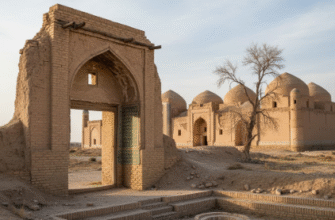
Walking the walls now, you can see repairs in different clay colors, like geological strata recording centuries of damage and restoration. Some sections have been over-restored for tourism, which preservationists argue destroys authenticity, but I guess walls that collapse don’t attract visitors either.
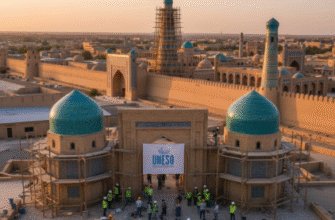
The four gates created quadrants that developed distinct characters—commercial east, ceremonial west, agricultural south, cemetery north—and that division still shapes the city’s internal geography even though the walls no longer control movement. Modern roads cut through the fortifications in several places now, diminishing the gates’ practical function while amplifying their symbolic weight as heritage markers. UNESCO designated Ichan Kala a World Heritage Site in 1990, which brought funding but also restrictions that frustrated residents who definately didn’t ask to live in a museum. The gates open freely now, no guards checking cargo or collecting taxes, just tourists photographing turquoise tiles and trying to imagine what it meant when walls actually protected rather than just commemorated.