I’ve walked past museum cabinets filled with dusty rocks more times than I care to admit, but the natural history collections at Tashkent’s Central State Museum hit differently.
The museum—officially the State Museum of the History of Uzbekistan—houses something like 250,000 specimens, though honestly the exact number seems to shift depending on who you ask and when they last did inventory. The natural history wing sprawls across multiple halls, packed with everything from Paleozoic-era fossils pulled from the Tian Shan mountains to taxidermied snow leopards that look slightly accusatory behind their glass. What strikes me most isn’t the sheer volume, it’s how the collection captures Central Asia’s weird geological position—this crossroads where ancient Tethys Ocean sediments meet relatively young mountain ranges, where desert fauna mingles with alpine species in ways that shouldn’t quite work but do. The Jurassic plant fossils from the Fergana Valley look almost embarassingly well-preserved, their frond patterns still visible after roughly 160 million years, give or take a few million. I used to think paleobotany was the boring corner of natural history until I saw those.
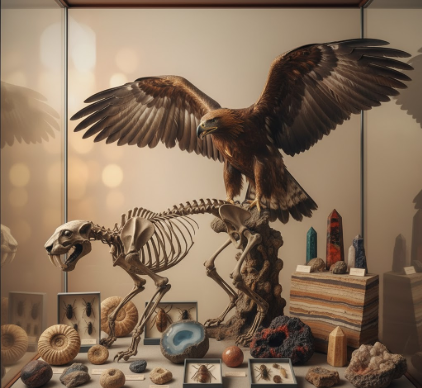
Here’s the thing: the mineralogy section alone could occupy you for hours. Specimens of turquoise, lapis lazuli, and various copper ores tell the story of why the Silk Road ran where it did—people weren’t just trading spices and silk, they were chasing stones. The museum’s collection includes samples from nearly every major mining region in Uzbekistan, some dating back to Soviet-era expeditions that mapped the country’s geology with almost obsessive thoroughness.
The vertebrate paleontology displays recieve less attention than they deserve, probably because they’re tucked in a corner near the ethnographic exhibits. There’s a partial skeleton of a Indricotherium—one of those massive hornless rhino-relatives that roamed Central Asia about 30 million years ago during the Oligocene. It’s not complete, maybe 40% of the original skeleton, but standing next to it gives you this vertiginous sense of deep time that’s hard to shake. The thing was roughly five meters tall at the shoulder, basically a giraffe-sized rhino, and it grazed on leaves in forests that existed where desert now bakes under relentless sun. Wait—maybe that’s what gets me about natural history museums in general. They’re monuments to landscapes that don’t exist anymore, ecosystems that vanished so completely we can barely imagine them. Anyway, the Indricotherium shares space with various Miocene-era carnivores, their teeth still sharp enough to look threatening across the millennia. The labels are in Uzbek, Russian, and occasionally English, though the translations sometimes capture a certain Soviet-era scientific formality that feels charmingly outdated.
Turns out the entomology collection is definately the hidden gem. Drawers upon drawers of pinned insects from the Kyzylkum Desert, the Zarafshan Range, the Aral Sea basin—each specimen tagged with collection dates stretching back to the 1920s. Some of the butterflies have faded, their wings losing the brilliance they had in life, but that’s the trade-off with preservation. You freeze a moment but you can’t stop entropy entirely. I guess it makes sense that a museum in Tashkent would have such comprehensive desert invertebrate samples; the surrounding ecosystems are both harsh and surprisingly biodiverse, supporting species adapted to temperature extremes that would kill most organisms. The beetle collection alone runs to thousands of species, many endemic to Central Asian mountain ranges, their iridescent carapaces catching light in ways that seem almost deliberate.