I used to think stone carving was just about chisels and patience.
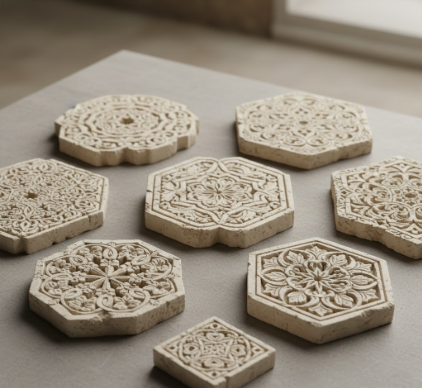
Then I spent three weeks in Bukhara’s old quarter, watching a seventy-year-old master named Rustam work a block of limestone the size of a refrigerator, and—honestly—I realized I’d been thinking about this craft all wrong. The thing about Bukhara’s architectural stone carving tradition is that it’s not really about decoration, not in the way we usually mean it. It’s about creating a kind of visual language that’s been evolving for roughly a thousand years, give or take a century or two, and every geometric pattern, every calligraphic flourish, every stylized floral motif carries layers of meaning that most tourists walk past without noticing. Rustam told me his grandfather could identify which workshop produced a carved panel just by looking at the depth of the cuts and the spacing of the repeating patterns. His grandfather was probably exaggerating, but maybe not. The workshops in Bukhara—there were maybe forty of them in the 16th century—each developed their own subtle variations on classical Islamic geometric designs, and these variations got passed down through apprenticeships that lasted seven, sometimes ten years.
The Geometry That Refuses to Stay Still on the Surface
Here’s the thing about traditional Bukhara stone carving: the patterns look flat in photographs, but they’re not. Stand in front of the Kalyan Minaret at different times of day and you’ll see what I mean—the terracotta brickwork and carved stone bands create shadows that shift and deepen as the sun moves, turning two-dimensional designs into something that breathes. I guess it makes sense when you realize these craftsmen were working without electric tools, without computer modeling, just iron chisels and wooden mallets and an understanding of how light behaves that seems almost intuitive. The most common motifs—the girih tiles, the interlaced arabesques, the Kufic script borders—they’re all designed to be read in changing light, which is why restoration work on these buildings is so tricky.
When Marble Meets the Migrations of Master Craftsmen Across Silk Road Cities
The marble used in Bukhara’s finest architectural elements didn’t come from Uzbekistan. Wait—maybe some of it did, but the really prized white marble, the stuff you see in the Ark Fortress and the Char Minar’s decorative panels, that came from quarries in what’s now Tajikistan and Afghanistan, hauled overland by caravans that also carried lapis lazuli and silk. And the craftsmen themselves moved around constantly—a master carver from Samarkand might spend five years in Bukhara working on a madrasa, then move to Khiva for another commission, bringing techniques and design innovations with him. This is verifiable in the historical records, though the details get fuzzy before the 15th century. Anyway, this circulation of both materials and expertise meant that Bukhara’s stone carving tradition was never static; it absorbed influences from Persian miniature painting, from Timurid architectural experiments, even from Chinese decorative arts that trickled in along the trade routes.
Rustam showed me a panel he’d been working on for eight months—a reproduction of a damaged section from the Nadir Divan-Begi Madrasa. The original dated to 1622.
The Tools That Haven’t Changed Much and the Apprentices Who Definately Have
The basic toolkit for traditional Bukhara stone carving hasn’t evolved much since the medieval period: flat chisels called qalam, pointed chisels for detail work, wooden mallets wrapped in leather to absorb shock, and compasses for laying out geometric grids. Modern carvers sometimes use angle grinders for the initial roughing out, which the old masters would probably find horrifying, but the finishing work still requires hand tools and a sensitivity to the stone’s grain that no machine can replicate. I’ve seen apprentices—most of them now in their twenties and thirties, a shift from the traditional model where you’d start learning at twelve or thirteen—spend entire days just practicing the basic cuts on scrap limestone. The repetition looks mind-numbing from the outside, but it’s building muscle memory and teaching them to read the stone, to feel where it wants to split and where it’ll hold fine detail.
How Islamic Geometry Became Architecture’s Secret Structural Language in Central Asian Buildings
Turns out the geometric patterns carved into Bukhara’s architectural elements weren’t just aesthetic choices—they also served structural and practical functions that took me embarrassingly long to understand. The muqarnas, those honeycomb-like carved structures you see in archways and domes, they’re actually distributing weight in specific ways, turning what could be structural weak points into load-bearing features. The deep relief carving on column capitals increases surface area, which—and I’m simplifying here—helps with thermal regulation in buildings that get blasted by Central Asian summers. A master carver I spoke with, not Rustam but a younger guy named Davron, explained that the traditional patterns also incorporated deliberate imperfections, tiny variations that prevented the formation of structural stress lines in the stone. Whether that’s actually true or just workshop mythology, I honestly can’t say. The academic literature on this is surprisingly thin, and what exists is mostly in Russian and Uzbek. But standing in the courtyard of the Ulugh Beg Madrasa, looking up at centuries-old carved panels that have survived earthquakes and invasions and Soviet-era neglect, you start to think maybe those old carvers knew exactly what they were doing.
Rustam’s hands were covered in small scars, white lines crisscrossing his knuckles where chisels had slipped over the decades.