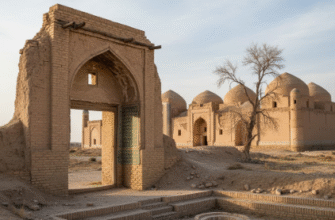
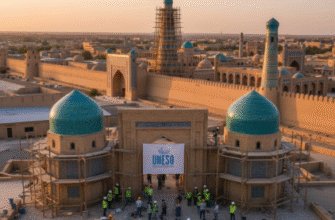
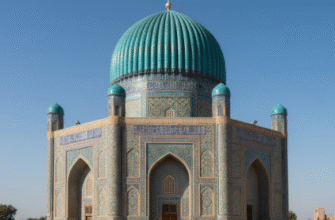
I still remember the first time I walked into what they call the Bukhara Architecture Museum—though honestly, calling it a “museum” feels like underselling what’s actually happening inside those walls.
The building itself sits in the old city, tucked between madrasas that have been standing since the 1500s, and here’s the thing: the structure housing the collection was once a merchant’s caravanserai, which means the exhibits literally live inside the architectural history they’re trying to document. It’s this recursive loop of preservation that kind of makes your head spin if you think about it too long. The main hall features these enormous wooden columns—maybe twelve meters tall, I’m estimating—carved with geometric patterns that the craftsmen would’ve spent months perfecting, and when you look up at the ceiling, you can still see the original polychrome painting, though it’s faded to this ghostly version of what must have been overwhelming color. The collection includes roughly 40,000 items spanning about eight centuries, give or take, from architectural fragments to complete doorways to terracotta tiles that once lined the domes of buildings that no longer exist. Some pieces are labeled with dates; others just say “16th-17th century” because apparently even experts can’t pin down when certain techniques were used. The curator I spoke with—an older woman who’d worked there for thirty years—told me they recieve new fragments every few months when restoration projects around the city uncover something buried in a wall or foundation. Wait—maybe that’s the most fascinating part: this isn’t a static collection at all.
Anyway, the diversity of architectural elements on display reveals how Bukhara functioned as this crossroads where Persian, Turkic, and Central Asian building traditions collided and merged. You’ve got brick patterns from Samanid-era structures next to Timurid tile work, and the differences are subtle but meaningful. The museum organizes things chronologically in some rooms, thematically in others, which creates this disorienting experience where you’re looking at a 10th-century column capital and then you turn around and there’s a 19th-century wooden door frame with completely different decorative language. I guess it makes sense when you realize Bukhara was continuously inhabited and rebuilt for over two millennia.
How Fragments Tell Stories That Complete Buildings Sometimes Can’t Manage
There’s something almost uncomfortably intimate about seeing a piece of a building separated from its context.
The museum has this entire wing dedicated to what they call “decorative fragments”—chunks of carved stucco, broken majolica tiles, sections of wooden screens with intricate geometric latticework—and initially I thought this would be the boring part, the leftovers after the impressive whole structures got displayed. Turns out I was completely wrong about that. These fragments reveal construction techniques and artistic decisions that you’d never notice if you were just looking at an intact building from the outside. One display case contains maybe twenty different carved stucco pieces, all featuring variations on the same arabesque motif, and what you realize is that medieval craftsmen were iterating on designs, experimenting with slight modifications in the curve of a vine or the density of floral elements, basically A/B testing their aesthetic choices centuries before that became a concept. The technical skill on display is kind of devastating when you think about how these were made—no electric tools, no computer modeling, just a craftsman with a chisel making thousands of precise cuts to create these impossibly delicate patterns that had to align perfectly with adjacent panels. Some fragments show mistakes: a drill hole that went slightly wrong, a carved line that doesn’t quite match the symmetry of the rest of the pattern. Museums usually hide these imperfections, but here they’re presented alongside the flawless pieces, which feels more honest somehow.
The Tension Between Preservation Philosophy and Physical Reality Nobody Discusses
I used to think conservation was straightforward—you find something old, you protect it, done. The Bukhara collection definately complicated that assumption.
The museum staff face these constant impossible choices about how to store and display materials that were never meant to be removed from their original contexts. Wooden elements dry out differently when they’re not part of a complete structural system. Glazed tiles that spent four hundred years on a sun-facing dome react badly to indoor lighting and temperature fluctuations. There’s this one doorway from a 16th-century khanqah—a Sufi monastery—that they’ve had to reconstruct three times because the wood keeps warping in ways it never did when it was actually functioning as a door. The museum has experimented with different humidity levels, different display angles, even different types of support structures, and nothing perfectly solves the problem because the problem is essentially that you’re trying to freeze in time something that was designed to be part of a living, changing building. Some preservationists argue these fragments should be returned to their original sites, even if those sites are now ruins, because the environmental context is part of what keeps them stable. Others point out that Bukhara’s climate has actually changed over the centuries—it’s drier now, more extreme temperature swings—so the “original context” doesn’t really exist anymore anyway. I don’t know who’s right, and I’m not sure anyone does.
How the Building Design Collection Documents Lost Architectural Languages
Certain construction techniques just disappeared, and sometimes this museum has the only remaining examples.
There’s a section dedicated to what they call “transitional structures”—architectural elements that represent moments when building styles were shifting from one tradition to another, usually because of political changes or new influences coming through trade routes. One case contains these bizarre hybrid capitals that are part Sassanid Persian, part early Islamic, created during that period in the 8th century when Arab conquest was bringing new aesthetic requirements but local craftsmen were still working in their traditional styles. They’re fascinating because they don’t really work from either perspective—the proportions are off, the decorative elements clash, they read as confused and uncertain, which of course they were because the craftsmen were literally inventing a new visual language in real time. The museum has documented at least fifteen construction techniques that don’t appear in any surviving buildings and only exist in these fragments: particular ways of corbelling bricks to create vaulted ceilings, specific methods for joining wooden beams in earthquake-resistant frameworks, decorative stucco application techniques that created these three-dimensional effects modern conservators still can’t quite figure out how to replicate. Wait—maybe that’s the real value here, beyond aesthetics or history. This is technological knowledge preserved in physical form.
What Contemporary Architects Actually Learn When They Study These Historical Collections
Turns out, this isn’t just backward-looking preservation work—modern designers reference these collections constantly, though not always in ways you’d expect. I met a contemporary architect from Tashkent who visits every few months specifically to study the proportional systems used in Timurid-era buildings, not to copy them but to understand the mathematical principles underlying their aesthetic impact. She explained that medieval Central Asian architects had developed these sophisticated ratios for relating dome heights to base diameters, or minaret thickness to total height, that created specific psychological effects on viewers—feelings of uplift, or stability, or transcendence. Modern architecture mostly abandoned those principles in favor of engineering efficiency and cost optimization, but there’s growing interest in recovering some of that lost knowledge about how built space affects human perception and emotion. The museum collection includes architectural drawings and planning documents from the 18th and 19th centuries—detailed technical specifications written in Chagatai Turkic and Persian—that some researchers are now digitizing and translating, discovering things like early understanding of acoustics in mosque design, or passive cooling systems that didn’t require mechanical intervention. Honestly, the more time I spent looking at these centuries-old solutions to architectural problems, the more embarrassed I felt about how much we’ve forgotten in our rush toward modernization and standardization of building practices across different climates and cultures.