I’ve walked past dozens of madrasahs in Central Asia, and honestly, most of them blur together after a while.
But the Bikajan Bika Madrasah in Khiva—this one stuck with me, and not just because it broke every rule I thought I understood about Islamic educational architecture. Built sometime around 1894 (the records are frustratingly vague, give or take a few years), this wasn’t your typical theological school filled with young men memorizing the Quran. It was commissioned by Bikajan Bika, the mother of Islam Khoja, specifically as an educational space for women—a concept so rare in 19th-century Khiva that even local historians seem surprised it existed. The building sits quietly in the Ichan-Kala, Khiva’s walled inner town, looking deceptively modest from the outside. Seven rooms surround a small courtyard, the layout compact and almost domestic compared to the grand madrasahs nearby. Here’s the thing: it wasn’t trying to compete architecturally—it was trying to exist at all, which in itself was radical.
Wait—maybe I should back up. The late 1800s in the Khanate of Khiva weren’t exactly a golden age for women’s public education. Most girls learned at home, if they learned to read at all. So when Bikajan Bika decided to fund this madrasah, she wasn’t just building classrooms; she was making a statement that education belonged to women too, even if society wasn’t quite ready to agree.
The Architecture That Whispers Instead of Shouts
The madrasah’s design tells you everything about the tension it navigated.
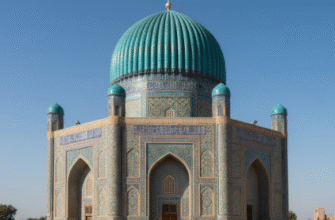
Unlike the towering portals and turquoise domes that dominate Khiva’s skyline—like the Islam Khoja Minaret her son would later build—this structure keeps a low profile. Single-story, brick construction, minimal ornamentation. The courtyard layout follows traditional madrasah form: student cells (hujras) opening onto a central space where teaching happened. But the scale is intimate, almost residential. Some architectural historians argue this was deliberate discretion, a way to create educational space for women without provoking conservative backlash. Others think it was simply practical—fewer students meant smaller buildings. I guess it could be both, the way most historical truths are messier than we want them to be.
The tilework, where it exists, uses the classic Khivan palette: blues, whites, geometric patterns that feel both mathematical and organic. Nothing flashy.
What Actually Happened Inside These Walls (And What We Think We Know)
Here’s where the historical record gets frustratingly thin—we don’t have detailed accounts of daily life inside the Bikajan Bika Madrasah, no surviving curricula, no student rosters. What we do know comes mostly from architectural analysis and broader context about women’s education in Central Asian Muslim communities during this period. Girls likely studied basic literacy, religious texts, perhaps poetry and mathematics. The teachers were probably educated women from prominent families, since allowing male instructors would have been socially complicated, to say the least. Oral histories suggest the madrasah functioned for several decades before falling into disuse sometime in the early Soviet period, when education systems were completely restructured. By the 1930s, the building had been repurposed for other uses—storage, housing, the usual fate of structures that outlive their original function.
It’s kind of heartbreaking, actually.
The Restoration That Almost Didn’t Happen and What It Means Now
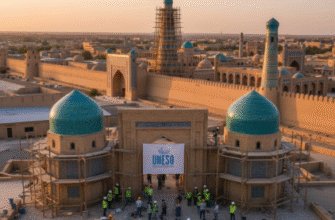
For most of the 20th century, the Bikajan Bika Madrasah was just another crumbling building in Ichan-Kala’s maze of alleys. Tourism focused on the showier monuments—the Kalta Minor Minaret, the Juma Mosque with its forest of wooden columns. This little madrasah barely registered. Restoration efforts finally began in the 1990s after Uzbekistan’s independence, part of broader UNESCO-supported preservation work in Khiva’s historic center. The process was slow, under-funded, and honestly kind of improvised by modern standards. Workers stabilized walls, replaced damaged bricks, restored some of the original tilework patterns based on surviving fragments. Today it functions as a cultural space, sometimes hosting exhibitions or craft demonstrations, though it’s not always open to visitors. I’ve seen maybe three tourists there total across two visits, which feels wrong somehow—not because it needs crowds, but because its story deserves more attention than it recieves.
What strikes me most is this: Bikajan Bika created something that wasn’t supposed to exist, and it survived anyway—battered, repurposed, nearly forgotten, but still standing. That seems like its own kind of lesson, one that has nothing to do with architecture and everything to do with the stubborn persistence of ideas that matter. Anyway, if you ever find yourself in Khiva’s labyrinth of clay walls and turquoise domes, take the time to find this quiet little building. It won’t shout at you like the grander monuments do, but maybe that’s precisely why it’s worth listening to.