I’ve photographed maybe seventy sunrises across Central Asia, and Bukhara still catches me off guard.
The thing about Bukhara is that it’s not just one of those places where you point your camera at a minaret and call it a day—though, honestly, that works too. The light here behaves differently than anywhere else I’ve worked, probably because of the desert air mixing with whatever moisture drifts up from the Zeravshan River basin, creating this hazy, almost golden particulate suspension that photographers dream about but can never quite replicate in post-processing. I used to think the best sunrise shots required mountain backdrops or coastal drama, but then I spent three weeks in Uzbekistan’s old Silk Road cities and realized that architectural silhouettes against gradient skies produce something equally compelling, maybe more so because the human element—these structures built roughly 1,000 years ago, give or take—adds narrative weight that pure landscape lacks.
The Kalyan Minaret catches first light around 5:47 AM in early September, which is when I recommend shooting it. The tower’s brickwork turns this impossible shade of amber-orange that lasts maybe eleven minutes before the sun climbs too high and flattens everything. You’ll want to position yourself in the courtyard of the Mir-i-Arab Madrasah if you can get access, though the public square works fine too.
Wait—maybe I should back up. Here’s the thing about shooting the Kalyan complex: everyone does it, which means you’re fighting against ten thousand identical Instagram images. But if you arrive before 5:30 and stake out the northeastern corner near the old bookseller stalls, you’ll catch the minaret with the Kalyan Mosque’s dome in the middle ground and this weird industrial chimney from a Soviet-era building poking up in the back—sounds terrible, I know, but the compositional tension between sacred and profane actually works. I’ve seen photographers crop that chimney out later, and honestly, the image loses something. The layering of Bukhara’s architectural timeline, from medieval Islamic to communist pragmatism, tells a more complete story than pristine historical recreation ever could.
Anyway, that’s one spot.
The Ark Fortress presents different challenges and different rewards, mainly because you’re shooting a massive earthen wall rather than delicate tilework, which means you need stronger directional light to reveal texture. I’d get there around 5:15 AM, earlier than the Kalyan shoot, and position yourself on Afrosiab Street looking southwest toward the main entrance. The fortress wall runs maybe twenty meters high—I’m guessing, I never actually measured—and when the sun breaks over the buildings behind you, it rakes across that compressed earth surface and every imperfection, every repair job from the last two millennia, suddenly becomes visible. You’ll need a polarizing filter here, definately, because the dust in the air creates glare that’ll wash out your foreground. I forgot mine once and spent forty minutes in Lightroom trying to recieve detail I’d lost at capture, which taught me that lesson pretty thoroughly.
The Chor-Minor is my favorite, though it shouldn’t be.
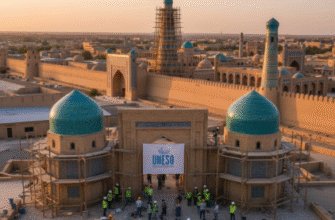
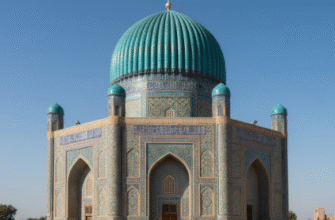
It’s this odd little structure with four towers topped by blue domes, built in 1807 as a gatehouse for a madrasa that no longer exists, and architecturally it’s kind of eccentric compared to Bukhara’s grander monuments—the proportions feel slightly off, the towers aren’t quite symmetrical, one dome is patched with different tiles. But precisely because it’s imperfect and human-scaled, it photographs with more personality than the postcard-perfect sites. I shoot it from the narrow alley on the western side, where residential buildings crowd close and laundry lines sometimes cross your frame—leave them in, trust me—around 6:10 AM when the light’s already somewhat established but still warm. The contrast between the deteriorating neighborhood context and these cheerful blue domes produces images that feel alive rather than museum-preserved. Turn around while you’re there and shoot back down the alley toward wherever the light’s coming from; I’ve gotten some of my best Bukhara work from those spontaneous reversals, catching shopkeepers opening shutters or cats navigating puddles with the Chor-Minor basically irrelevant in the background.
Here’s what I guess I’m actually saying: Bukhara rewards photographers who show up early but also those who challenge their own compositional instincts. The iconic shots exist and they’re worth taking—the Kalyan Minaret will never not be stunning at first light—but the city’s real photographic richness lives in the spaces between monuments, in the transitions between eras, in the messy reality of a living historical city rather than an open-air museum. I used to approach sunrise photography as pure landscape discipline, all about light quality and sky color, but working in places like Bukhara taught me that architecture and human context matter equally, maybe more.
The technical stuff matters less than you’d think, honestly. I’ve shot Bukhara on everything from a full-frame DSLR with prime lenses to my phone when I overslept and had to run out with whatever was charging. The light does most of the work if you position yourself thoughtfully and wait for the right twelve minutes.