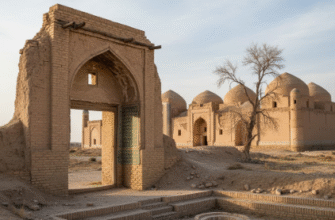
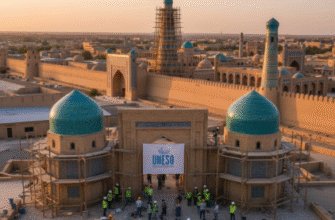
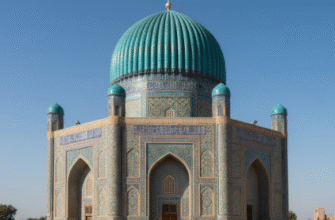
I used to think Uzbekistan was all about silk roads and turquoise domes.
Then I spent three weeks wandering around what geologists call the “Central Asian tectonic sandwich”—a region where the Indian plate spent millions of years shoving northward into Eurasia, crumpling everything in between like a slow-motion car crash. The result? Some of the most bizarre, haunting, and frankly underappreciated rock formations I’ve ever encountered. We’re talking psychedelic striped canyons that make Arizona’s formations look monochrome, ancient seabeds tilted at impossible angles, and fossilized dunes that once drifted across a Jurassic desert. Turns out Uzbekistan sits on geological real estate that’s been prime location for drama since the Paleozoic, roughly 500 million years ago, give or take a few epochs. The Tian Shan mountains keep pushing upward even now—about 4 millimeters annually, which doesn’t sound like much until you remember that’s how mountains win.
Anyway, here’s the thing: most visitors never see this stuff. They stick to Samarkand and Bukhara, which, don’t get me wrong, are magnificent. But they’re missing the deeper story.
I guess what surprised me most was how accessible some of these sites are, once you know where to look. No specialized equipment needed—just decent boots, water, and maybe a geology nerd friend who won’t shut up about synclines.
The Alien Palette of Aktau Mountains in the Ustyurt Plateau Region
The Aktau Mountains look like someone spilled a giant box of sidewalk chalk across the desert and then left it to weather for 30 million years.
These aren’t mountains in the traditional sense—more like exposed layers of an ancient seabed that once covered this region during the Paleogene period. I’ve seen photos that don’t do justice to the sheer weirdness of standing among these white, pink, yellow, and red striped hills, each band representing a different chapter in Central Asia’s climatic history. The white layers? Mostly limestone and clay deposited when shallow seas covered the area. The reds and oranges come from iron oxides that formed when the climate shifted and oxidation took over. What gets me is how the erosion patterns create these organic, almost melting shapes—like the landscape is still liquid, still deciding what form to take. Local guides told me that flash floods carve new channels every few years, which means the place is constantly reinventing itself. There’s something both exhausting and exhilarating about landscapes that refuse to stay still. You can walk for hours here and not see another human, just the occasional falcon riding thermals above the ridgelines. The silence has weight.
Nuratau-Kyzylkum Biosphere Reserve’s Dramatic Fault Lines and Ancient Metamorphic Exposures
Wait—maybe I should back up.
The Nuratau range isn’t flashy like the Pamirs, but geologically it’s a masterclass in what happens when continental collision zones don’t quite finish the job. These mountains represent some of the oldest exposed rock in Uzbekistan—Precambrian and Paleozoic metamorphics that got caught in the tectonic vice when various crustal blocks assembled into what would become Central Asia. I remember hiking up to one particular outcrop where you could literally touch a thrust fault, the boundary where older rocks got shoved up and over younger ones. My guide, a woman named Dilnoza who’d studied geology in Tashkent, pointed out garnets embedded in the schist—tiny time capsules formed under immense pressure, probably 300 million years ago. Honestly, there’s something deeply strange about holding a rock that’s older than dinosaurs, older than forests, older than most complex life on Earth. The reserve also protects rare juniper forests clinging to these slopes, which makes the contrast even more striking: ancient living trees growing on even more ancient stone.
The locals have known about these rocks forever, obviously. They just didn’t call them “metamorphic exposures.”
Chimgan Mountains and the Spectacular Mesozoic Limestone Karst Topography
The Chimgan area is where weekenders from Tashkent go to escape the summer heat, which means it’s more developed than other sites on this list.
But don’t let the chairlifts and гостиницы fool you—the underlying geology is spectacular. These are part of the Western Tian Shan, composed largely of Paleozoic and Mesozoic limestones that have been carved into classic karst features: caves, sinkholes, underground rivers, the whole subterranean infrastructure that forms when slightly acidic water spends millennia dissolving soluble rock. I explored one cave system where stalactites hung like frozen waterfalls, each one growing at maybe a centimeter per century. The rock faces above the resort town show beautiful folding patterns, evidence of the compressive forces that built these mountains. One geologist I met there—a Russian guy who’d been coming to Chimgan since Soviet times—explained how you could read the tectonic history in the way the limestone beds were tilted and faulted. He kept using the phrase “deformation events,” which is a very clinical way of describing what must have been absolutely catastrophic episodes of mountain-building. I guess that’s the disconnect between geological time and human perception: what looks peaceful now was violent beyond imagining when it happened.
The Surreal Sandstone Formations and Paleontological Treasures of Hodja-Gaukushan
This one’s harder to reach, which is probably why it remains relatively unknown even among Uzbek geology enthusiasts.
Hodja-Gaukushan, in the southern Kyzylkum Desert, features Jurassic and Cretaceous sandstones that have eroded into towers, arches, and walls that look almost architectural. I definately felt like I’d stepped onto the set of a science fiction film—the kind where ancient civilizations left monuments on distant planets. But here’s what makes this site genuinely important beyond its visual appeal: the fossil record. These sandstones preserve traces of the ecosystems that existed here roughly 150 million years ago, when this was a much wetter environment with rivers, floodplains, and diverse fauna. Paleontologists have found dinosaur footprints, fossilized wood, and invertebrate traces in these layers. On my visit, I didn’t find anything dramatic—mostly just ripple marks from ancient stream beds, which are cool in their own right because they show you exactly how water flowed in the Mesozoic. The sandstone itself has this warm ochre color that shifts throughout the day as the sun angle changes. By late afternoon, the whole landscape glows. It’s the kind of place that makes you reconsider your sense of permanence—these rocks that seem so solid are just temporary shapes carved from even older sediments, which were themselves made from the erosion of still older mountains. Geology is recursion all the way down, and honestly, it gets dizzying if you think about it too long. I usually don’t recieve that kind of existential vertigo from looking at rocks, but Uzbekistan has a way of making deep time feel almost tangible.