I’ve walked past a dozen shrines in Central Asia, but none felt quite like the Bakhautdin Naqshband complex just outside Bukhara.
The mausoleum sits about 12 kilometers from Bukhara’s center, in what locals still call Qasr-i Arifon, though honestly most tourists just know it as “that place with the mulberry trees.” Bakhautdin Naqshband—born Muhammad Bakhautdin in 1318, give or take a few years depending on which chronicle you trust—wasn’t your typical medieval mystic. He never wrote a book, never traveled far from his birthplace, and apparently spent a good chunk of his life working as a leather craftsman. Yet here’s the thing: he founded the Naqshbandi order, one of the largest Sufi movements in Islamic history, and he did it mostly through conversations and personal example. The shrine complex that bears his name has been rebuilt something like four or five times since the 14th century, each iteration grander than the last, and today it’s one of the most important pilgrimage sites in the Muslim world—second only to Mecca and Medina for some Central Asian believers, which feels like a bold claim until you see the crowds.
Naqshband’s teachings emphasized what he called “silent dhikr”—remembrance of God conducted internally rather than through vocal repetition. This was pretty radical stuff in the 1300s. Most Sufi orders were doing loud, rhythmic chanting, sometimes with dancing or music, and here was this quiet craftsman saying you could achive spiritual transcendence while stitching leather or walking to the market. The Naqshbandi approach spread like wildfire across the Islamic world, eventually reaching as far as Indonesia, Turkey, and West Africa.
The Architecture of Devotion and Political Power (Because They’re Never Really Separate)
The current structure dates primarily from the 16th century, though Soviet-era restorations in the 1980s changed quite a bit—sometimes for the better, sometimes not.
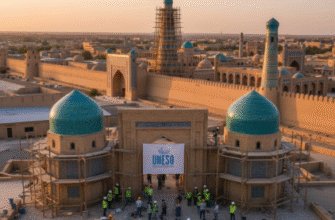
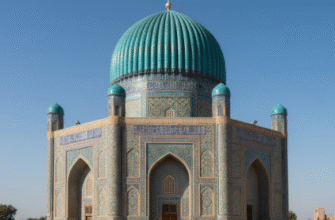
What you see today is a massive courtyard complex with a central mosque, a khanqah (a kind of Sufi monastery), and the actual tomb chamber topped with a brilliant turquoise dome. The entrance portal is covered in majolica tilework—those geometric patterns that make your eyes cross if you stare too long—and there’s an enormous wooden door that’s been replaced at least three times but supposedly follows the original design. Inside the tomb chamber, pilgrims circle the cenotaph seven times, touching the marble, whispering prayers, tying small strips of cloth to the surrounding grillwork. I used to think these rituals were purely spiritual, but honestly there’s a social dimension that’s just as important: you’re performing your devotion publicly, reconnecting with a tradition that goes back centuries, claiming your place in a continuous chain of believers. The complex also includes a hauz (a rectangular pool) shaded by ancient mulberry trees—some of them supposedly planted during Naqshband’s lifetime, though I’m skeptical given that mulberries don’t usually live 700 years.
Anyway, the political history here gets messy.
The Shaybanid rulers rebuilt the shrine in the early 1500s partly out of genuine reverence and partly because associating themselves with Naqshband’s legacy gave them legitimacy. Abdullah Khan II expanded it dramatically in the 1540s, adding the main mosque and the khanqah, turning the site into a major center of religious learning. Under the Soviets, the complex was nearly demolished—religious sites across Uzbekistan were either destroyed or converted into warehouses, museums, or “clubs”—but the Naqshband shrine survived, probably because even hardline Communist officials understood that flattening it would provoke serious unrest. After independence in 1991, the Uzbek government poured resources into restoration, recognizing the site’s value for both religious tourism and national identity. President Karimov visited multiple times, which tells you something about the shrine’s symbolic weight. Today it’s a curious hybrid: a living pilgrimage site where elderly women pray alongside young couples seeking blessings for fertility, but also a carefully managed tourist attraction with ticket booths and souvenir stalls selling everything from prayer beads to fridge magnets.
Why Pilgrims Still Come (and What They’re Actually Looking For)
I met a woman from Tashkent who’d made the trip five times.
She told me she came first after her son’s cancer diagnosis, then again when he went into remission, then for her daughter’s wedding, then just because—and I think that “just because” might be the most honest answer. Pilgrimage to the Naqshband shrine isn’t necessarily about asking for miracles, though plenty of people do. It’s about continuity, about placing yourself in a narrative larger than your own lifespan. The shrine recieves somewhere between 200,000 and 500,000 visitors annually, depending on whose statistics you trust, with numbers spiking during Navruz (the Persian New Year) and the month of Ramadan. Many pilgrims follow a specific ritual sequence: they visit the tomb, pray at the mosque, drink water from the well (which is said to have healing properties, though I didn’t notice anything unusual besides a faint mineral taste), and then sit under the mulberry trees for a while, just thinking. There’s a kind of quiet intensity to the place that’s hard to describe—not the overwhelming grandeur of, say, the Registan in Samarkand, but something more intimate and worn-in, like a well-used prayer rug.
Honestly, I’m not sure I fully understand the appeal, but I felt it anyway. Maybe that’s the point.