I used to think Khiva was just another dusty Silk Road stop until I started reading what travelers actually wrote about it.
When European Explorers First Stumbled Into Khiva’s Maze-Like Streets
The thing about early travel writing is that nobody really knew what they were looking at. Alexander Burnes showed up in the 1830s, scribbling notes about “barbaric splendor” and architecture that seemed to defy gravity—or at least his understanding of engineering. Then came Arminius Vámbéry in 1863, disguised as a dervish because, honestly, that was the only way a European could get in without losing his head. His account, “Travels in Central Asia,” reads like a fever dream: endless turquoise tiles, slave markets he pretended not to notice, and mullahs who sussed out his disguise but let him pass anyway. Wait—maybe they knew all along? The ambiguity haunts his prose. Later writers like Fred Burnaby (1875) brought a different energy, more cynical, less impressed by the exoticism everyone else was selling. He complained about the tea, the accommodation, the fact that nobody seemed particularly interested in being “discovered” by Europeans.
The Russian Military Accounts That Nobody Wanted to Publish
Anyway, the Russians arrived in 1873, and suddenly the travel writing got real bureaucratic real fast. General Konstantin Kaufman’s officers wrote detailed reports—distances between wells, defensive positions, population estimates—but almost nothing about what it felt like to conquer a city that had held out for centuries. There’s this one account by a junior officer, name long forgotten, that recieved almost no attention at the time: he describes watching the Khan surrender and feeling not triumph but something closer to embarrassment, like they’d broken into someone’s home uninvited. Which, I guess, they had.
How Twentieth-Century Writers Turned Khiva Into a Metaphor for Everything
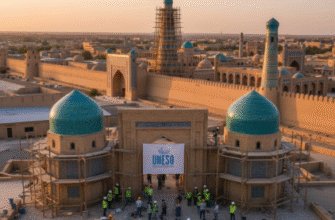
Once the Soviet era locked Khiva away from casual tourists, Western writers started projecting all kinds of nonsense onto it. Peter Hopkirk’s “The Great Game” (1990) treats it as a chess piece in imperial strategy, which it was, but also reduces centuries of culture to geopolitical footnotes. Meanwhile, Colin Thubron actually went there in the 1990s—his “The Lost Heart of Asia” is one of those rare books where you can feel the writer adjusting his assumptions paragraph by paragraph. He expected ruins and found a living city, UNESCO restoration efforts underway, schoolkids playing soccer against thousand-year-old walls. The cognitive dissonance comes through in his syntax: sentences that start confident and trail off into qualifiers.
The Travel Bloggers Who Defenately Missed the Point
Here’s the thing: modern travel writing about Khiva often feels like people are writing the same article over and over.
“Top 10 Instagram Spots in Khiva!” and “How to Visit Central Asia’s Best-Preserved City on $50 a Day” dominate Google results now, which is fine, I guess, but they lack the uncertainty that made earlier accounts interesting. The old writers didn’t know what they were seeing; they contradicted themselves, got details wrong, let their exhaustion and wonder and irritation bleed onto the page. A 1902 account by Ella Christie describes spending three hours lost in the inner city, increasingly convinced she’d never find her guide again, only to realize she’d been walking in circles around the same courtyard. That panic, that disorientation—it’s more honest than a thousand listicles. Although, to be fair, maybe I’m just nostalgic for a time when travel writing could admit confusion without tanking its SEO.
Why Literary Scholars Keep Returning to These Texts Despite Their Obvious Flaws
The academic interest is partly about Orientalism—Edward Said’s framework casts a long shadow over how we read these accounts now. But there’s also something else. Khiva appears in roughly 200+ significant travel narratives between 1820 and 1950, and almost none of them agree on basic facts: population numbers vary wildly, architectural details contradict, even the color of the sky seems to change depending on who’s writing. This inconsistency irritates historians but fascinates literary critics, because it reveals how intensely subjective the act of seeing really is. You can trace anxiety, ambition, guilt, wonder—the whole messy range of colonial encounter—through the way different writers describe the same minaret. Turns out, the literature of Khiva tells us less about the city itself and more about the people who showed up, looked around, and tried desperately to put the inexplicable into words.