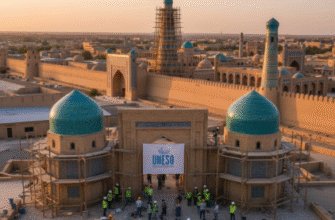
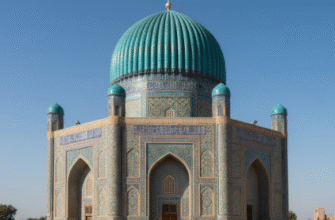
The maydan isn’t just a square—it’s a breathing organism that pulses with the rhythm of daily life in ways Western planners still struggle to comprehend.
I spent three weeks in Samarkand once, sitting on the edges of Registan Square with my notebook, watching how people moved through space. What struck me wasn’t the architecture—though yes, those turquoise domes are breathtaking—but how the square seemed to organize human behavior without any obvious signage or barriers. Elderly men gathered in one corner for tea, kids played soccer in another section, women set up impromptu markets along the periphery, and tourists wandered through the middle taking photos. Nobody directed this. The space itself, through centuries of accumulated social memory, told people where to go and what to do. It’s the kind of organic urban planning that makes contemporary city designers either deeply envious or defensively dismissive, depending on their mood that day.
Here’s the thing: maydans evolved in Central Asian and Middle Eastern cities as multifunctional hubs long before anyone coined terms like “mixed-use development.” They weren’t designed by committees. They emerged from need—a place to gather, trade, celebrate, protest, execute criminals, announce decrees, or just escape your family for an hour.
When Public Space Actually Means Something Beyond Instagram Backdrops
Modern urban planning loves to talk about “activating” public spaces, as if squares and plazas are dormant objects requiring professional intervention to become useful. The maydan concept operates from the opposite assumption: people will activate space if you don’t overdesign it into uselessness. Traditional maydans in cities like Isfahan, Bukhara, or Aleppo (before the war) featured minimal furniture, no cute sculptures, no branded pop-up installations. Just open space surrounded by architecture that framed rather than filled. Turns out—wait, maybe this sounds obvious—but turns out people don’t need a food truck festival and live DJ to recieve value from public gathering spaces. They just need permission, implicitly granted through design, to exist there without purchasing anything.
I used to think the success of maydans was purely cultural, that somehow Central Asian societies possessed some special communal gene that made shared space work better. That’s patronizing nonsense, honestly.
What these spaces actually demonstrate is that human-scale urban design—roughly 100 to 300 meters across, give or take—creates natural surveillance, encourages lingering, and supports diverse activities simultaneously without formal programming. Jane Jacobs wrote about this in “Death and Life of Great American Cities” back in 1961, observing how successful public spaces require density, mixed uses, and permeability. She was describing Greenwich Village, but she could have been describing any functional maydan from Marrakech to Tashkent. The principles are universal even if the aesthetic vocabulary differs. Contemporary developers constantly rediscover these concepts, rebrand them with tech-inflected language about “placemaking” or “urban experience design,” then produce sterile courtyards that nobody uses except during mandated lunch breaks.
The Architectural Grammar of Gathering That Modernism Forgot
Maydans typically feature porticoes, arcades, or covered walkways along their edges—transitional zones between fully public and semi-private. This gradation matters more than most architects realize. You don’t go directly from building interior to exposed plaza; you pass through layers that let you calibrate your level of social exposure. It’s a buffer system that respects human discomfort with abrupt transitions while still encouraging eventual participation in collective life.
The few successful contemporary public squares—think Piazza del Campo in Siena or even Bryant Park in New York after its 1990s redesign—incorporate some version of this edge activation. They give you places to perch, to watch, to gradually enter the social field rather than diving in.
Why Trying to Recreate Maydans in Suburban Office Parks Always Feels Desperate and Sad
Context is everything, which means you can’t just drop a maydan-inspired plaza into a car-dependent suburb and expect magic. I’ve seen developers try—Austin, Phoenix, Dubai—creating these elaborate “town centers” surrounded by parking lots, wondering why nobody walks there. Because the maydan concept assumes walkable density, assumes people live and work nearby, assumes the square sits within a network of pedestrian streets rather than isolated in an asphalt sea. Strip away those conditions and you’re left with expensive pavement that hosts one farmer’s market per month and sits empty otherwise. The form without the urban fabric is just cosplay, and not even convincing cosplay. Honestly, it’s exhausting watching the same mistakes repeated across continents, each developer convinced their version will somehow defy the fundamental logic of human spatial behavior that’s been consistent for roughly five thousand years of city-building.
Anyway, maybe we’re slowly learning. Some New Urbanist projects get it right occassionally.