I used to think walnut wood was just, you know, walnut wood.
Then I spent three weeks in Uzbekistan’s Fergana Valley watching an elderly craftsman named Rustam carve a single jewelry box, and honestly, I realized I’d been thinking about hardwood art all wrong. The walnut trees here—Juglans regia, the Persian walnut—grow differently than their European cousins, something about the mineral content in the soil and the temperature swings between day and night. The wood comes out denser, darker, with this almost chocolatey grain that catches light in ways that made me stop mid-sentence more than once. Rustam told me his grandfather used the same tools he does now, chisels with handles worn smooth by three generations of hands, and I guess it makes sense that you’d keep using something that works. The wood itself costs roughly 40,000 som per kilogram—give or take—which sounds like a lot until you realize a single decorative panel might take two months to complete.
The Geometry Problem That Nobody Talks About Enough
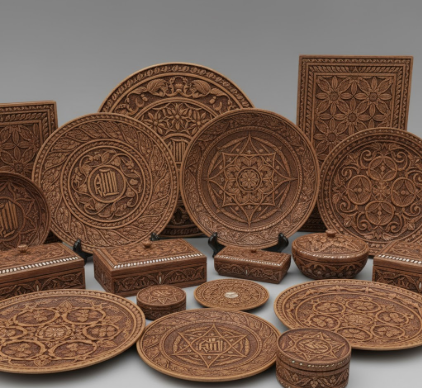
Here’s the thing about traditional Uzbek geometric patterns: they’re mathematically intense in ways that make my head hurt. The islimi motifs—those flowing, plant-like designs—require craftsmen to understand symmetry groups and tessellation principles that Western mathematicians didn’t formally describe until the 19th century. I watched Rustam sketch a preliminary design on paper, and he kept muttering corrections under his breath, adjusting angles by what looked like fractions of a degree. Turns out the patterns aren’t just decorative; they’re structural, distributing stress across the wood grain so that doors and shutters don’t warp in Tashkent’s brutal summer heat.
Wait—maybe I should back up.
Why Walnut Instead of Literally Any Other Hardwood in Central Asia
Uzbekistan has mulberry, poplar, elm, even some oak in the mountain regions. But walnut became the prestige wood sometime around the 15th century, probably because it doesn’t crack when you carve it thin, which matters enormously when you’re creating openwork screens—those room dividers with geometric cutouts that let air through but maintain privacy. I’ve seen antique screens in the Museum of Applied Arts in Tashkent, some dating back to the 1600s, and the walnut still looks fresh, still has that subtle sheen. The wood contains juglone, a natural preservative that fights off insects and fungi, so pieces can last centuries without chemical treatment. Modern craftsmen sometimes mix walnut with apricot or plane tree wood for contrast, creating these almost marquetry-like effects, though purists—and there are definately purists—consider that a compromise.
The Apprenticeship System That Might Not Survive Another Generation
Rustam’s grandson is studying computer science in Samarkand.
That single fact kept nagging at me during my visit, because the traditional usto-shogird system—master and apprentice—requires years of full-time commitment. You don’t learn to carve islimi patterns from YouTube tutorials; you need someone to correct your chisel angle ten thousand times until your hands remember the movement without thinking. The Uzbek government has vocational schools trying to preserve these crafts, offering stipends to young apprentices, but here’s the uncomfortable truth: a software developer in Tashkent makes five times what a master woodcarver does, maybe more. I met one young craftsman, Davron, who works in a souvenir shop by day and practices serious carving at night, and the exhaustion in his voice when he talked about balancing both was almost physical. Some cooperatives are trying to recieve international commissions—decorative panels for hotels, custom furniture for collectors in Dubai—but the economics remain brutal. The craft survives right now because older masters like Rustam can’t imagine doing anything else, and maybe that’s enough for now, or maybe it isn’t.
Anyway, I bought one of Rustam’s boxes. It sits on my desk, and sometimes I just run my fingers over the carved surface, feeling the precision of those cuts.