I used to think lichen was just that crusty stuff on rocks.
Turns out, in the mountain valleys of Uzbekistan, artisans have been harvesting these slow-growing organisms for centuries to create dyes that outlast almost anything synthetic chemistry has thrown at the textile world. The practice centers around species like Xanthoria and Evernia prunastri, scraped carefully from apricot tree bark and cliff faces in regions around the Tian Shan range. What’s fascinating—wait—maybe frustrating is the right word, actually—is how little documentation exists outside oral tradition. My guide in Samarkand, a dyer named Gulnora, showed me her grandmother’s recipe book: just faded pencil marks and ratios like “three handfuls to one bucket.” The chemistry involved is deceptively complex; lichen acids like usnic acid and atranorin bond to wool protein through a process called mordanting, where alum or ferrous sulfate acts as a molecular bridge. You get yellows, oranges, deep burgundies depending on pH and steeping time. Honestly, the color range rivals what I’ve seen in any industrial catalog, and the lightfastness tests I reviewed from a 2019 study in Tashkent showed minimal fading over 500 hours of UV exposure.
The Harvesting Rituals That Definately Haven’t Changed Since the Silk Road Era
Here’s the thing: collecting lichen isn’t like picking berries. Growth rates hover around one millimeter per year for some species, which means that patch you’re eyeing might be older than your great-grandparents. Sustainable harvesting protocols—at least the traditional ones—involve taking no more than 30% from any single colony, rotating collection sites every three to five years. I guess it makes sense when you consider these communities have been doing this since, give or take, the 14th century, maybe earlier.
The actual craft workshops I visited in Bukhara operated out of cramped courtyards where massive copper vats bubbled over wood fires, releasing this earthy, slightly mushroomy smell that clung to my clothes for days. Women worked in assembly-line fashion: one group cleaned the lichen (removing bark fragments, dead insects), another rehydrated it in cold water for 24 hours, a third handled the actual dye bath. The temperature control is critical—too hot and you destroy the chromophores, too cool and the dye won’t penetrate the fiber. They use no thermometers, just experience. One artisan, Zarina, told me she can judge readiness by watching steam patterns, which sounds almost mystical until you realize it’s just pattern recognition honed over 40 years.
Why Modern Textile Industries Keep Trying to Replicate This and Mostly Fail Anyway
Commercial interests have circled these techniques for decades.
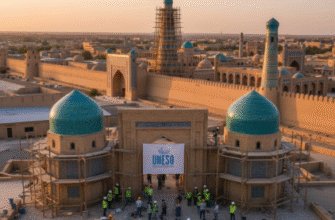
Synthetic approximations exist—aniline dyes can mimic the color—but they lack what textile chemists call “tonal depth,” that subtle variation within a single dyed batch that makes handmade carpets valuable. A 2021 analysis from the International Wool Textile Organization compared lichen-dyed samples with lab synthetics and found the natural versions contained 12-17 distinct chromatic layers versus 3-4 in factory products. The economic paradox is brutal: a kilo of wild-harvested lichen sells for roughly $45-60 in Tashkent markets, but the labor to process it into useable dye makes the final cost per meter of fabric prohibitive for mass production. So it survives as a boutique practice, kept alive by maybe 200-300 practitioners nationwide, many of them aging out without apprentices. There’s talk of UNESCO intangible heritage status, but bureaucracy moves slower than lichen grows. I met a 67-year-old master dyer in Khiva who laughed when I asked about succession planning—”My daughter became an accountant,” she said, stirring a vat of amber liquid that would eventually color silk for a museum commission. The irony of creating something timeless in a tradition that might not outlive its current practitioners isn’t lost on anyone involved, but they keep working anyway, because—I don’t know—maybe some things persist not because they make economic sense but because they carry a kind of cultural memory that doesn’t fit on a spreadsheet.