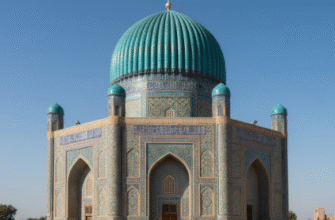
The first thing you notice when the sun drops behind Khiva’s city walls is the silence.
I mean, not complete silence—there’s still the shuffle of feet on ancient stone, the occasional murmur of a tour guide gesturing toward some elaborate tile work that’s been sitting there for, what, five centuries? Maybe six? The records get fuzzy around the edges when you’re talking about a place that’s been continuously inhabited since roughly the 6th century BCE, give or take a few hundred years depending on which archaeologist you ask. But here’s the thing: the daytime crowds that swarm through Ichan-Kala, the walled inner city that UNESCO decided was important enough to protect back in 1990, they thin out dramatically once the tour buses rumble away. What you’re left with is something stranger, more intimate—a kind of theatrical quiet where every footstep echoes and the tilework on the Kalta Minor minaret catches the last orange light like it’s showing off.
I used to think night tours were a gimmick, honestly. Just another way to repackage the same experience for tourists who’ve already done the daytime circuit. Turns out I was wrong about that, or at least partially wrong, which is the kind of admission I hate making but there it is.
The evening atmosphere in Khiva’s old town doesn’t just feel different—it is different, in ways that go beyond simple lighting changes. The madrassas, those Islamic schools with their towering portals and courtyards that seem designed specifically to make you feel small, they transform. During the day they’re impressive in an architectural sense, sure, but at night with strategic illumination highlighting the majolica tilework—those blues and turquoises that Central Asian craftsmen perfected over centuries of trial and error—they become almost overwhelming. The Mukhammad Amin Khan Madrassa, which is the largest in Khiva with its 125 cells for students, turns into this geometric fever dream when lit from below.
Wait—maybe I should back up.
Khiva sits in western Uzbekistan, in the Khorezm region, and it’s been a key trading post along various incarnations of the Silk Road for millennia. The city you walk through today, the one with the approximately 250 old houses and 60-odd architectural monuments crammed inside those 2.2 kilometers of defensive walls, is largely from the 18th and 19th centuries. But layers exist beneath that—archaeological layers, historical layers, the kind of temporal density that makes your brain hurt if you think about it too long. The Khans who ruled from here weren’t particularly known for their gentleness, and the slave markets that operated in the city center until the Russian conquest in 1873 are a reminder that picturesque doesn’t mean peaceful. History is messy like that.
Anyway, the night tours.
Most of them start around sunset, which in summer means 8 PM or later, and they follow a fairly predictable route through the main sites: the Kalta Minor with its unfinished bulk (the Khan who commissioned it died before completion, and apparently nobody else felt motivated to finish a 29-meter minaret that was supposed to reach 70-80 meters), the Juma Mosque with its forest of 213 wooden columns each carved differently because they were collected from various demolished structures over several centuries, and the Tash Hauli Palace where the harem quarters still have that unsettling voyeuristic quality even when they’re empty and lit by carefully placed spotlights. The guides vary in quality—some recite facts like they’re reading from a script they’ve memorized phonetically, others actaully know their stuff and can tell you why certain tiles are arranged in specific geometric patterns that relate to Islamic cosmology.
What gets me, though, is the accidental moments.
The way a cat will dart across the courtyard of the Pakhlavan Makhmud Mausoleum, which is this revered site dedicated to a 14th-century poet-wrestler-philosopher who became Khiva’s patron saint, and for a second the whole constructed tourist experience just collapses into something real and present. Or how the temperature drops as night deepens and you suddenly understand why these massive walls and narrow streets made sense in a desert climate—they’re thermal management, basically, architecture as environmental control long before anyone was using those terms. I’ve seen tourists stand in the shadow of the Islam Khodja minaret, which at 56.6 meters is the tallest structure in the old town and visible from pretty much everywhere, and you can watch them doing the mental math: this was completed in 1910, just seven years before the Russian Revolution would change everything, and the craftsmen who built it were using techniques that hadn’t changed substantially in centuries.
The thing about evening tours in Khiva is they strip away some of the educational pretense. You’re not there to learn every historical detail or photograph every surface—the lighting’s tricky anyway, and most phone cameras struggle with the contrast. You’re there to wander through a place that’s somehow managed to preserve not just buildings but an entire urban layout from another era, and to feel the particular melancholy that comes with walking through beauty that’s been commodified but not entirely domesticated. The Silk Road caravans don’t come through anymore, obviously. The city’s population of roughly 90,000 mostly lives outside the old walls in the modern section. What remains inside Ichan-Kala is part museum, part living neighborhood, part stage set—and at night, when the boundaries between those categories blur, it’s almost possible to forget which century you’re standing in.
Which I guess is the whole point, really.