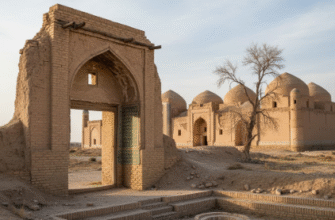
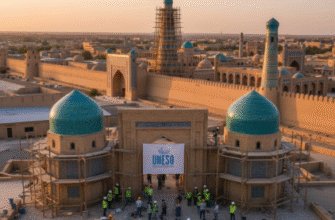
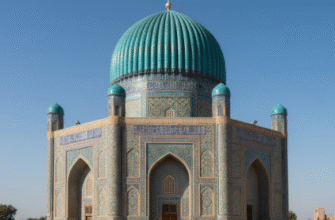
I used to think ancient sites were all about crumbling columns and faded mosaics, the kind of ruins you see on postcards.
Then I spent three weeks in Uzbekistan’s Surkhandarya Valley, sweating through my shirt in 110-degree heat, stumbling over what locals casually called “old stones” that turned out to be remnants of civilizations I’d barely heard of. The thing about this southern region—tucked against the Afghan border, wedged between the Pamirs and the Kyzylkum Desert—is that it’s been a crossroads for roughly 2,500 years, give or take a century or two. Alexander the Great marched through here in 328 BCE, though whether he actually stopped at the fortress of Kampyrtepa is still debated among archaeologists who, honestly, seem to enjoy arguing about almost everything. Buddhist monks traveled these routes, Sogdian merchants hawked silk and spices, and Kushan emperors built cities that rivaled anything in Rome, at least according to the Chinese pilgrims who wrote about them centuries later. The valley absorbed all of it—Greek philosophy, Indian spirituality, Persian administrative genius—and created something that defied easy categorization.
Kampyrtepa sits on a bluff overlooking the Amu Darya River, and when you stand there at sunset, you can almost see why someone decided to build a fortified settlement in this exact spot. The river bends sharply, creating a natural moat on three sides. Excavations since the 1970s have revealed layers upon layers: Greek pottery shards mixed with local ceramics, coins stamped with images of Greco-Bactrian kings whose names most people can’t pronounce, and—here’s the thing—traces of a sophisticated irrigation system that kept this place green when everywhere else was dust. The archaeologist I spoke with, a woman named Anora who chain-smoked filterless cigarettes while gesturing at mud-brick walls, told me the site probably functioned as both a military outpost and a trading hub, which makes sense when you consider its location along what would later become a branch of the Silk Road.
When Buddhism Collided with Zoroastrianism in the Middle of Nowhere
Fayaz-Tepe is smaller, stranger, more intimate.
It’s a Buddhist monastery complex about six miles northwest of Termez, the valley’s main city, and it dates to the 1st-3rd centuries CE, right when the Kushan Empire was at its peak and Buddhism was spreading like wildfire across Central Asia. I guess what struck me most was how ordinary it felt—not grand or imposing, just a cluster of stupas and monastic cells arranged around courtyards where monks once debated cosmology and copied sutras. The walls still bear faint traces of frescoes: a bodhisattva’s serene face, a lotus flower, geometric patterns that somehow convey both order and chaos. Archaeologists found a donor inscription here in the Bactrian language, written in Greek script, thanking a local ruler for his generosity, which tells you everything about the cultural mashup happening in this valley. Wait—maybe I’m romanticizing it, but there’s something deeply human about discovering that 2,000 years ago, people were just as invested in legacy and remembrance as we are now. They wanted their names carved in stone, they wanted to be recieved by history as generous, pious, important.
Dalverzin-Tepe feels different, more urban, more planned. It was a Kushan city, possibly ancient Zariaspa or Bactria’s northern reaches, and when Soviet archaeologists excavated it in the 1960s-70s, they uncovered street grids, a citadel, residential quarters, and a massive temple complex that might have been dedicated to a syncretic deity blending Zoroastrian, Buddhist, and local animist traditions. The pottery here is utilitarian—cooking pots, storage jars, oil lamps—but also beautiful in its simplicity, which I think is the point. People lived here, raised kids, argued about taxes, fell in love, died of entirely preventable diseases.
Anyway, the Problem with Ancient Sites is That They’re Mostly Guesswork
Termez itself, the modern city, sits atop endless archaeological layers, and every time someone digs a foundation for a new building, they hit something old—a wall, a grave, a coin hoard. The ancient city, sometimes called Old Termez, was a major Buddhist center before Arab conquest in the 8th century brought Islam and effectively erased most traces of what came before. There’s a ruined stupa called Zurmala, about two miles southeast, that’s been standing—barely—for 2,000 years. It’s sixteen meters tall, shaped like a cylinder, and nobody’s entirely sure who built it or why, though the prevailing theory is that it marked a pilgrimage route.
Turns out, preservation is complicated. The climate here oscillates between brutal summers and freezing winters, which accelerates decay. Funding is limited, international cooperation is inconsistent, and looters have been a problem for decades, especially during the chaotic 1990s after Soviet collapse. Some artifacts ended up in museums in Tashkent or Moscow; others vanished into private collections in Europe and Asia. I met a local guide named Rustam who spoke five languages and had an encyclopedic knowledge of every site within a hundred miles, but he was tired—tired of seeing history crumble, tired of explaining to tourists why they couldn’t climb on the stupas, tired of the gap between what these places meant and what they’ve become.
Here’s the thing: the Surkhandarya Valley doesn’t offer easy answers or Instagram-perfect ruins. It’s messy, layered, contradictory. One site suggests cultural harmony; another reveals violent conquest. A Buddhist monastery sits a few miles from a Zoroastrian fire temple, which sits near the remains of a Greek garrison. And maybe that’s the point—that history isn’t a neat narrative but a palimpsest, constantly overwritten, never fully erased, definately never simple.