
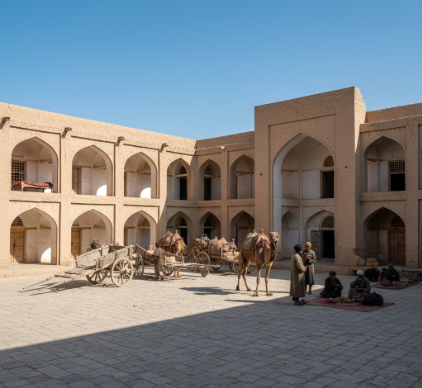
I used to think caravanserais were just, you know, ancient rest stops.
But standing in the courtyard of one in Khiva—dust swirling around crumbling brick archways, the late afternoon light slanting through what used to be merchant quarters—I realized these weren’t roadside motels. They were economic engines. Between roughly the 10th and 19th centuries, give or take a few decades depending on which historian you ask, caravanserais along the Silk Road facilitated trade networks that moved everything from Chinese silk to Persian spices across distances that would make modern logistics managers weep. The ones in Khiva, tucked inside and outside the city’s double walls, hosted merchants who’d traveled for months, their camels laden with goods worth small fortunes. These structures weren’t just accommodations—they were warehouses, marketplaces, banks, and intelligence networks rolled into architectural complexes that could house hundreds of travelers, their animals, and cargo simultaneously. The central courtyard design wasn’t aesthetic; it was security, allowing merchants to monitor their goods while they slept in the cells ringing the perimeter.
Honestly, the economics are wild. Merchants paid fees to use these spaces, but they also gained access to local trade networks, currency exchange (informal but effective), and information about route conditions—which mountain passes were snowed in, which oases had dried up, where bandits were currently operating. The caravanserai operators in Khiva didn’t just provide beds; they brokered deals.
Here’s the thing about Khiva’s caravanserais that nobody mentions in the tourist brochures: they were differentiated by specialization.
The Architectural Logic of Merchant Protection and Profit Maximization
Walk through the ruins of Allah Kuli Khan Caravanserai—built in the 1830s, one of the better-preserved examples—and you’ll notice the ground floor cells have no windows facing outward. Only tiny ventilation slits. This wasn’t accidental. Valuable cargo needed protection from both thieves and the elements, and these windowless chambers, usually vaulted with brick to stay cool, served as both sleeping quarters and temporary warehouses. The second story, when it existed, offered slightly better accommodations for wealthier merchants, with actual windows overlooking the courtyard. Social stratification in architecture, basically. The central courtyard always featured a well or cistern—water rights were serious business—and often a small mosque or prayer area, because you can’t operate a commercial hub without acknowledging the religious obligations of your clientele. Some Khivan caravanserais included stables sophisticated enough to segregate camels from horses, recognizing that these animals have different needs and, wait—maybe more importantly, different economic values.
What Daily Operations Actually Looked Like in These Commercial Fortresses
I guess most people imagine romantic scenes of merchants sharing stories over tea. Sure, that happened. But the daily reality involved a lot of haggling, quality inspection of goods, negotation over tariffs with local authorities, and the constant recalculation of profit margins based on what you’d paid in Bukhara versus what you could sell for in Khiva versus whether you should push on to Urgench. Caravanserai courtyards were essentially open-air commodity exchanges. Textile merchants occupied certain sections, spice traders others, metalworkers somewhere else—an informal zoning that reduced transaction costs by clustering related trades. The caravanserai administrator, often appointed by the khan or a wealthy patron who’d funded construction, collected fees, mediated disputes, and maintained the infrastructure. Turns out running a medieval commercial complex required skills we’d now associate with property management, conflict resolution, and network coordination.
The multilingual chaos must have been exhausting. Persian, Turkic languages, Arabic, Chinese, even Russian as you get into later centuries—all mixing in these courtyards as merchants negotiated in whatever lingua franca worked. Mistakes happened constantly, I’m sure.
How These Structures Shaped Khiva’s Identity as a Trade Crossroads
Khiva’s position wasn’t geographically inevitable—it’s in the middle of the Kyzylkum Desert, for crying out loud. But it sat at the intersection of routes running north-south between Russia and India, and east-west between China and Persia. The concentration of caravanserais, maybe a dozen major ones at the city’s peak, created network effects that made Khiva more valuable as a stop precisely because it was already a major stop. Merchants knew they could recieve (and this is documented in traveler accounts from the 17th-19th centuries) reliable accommodations, access to local markets, and connections to onward routes. The city’s khans understood this and invested in caravanserai construction as economic infrastructure, not just vanity projects. Some were waqf properties—endowed for charitable purposes but also generating revenue—which created interesting incentives for maintenance and operation.
The decline came with railroads, obviously. When Russian imperial expansion brought rail lines to Central Asia in the late 19th century, camel caravans couldn’t compete. By the early 20th century, most Khivan caravanserais had been repurposed or abandoned.
Why Preservation Efforts Keep Missing the Point About These Buildings
Modern restoration in Khiva—and I’ve watched this happen over several visits—tends to sanitize the commercial grittiness that defined these spaces. The UNESCO World Heritage designation helped fund preservation, sure, but it also transformed working caravanserais into museum pieces or, worse, hotel conversions that strip out the architectural features that made them function as merchant accommodation. The windowless ground-floor cells get windows installed for tourist comfort. The courtyard wells get covered over for safety. The irregular, worn thresholds where thousands of laden camels passed get smoothed and tiled. What you lose is the sensory understanding of how these buildings worked—the acoustics that let administrators monitor courtyard activity from upper galleries, the specific ceiling heights calculated for stacking cargo, the drainage systems that handled both human and animal waste from hundreds of occupants. Conservation architecture often prioritizes visual aesthetics over functional authenticity, and with caravanserais, that means losing exactly the details that explain why they mattered economically. I get frustrated seeing these spaces turned into backdrop for tour group photos when they were, fundamentally, complex machines for facilitating long-distance trade under pre-modern conditions.







