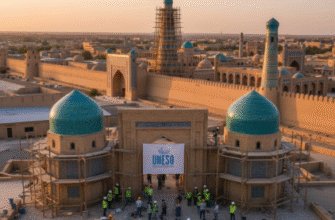
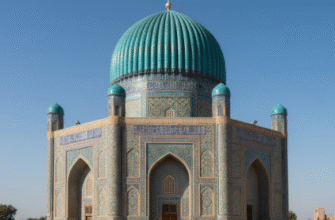
I used to think madrasahs were just austere rooms with students hunched over ancient texts, but Madari Khan Madrasah in Khiva shattered that assumption the moment I stood in its courtyard.
Built in 1871 by Muhammad Rahim Khan II, the penultimate khan of Khiva, this madrasah occupies a peculiar spot in the city’s architectural timeline—late enough that Russian influence was creeping into Central Asia, early enough that traditional Khorezm craftsmanship still dominated every tile and carved door. The khan named it after his mother, Madari Khan, which already tells you something about the emotional landscape here. Royal endowments weren’t just political theater; they were deeply personal acts, blending piety with memory with, honestly, a fair bit of ego. The complex sits just west of the Kalta Minor minaret, that famously unfinished tower that looks like someone gave up halfway through an ambitious ceramics project. Walking between them feels like moving between two different anxieties—one about completion, one about legacy. The madrasah itself follows the standard Central Asian layout: a rectangular courtyard flanked by two stories of hujras, those small student cells that make modern dorm rooms look spacious. Fifty cells, give or take a few depending on which archival source you trust, each maybe ten feet by eight, enough for a sleeping mat and some books and not much else.
Here’s the thing—by the 1870s, Khiva’s golden age of scholarship was already dimming. The khanate faced pressure from Tsarist expansion, internal power struggles, shifting trade routes. Yet Muhammad Rahim Khan poured resources into education anyway, or maybe because of all that chaos. The madrasah taught traditional Islamic sciences: Quranic exegesis, hadith, Arabic grammar, logic, astronomy for prayer calculations. Nothing groundbreaking, but that wasn’t really the point. Madari Khan Madrasah functioned as a stabilizing force, a statement that Khiva’s intellectual traditions would persist even as everything else felt precarious.
The Architecture That Refuses to Whisper—Turquoise Majolica and Carved Doors That Still Smell Like Walnut Oil
The exterior tilework hits you first. Turquoise and cobalt majolica panels, geometric patterns interlocking with such precision you’d swear they were machine-cut, except you can see the tiny irregularities that prove human hands laid each piece. The main portal—the pishtaq—rises maybe forty feet, decorated with carved ganch (that’s plaster mixed with clay, a Central Asian specialty) that looks almost lace-like. I guess what strikes me most is the restraint. Unlike earlier Khivan monuments that pile on ornamentation until your eyes don’t know where to land, Madari Khan feels measured, almost tired. The palette is narrower. The inscriptions are shorter. Maybe that reflects the era’s diminished confidence, or maybe I’m projecting. Anyway, inside the courtyard, two-tiered wooden galleries run along the hujra facades, columns carved from local elm and walnut, the kind of wood that darkens beautifully over time. Soviet-era restoration added some concrete where wooden beams had rotted—you can spot it if you look close, a diffrent texture that doesn’t quite match. Those restorations happened in the 1960s and 70s, when Khiva was being packaged as an open-air museum, which saved the structures but also froze them in a kind of nostalgic amber.
Students lived here until the early Soviet period, when traditional madrasahs were gradually phased out in favor of secular schools. The last cohort probably left around 1924, maybe 1925. Now it’s part of the Itchan Kala complex, a UNESCO World Heritage site since 1990, which means tourists wander through those hujras snapping photos instead of theology students debating fiqh until midnight.
What Actually Happened in Those Cells—Memorization, Hunger, Occasional Mysticism, and the Economics of Waqf Funding
The educational model was rigorous in a way that’d make modern students weep. A typical student might spend five years just mastering Arabic grammar through texts like the Misbah or the Kafiya, then another three on logic using works by Taftazani, then years more on hadith collections and legal theory. Instruction happened in the courtyard or inside the darskhana, the larger lecture hall on the north side, where a mudarris—a senior teacher—would read from a text and students would recite, question, memorize. It sounds monotonous, and parts of it definately were, but there’s also accounts of intellectual fireworks, debates that stretched hours, students challenging interpretations with references pulled from memory. Funding came through waqf, religious endowments tied to agricultural land or urban properties. Muhammad Rahim Khan allocated revenues from specific orchards and caravanserais to support the madrasah—paying teachers, feeding students, maintaining the building. When those revenue streams dried up under Soviet collectivization, the institution collapsed.
Wait—maybe what bothers me about the current state isn’t the tourist presence itself but the silence. Madrasahs were loud, chaotic places. Students arguing, reciting aloud, the clatter of wooden sandals on stone, pigeons roosting in the iwans. Now it’s hushed, reverential, preserved. The irony is that preservation killed the very life it aimed to honor.