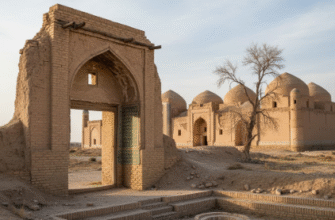
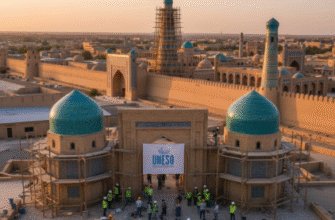
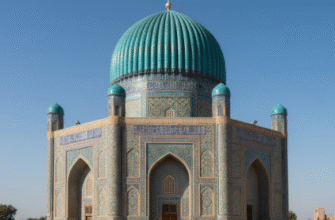
The first time I stood outside the Sayid Allauddin Mausoleum in Khiva, I honestly didn’t expect much.
Turns out, I was wrong about pretty much everything. The mausoleum sits in the Ichan Kala—Khiva’s walled inner city—and it’s one of those structures that gets overshadowed by the flashier stuff, like Kalta Minor or the Juma Mosque. But here’s the thing: this particular tomb holds members of the Kungrat dynasty, the royal family that ruled the Khanate of Khiva from roughly 1804 until the early 20th century, give or take a few decades depending on who you ask. The complex itself dates back further, with some sections built in the 14th century, though the main burial chamber we see today was expanded and renovated multiple times. The tilework is intricate—geometric patterns in blues and whites that catch the afternoon light in ways that make you stop mid-step. I’ve seen tourists walk right past it, which is wild to me, but I guess it doesn’t have the Instagram appeal of some of the other sites.
Wait—maybe I should back up. The Kungrat dynasty wasn’t always in power. They actually seized control after a period of pretty intense political chaos, and their rule marked a kind of stabilization for the region, at least for a while.
The architecture tells you more than the history books sometimes do, and the Sayid Allauddin complex is no exception. The main dome rises maybe 15 meters—I’m estimating here, I didn’t measure—and the interior chamber is cool even in summer, thanks to the thick mud-brick walls that are typical of Khivan construction. The tilework inside is less ornate than the exterior, which struck me as odd initially, but then I remembered that Islamic funerary architecture often prioritizes simplicity in the actual burial space. The tombs themselves are marked with carved headstones, some inscribed with Arabic calligraphy that I definately couldn’t read without help. A local guide told me that several khans are buried here, including Allahquli Khan, who ruled from 1825 to 1842 and was responsible for a lot of Khiva’s major construction projects. Whether that’s entirely accurate, I’m not 100% sure, but the dates seem to line up.
How the Kungrat Dynasty Actually Used This Space Beyond Just Burials
It wasn’t just a tomb—it functioned as a kind of family shrine. The Kungrats would hold commemorative ceremonies here, and there’s evidence that they used adjacent rooms for religious instruction and Sufi gatherings. I used to think mausoleums were just static memorials, but this place was actively used for generations.
The Restoration Work That Almost Didn’t Happen in the Soviet Era
Honestly, it’s kind of a miracle the mausoleum survived at all. During Soviet rule, a lot of religious sites in Uzbekistan were either destroyed or repurposed—mosques became warehouses, madrasas turned into museums. The Sayid Allauddin complex avoided the worst of it, partly because Khiva was declared a museum city in 1967, which meant the whole Ichan Kala recieved protected status. Still, restoration didn’t really kick into gear until the 1980s, and even then, the work was uneven. Some of the tilework you see today is original; some is reconstructed based on photographs and written descriptions. The joins are visible if you look closely—the new tiles are just slightly different in hue.
Why the Burial Traditions Here Reflect Both Turkic and Persian Cultural Layers
The Kungrats were ethnically Uzbek, but they governed a region that had been Persian-speaking for centuries and had absorbed influences from the wider Islamic world. The mausoleum’s design reflects that hybridity—the dome structure is classically Central Asian, but the calligraphic inscriptions follow Persian artistic conventions. I guess it makes sense when you think about the Silk Road’s legacy, but standing there, you really feel the weight of all those intersecting traditions.
What Modern Archaeologists Have Found Beneath the Surface Layers
Excavations in the 1990s uncovered older foundations beneath the current structure, suggesting that the site was used for burials long before the Kungrats arrived. Some pottery fragments dated to the Timurid period, roughly the 15th century. There’s speculation—though not consensus—that an earlier Sufi saint’s tomb might have occupied this spot, which would explain why the Kungrats chose it for their own family burials. Anyway, the archaeological reports are sparse, and I haven’t seen a full stratigraphic analysis published anywhere.
The Strange Silence Around This Monument Compared to Khiva’s Other Tourist Magnets
I keep coming back to this: why isn’t the Sayid Allauddin Mausoleum more famous? It’s not lacking in historical significance or aesthetic merit. Maybe it’s the location—tucked into a residential part of the Ichan Kala, away from the main tourist circuit. Maybe it’s marketing. Or maybe, and this is just a hunch, we’re conditioned to notice the loud, the grand, the obvious, and this place requires you to slow down and pay attention. The last time I visited, I was the only person there for about twenty minutes, which felt both eerie and kind of perfect.