The madrasah sits there, quietly.
Muhammad Rahim Khan II built this Islamic school in the late 19th century—specifically between 1871 and 1876, though some sources say 1872, and honestly, the exact date feels less important than what the building represented in Khiva’s twilight years as an independent khanate. The structure rose during what historians call the “late period,” which is a polite way of saying the Khanate of Khiva was circling the drain, politically speaking. Russian imperial forces were tightening their grip on Central Asia, and Muhammad Rahim Khan, who ruled from 1864 to 1910, seemed to understand that cultural monuments might outlast political sovereignty. The madrasah featured a traditional layout—courtyard, cells for students, lecture halls—but with decorative elements that showed both Persian influences and something distinctly Khivan, a kind of architectural code-switching that I’ve seen in other late-period buildings from declining states. Wait—maybe that’s too harsh. The khanate wasn’t exactly thriving, but it wasn’t dead yet either.
When Educational Ambitions Met Geopolitical Realities in 1870s Khiva
The timing matters more than I initially thought. By the 1870s, Khiva had already become a Russian protectorate—the 1873 treaty formalized this, making the khanate nominally independent but functionally subordinate. Building a madrasah in this context feels almost defiant, or maybe just stubborn. Traditional Islamic education continued even as Russian administrative structures crept in. Students would have studied the Quran, hadith, Arabic grammar, logic, maybe some astronomy and mathematics—the standard curriculum that had been taught across Central Asia for centuries. But here’s the thing: the world outside those turquoise-tiled walls was changing faster than the curriculum inside them. Russian schools were introducing different subjects, different languages, different futures.
I used to think these late-period madrasahs were just nostalgic gestures, architectural comfort food for a fading elite. Turns out, they were more complicated. Muhammad Rahim Khan himself was literate in multiple languages, wrote poetry, and understood that education was strategic, not just traditional. The madrasah employed prominent scholars—though their names have largely faded from accessible records, which frustrates me more than it probably should.
Architectural Choices That Reveal More Than Builders Probably Intended
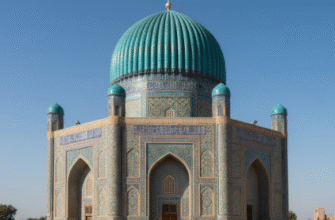
The building itself uses majolica tilework, which is standard for Khivan architecture but executed with particular care here. Blues dominating, of course—turquoise, azure, cobalt—interrupted by white and yellow geometric patterns that create an almost hypnotic effect if you stare long enough, which I definately have in photographs since I haven’t actually been there. The portal faces east, another traditional choice, but the proportions feel slightly off compared to earlier Khivan madrasahs like the Sherghazi Khan or Muhammad Amin Khan complexes. Maybe resources were tighter. Maybe aesthetic preferences had shifted. The courtyard once held roughly 40 to 50 student cells, give or take, arranged in the typical two-story configuration around the central space.
Some of the tilework incorporated floral motifs alongside the geometric patterns, which might signal Persian artistic influence or might just signal that the craftsmen liked flowers. Art history sometimes pretends to certainty it doesn’t actually possess.
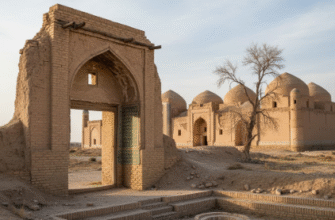
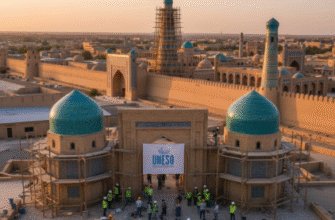
What strikes me now, looking at images of the restored sections, is how the building has outlived its original function by a century and a half. It’s a museum now, or part of the Itchan Kala complex that UNESCO designated a World Heritage Site in 1990. Tourists photograph the tiles. Guides recite facts. The cells that once housed teenage boys memorizing Quranic verses now house… well, air and occasional visitors, I guess.
How a School Became a Monument and What That Transformation Actually Means
The madrasah stopped functioning as an educational institution sometime after the Russian Revolution—sources vary, but likely in the 1920s when Soviet authorities began systematically closing religious schools across Central Asia. The building survived, though, which not all madrasahs did. Some were demolished, some repurposed into warehouses or administrative offices, some just crumbled. This one got lucky, if you can call becoming a tourist attraction luck.
Restoration work has happened in waves, most recently in the late Soviet period and again after Uzbekistan’s independence in 1991. Modern conservation raises its own questions—how much restoration becomes reconstruction? When does preservation slip into invention? The tiles you see now might be 150 years old or 30 years old, and sometimes it’s hard to tell the difference, which either speaks to the skill of contemporary craftsmen or to the loss of authentic historical texture, depending on your perspective that particular day.
I keep thinking about the students who studied there in the 1880s and 1890s, unaware they were part of a ending tradition. They probably assumed madrasahs would continue forever, the way we assume things that have always existed will keep existing. Anyway, they were wrong, and their wrongness is now a UNESCO site. The madrasah stands as evidence of Muhammad Rahim Khan’s late-period attempt to assert cultural continuity in the face of political subordination—an attempt that succeeded architecturally but failed institutionally, which might be the best outcome anyone could have reasonably expected under the circumstances.