I used to think straw was just something you threw away after harvest.
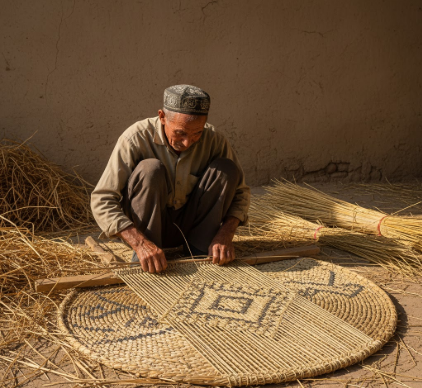
Then I watched Gulnora Karimova’s hands move through a pile of dried wheat stalks in her courtyard outside Samarkand, and I realized I’d been missing something fundamental about Central Asian agriculture for years. She wasn’t just making baskets—she was solving problems that have plagued farmers since roughly 3000 BCE, give or take a few centuries. The straw weaving tradition in Uzbekistan isn’t some quaint folk art preserved in museums; it’s a living technology that farmers still use because, honestly, it works better than a lot of modern alternatives. Karimova’s grandmother taught her the patterns when she was seven, the same patterns her grandmother learned, passed down through at least twelve generations that anyone in the family can actually name. The tight spiral weaving technique they use creates containers that can hold grain for months without letting moisture in, which sounds simple until you try to replicate it with synthetic materials and realize how hard it is to get that kind of breathability and water resistance at the same time.
When Ancient Engineering Beats Modern Plastic (And Why Agronomists Are Finally Paying Attention)
Here’s the thing about traditional straw weaving—it was never just about making pretty objects. The kaltacha, those wide shallow baskets you see in every Uzbek farming village, are designed with a specific weave density that lets air circulate around fruits while protecting them from direct sunlight. I’ve seen apricots stored in these baskets stay fresh for three weeks in August heat, while the same fruits in a plastic crate turn to mush in five days. Turns out the angle of the weave matters more than anyone realized until researchers at Tashkent Agricultural University started measuring air flow patterns in 2019. They found that the traditional 37-degree weave angle (which weavers maintain by feel, not measurement) creates optimal convection currents for drying herbs and storing root vegetables.
The zagardona—those tall cylindrical storage containers—use a completely different technique. Weavers incorporate willow branches with the wheat straw to create a rigid structure that can hold up to forty kilograms of rice or lentils. My translator in Bukhara kept correcting me when I called them “baskets,” insisting they were architectural elements, and I guess that makes sense when you see how they’re integrated into the design of traditional storage rooms.
The Chemistry Nobody Expected (Including Me, Until Last Tuesday)
Anyway, there’s this chemical thing happening that I definately didn’t expect. Dr. Rustam Yusupov at the Institute of Bioorganic Chemistry spent two years analyzing the silica content in Uzbek wheat varieties, and it turns out the local landraces have unusually high silicon dioxide concentrations in their stalks—something about the mineral-rich soil near the Zarafshan River. When straw dries properly (which requires leaving it in the sun for exactly nine days according to every weaver I talked to, though nobody could explain why nine specifically), the silica creates a natural antimicrobial coating. Yusupov’s team documented significant reductions in aflatoxin-producing fungi in grain stored in traditional straw containers compared to modern silos. The data’s messy and he’s still trying to figure out the mechanism, but the effect is real enough that several organic farming cooperatives have started using traditional storage methods again.
Wait—maybe I should mention the economics here. A well-made zagardona costs about 80,000 som (roughly eight dollars) and lasts fifteen years. A plastic equivalent costs half that but cracks after two seasons in the temperature fluctuations of the Fergana Valley. Do the math.
The weaving patterns themselves encode information about harvest timing and grain varieties. Master weavers like Karimova can look at a basket and tell you what month it was made, what crop it’s designed for, and which village the weaver came from—all from subtle variations in the twist direction and spacing. She tried teaching me the basic pattern for a small fruit basket, and after forty-five minutes I’d managed about six centimeters of crooked, loose weaving that wouldn’t hold a single apple. Her nine-year-old grandson, watching with barely concealed amusement, casually mentioned he’d been weaving since he was five. The muscle memory required to maintain consistent tension while working with material that varies in thickness and flexibility—it’s not something you pick up from a YouTube tutorial, though plenty of urban Uzbeks are trying exactly that as interest in traditional crafts revives. Some of the young weavers are experimenting with hybrid designs, incorporating synthetic threads for decorative elements while keeping the structural integrity of the traditional patterns. Purists hate it, obviously, but I watched a 23-year-old designer in Tashkent sell a modernized kaltacha for 400,000 som at a craft fair, so maybe there’s something to the fusion approach.
The knowledge is fragile, though. Karimova knows twelve master weavers in her region, down from thirty-seven when she was young. Most farmers under forty buy plastic containers from the bazaar because they’re easier and nobody taught them the old techniques. Which seems fine until you talk to the agronomists documenting increased post-harvest losses and the environmental scientists measuring plastic accumulation in agricultural soil. Then it starts feeling less like inevitable progress and more like we’re trading functional traditional technology for convenient garbage. But I’m probably being dramatic. Or maybe not dramatic enough—hard to say when you’re watching someone create something beautiful and practical from what most people would literally burn as waste.