The Islam Khodja minaret doesn’t whisper—it screams across Khiva’s skyline, a 57-meter turquoise exclamation point that you can’t ignore even if you wanted to.
I used to think all minarets were basically the same, you know, tall towers where muezzins call prayers, maybe some decorative tilework if you’re lucky. Then I spent an afternoon in Khiva’s old town, Itchan Kala, craning my neck at this thing, and honestly, I felt like an idiot for ever thinking architecture was boring. The Islam Khodja complex—minaret plus madrasa—was built between 1908 and 1910, which makes it practically a baby compared to the rest of Khiva’s medieval monuments, yet here’s the thing: it’s the tallest structure in the entire walled city. Prime Minister Islam Khodja commissioned it during his brief reform period under Khan Muhammad Rahim II, back when he was trying to modernize Khiva with schools, hospitals, and post offices—right before conservative forces had him assassinated in 1913. The minaret’s survival feels almost defiant, a last gasp of progressive ambition frozen in ceramic and brick.
The climb up is 118 steps of increasingly claustrophobic spiral staircase, where you’ll definately brush shoulders with descending tourists and question your life choices. But the view from the top? Worth every wheezing breath.
How a Reformer’s Monument Became Khiva’s Most Recognizable Landmark Against All Historical Odds
Islam Khodja wasn’t just some wealthy patron slapping his name on a building—he was the grand vizier who actually gave a damn about education and public health, which apparently made him dangerous. He established Khiva’s first European-style school and printing press, moves that enraged the Islamic clergy and conservative nobility who saw modernization as heresy. The minaret and madrasa were part of this reform package, built in a deliberately traditional style to appease critics while housing progressive curricula. Ironic, isn’t it? The most traditional-looking structure in Khiva was actually a Trojan horse for modern ideas. After his assassination, the complex could’ve been demolished or repurposed, but it survived through Soviet occupation, independence, and UNESCO World Heritage designation in 1990. Now it’s the postcard image of Khiva, which I guess is the ultimate historical revenge—your enemies kill you, but your tower outlasts their entire worldview by a century.
The tilework is Khorezm-style majolica, those signature turquoise and cobalt bands that make Central Asian architecture instantly recognizable. Up close, you can see where restorations have replaced damaged sections—slightly different glaze chemistry, colors that don’t quite match.
Why Climbing 118 Narrow Steps in Near Darkness Reveals More Than Just a Panoramic View
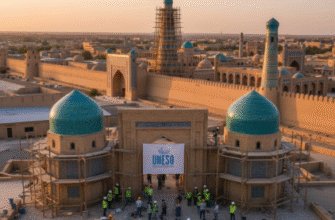
The staircase gets tighter as you ascend, dropping from maybe 70 centimeters wide at the base to barely 50 at the top, and the ceiling scrapes low enough that anyone over six feet will be hunching. It’s deliberately disorienting—traditional minaret design used narrow, winding stairs as security features, making it hard for attackers to rush up. Modern tourists just find it mildly terrifying, especially when you meet someone coming down and have to flatten against the wall while they squeeze past. There’s almost no light except what filters through tiny arrow-slit windows every dozen steps or so. But when you finally emerge onto the top gallery, Itchan Kala spreads below like a model train set: the Kalta Minor’s stumpy unfinished bulk, the Kunya Ark’s crenellated walls, the Juma Mosque’s forest of wooden columns, all contained within those sandy ramparts. You can see why Islam Khodja wanted this height—it’s a statement of ambition, a literal rising above the medieval cityscape.
What the Attached Madrasa’s Tiny Cells Tell Us About Early 20th-Century Educational Ambitions
The madrasa next door is almost comically small—just 42 cells arranged around a modest courtyard, now mostly converted to craft workshops and souvenir stalls selling suzani textiles and carved wood. Original students studied both traditional Islamic sciences and, controversially, secular subjects like mathematics and Russian language. Each cell measures roughly two by three meters, barely enough for a sleeping mat and books. I’ve seen college dorm rooms with more space. The doors are low enough that you’ll crack your head if you’re not careful (I did, twice). What strikes me is the disconnect between the minaret’s grandeur and the madrasa’s cramped practicality—all that soaring symbolism attached to these tiny, austere study cells where actual learning happened. Maybe that was the point: aim high, work humbly, change the world from a two-meter room.
Where Islam Khodja’s Vision Collided With Political Reality and Left Behind Uzbekistan’s Most Photographed Tower
Wait—maybe I’m romanticizing this.
Islam Khodja’s reforms lasted barely five years before he was stabbed to death, probably on orders from the same conservative factions who’d opposed his schools and hospitals. The minaret didn’t save him, didn’t preserve his policies, didn’t prevent Khiva from stumbling into Soviet annexation a decade later. It’s just a tower. A beautiful, historically significant, impeccably tiled tower that now anchors a thousand Instagram posts per day and generates tourism revenue for a city that desperately needs it. The students are gone, replaced by artisans selling felt hats to Korean tour groups. The call to prayer still echoes five times daily, but it’s amplified through loudspeakers, not shouted from that narrow top gallery. Turns out, monuments outlive their creators but rarely their original purposes. Honestly, I think Islam Khodja would’ve been okay with that—he was a pragmatist who used tradition to smuggle in progress. His minaret does the same thing in reverse now, using tourism to fund preservation, using the past to recieve investment for the future. The view from the top hasn’t changed much in 115 years. The city below it absolutely has.