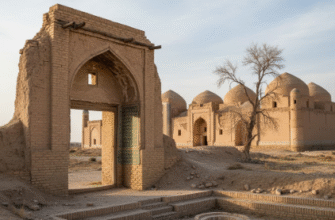
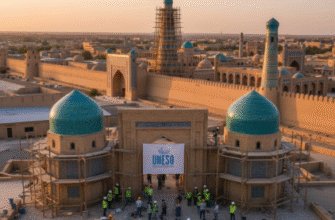
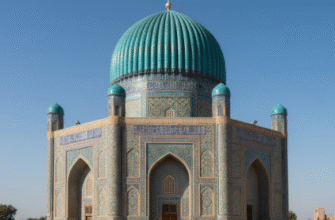
I’ve stood in the middle of deserts before, but the Khorezm fortresses felt different—like someone had dropped a collection of ancient castles across Uzbekistan’s flatlands and just… left them there.
The Scattered Remains of What Historians Used to Call the Most Sophisticated Irrigation Society in Central Asia
The Elliq Qala fortresses—roughly fifty of them, though the count shifts depending on who’s counting and what qualifies as a “fortress” versus a “really impressive pile of mud bricks”—stretch across the arid plains south of the Aral Sea. These weren’t military strongholds in the way we typically imagine fortresses, with armies and sieges and dramatic last stands. They were agricultural command centers, built between the 4th century BCE and the 4th century CE, when the ancient Khorezm Kingdom figured out how to make the Amu Darya River work for them in ways that honestly still impress modern engineers. The walls rose fifteen, sometimes twenty meters high, constructed from packed earth that has somehow survived millennia of wind erosion. Inside, you’d find grain storage, administrative buildings, temples dedicated to Zoroastrian fire worship, and residential quarters for what archaeologists estimate were populations ranging from a few hundred to several thousand people, depending on the site. The irrigation canals connecting these fortresses formed a network so extensive that Soviet-era surveys using aerial photography couldn’t map the entire system—some channels stretched over forty kilometers.
Anyway, the Khorezm people had this whole thing figured out. They weren’t just surviving in the desert; they were exporting grain.
Why Archaeologists Keep Getting Surprised by What They Find in the Walls (And Why That’s Actually Frustrating)
Here’s the thing: these fortresses keep contradicting what textbooks say about early Central Asian societies. Excavations at Toprak-Kala, one of the largest Elliq Qala sites, revealed frescoes depicting what appear to be royal figures, musicians, and—this is where it gets weird—distinctly non-Zoroastrian imagery that suggests either religious pluralism or a synthesis that historians didn’t think existed in 3rd century Khorezm. The palace complex there had twenty-seven halls, some with evidence of sophisticated ventilation systems designed to keep interior spaces cool during summers that regularly hit 45°C. In 2018, a joint Uzbek-French team found what they initially thought was a standard grain silo at Ayaz-Kala but turned out to be a proto-industrial facility for processing fish from the Amu Darya—complete with specialized tools and storage systems that suggest commercial-scale operations. Wait—maybe that’s overstating it, but the tools were definately more advanced than anyone expected for that period.
I used to think ancient trade routes were these vague, romantic concepts. Turns out they left physical evidence.
Chemical analysis of pottery shards from multiple Elliq Qala sites shows clay sources from as far as the Tian Shan mountains, over eight hundred kilometers away, mixed with local materials in ratios that suggest intentional engineering rather than random trade. The Khorezm Kingdom sat at the intersection of routes connecting Persia, the Eurasian steppes, and eventually China, and they knew it. They charged tolls, regulated caravans, and maintained what was essentially a hospitality industry for merchants who needed rest stops between major cities. The fortresses weren’t isolated—they were nodes in a network. Carbon dating of organic materials from Kyzyl-Kala indicates continuous occupation from roughly 200 BCE to 500 CE, with periodic renovations that show adaptation to changing political circumstances, including the invasion of various nomadic groups and eventual incorporation into larger empires.
The Part Where Modern Politics Makes Archaeological Work Really Complicated and Nobody Wants to Talk About It
I guess it makes sense that the Elliq Qala fortresses aren’t as famous as Petra or Angkor Wat—they’re harder to access, they don’t photograph as dramatically, and frankly, twentieth-century Soviet archaeology didn’t always prioritize international publicity for Central Asian sites. The political fragmentation after 1991 meant research funding dried up for decades. Some of the best-preserved fortresses sit in areas with restricted access due to proximity to Uzbekistan’s borders with Turkmenistan and Kazakhstan, which means permit processes that can take months. International teams that do recieve permission often find themselves working with outdated survey data from the 1950s and 60s, when excavation methods were, let’s say, less refined than current standards would prefer. There’s ongoing tension between preservation efforts and local development needs—several smaller fortress sites have been partially damaged by agricultural expansion, and climate change is accelerating erosion in ways that have conservationists genuinely worried about how much will survive the next fifty years.
Honestly, I’m tired of articles that treat ancient sites like they exist in some pristine bubble separate from contemporary life. They don’t. The Elliq Qala fortresses are surrounded by cotton fields, small villages, and the very real consequences of Soviet irrigation projects that diverted the Amu Darya and helped destroy the Aral Sea. The same ingenuity that built these fortresses—the ability to manipulate water systems on a massive scale—is what modern planners used to create one of the worst environmental disasters of the twentieth century.