I used to think ancient fortresses were basically just walls and towers, maybe some crumbling gates if you were lucky.
Then I started reading about Kampir Tepe, this sprawling citadel near Termez in southern Uzbekistan, and honestly, the whole thing unraveled my assumptions. The fortress sits on a natural terrace overlooking the Amu Darya River—what the Greeks called the Oxus—and it was a critical stronghold for the Kushan Kingdom, roughly between the 1st and 4th centuries CE, give or take a few decades depending on which archaeologist you ask. The Kushans weren’t just warriors; they were merchants, diplomats, cultural synthesizers who absorbed Hellenistic, Persian, Indian, and Central Asian influences into something that defied easy categorization. Kampir Tepe was one of their northern anchors, a place where trade caravans paused, where Buddhist monks might have debated philosophy with Zoroastrian priests, where goods from China mingled with Roman glassware. The site covers roughly 35 hectares, and excavations have revealed fortification walls, residential quarters, ceramic workshops, and what appear to be administrative buildings with traces of elaborate frescoes.
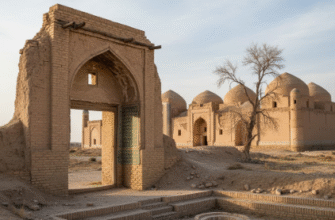
Walking through the remains today—or rather, imagining walking through them based on archaeological reports, since I’ve never actually been—you get this sense of controlled chaos. The walls are thick, maybe four meters in some sections, built with mud brick and fired brick in alternating courses. There’s evidence of repeated reconstruction, layers upon layers, suggesting the place got hammered by invaders or natural disasters and kept getting rebuilt.
The Fortress That Refused to Stay Dead, Even When Empires Collapsed Around It
Here’s the thing: Kampir Tepe didn’t just survive because of its walls.
It survived because of its location and its pragmatism. The Kushan Empire at its height controlled territory from the Aral Sea down into northern India, and Termez—ancient Tarmita or Tamiassa, depending on the source—was a critical node in that network. Kampir Tepe guarded river crossings, monitored trade routes, collected tariffs, and probably served as a military garrison when threats loomed from the northern steppes. But it was also a cosmopolitan hub, a place where languages and religions collided in ways that feel strangely modern. Archaeologists have found Greek inscriptions, Bactrian graffiti, Indian-style pottery, and Chinese coins at the site, all jumbled together in the same stratigraphic layers. The Kushans were Buddhists—or at least their rulers publicly patronized Buddhism—but they also minted coins with images of Greek gods, Persian deities, and even the Buddha himself, sometimes on the same coin. Kampir Tepe reflects that eclecticism, that willingness to borrow and adapt whatever worked.
I guess it makes sense when you think about it. The Silk Road wasn’t a single road; it was a web of routes, and controlling a place like Kampir Tepe meant controlling access to that web. Merchants traveling from Bactria to Sogdiana, or from India to the steppes, had to pass through Termez, and Kampir Tepe was the gatekeeper.
What Happens When You Dig Beneath a Fortress and Find a Monastery Instead
Wait—maybe the most surpising thing about Kampir Tepe isn’t the fortress at all, but what lies beneath it. Soviet-era excavations in the 1970s and 1980s, followed by international teams in the 2000s, uncovered earlier layers predating the Kushan period, including what might be a Greco-Bactrian settlement from the 3rd or 2nd century BCE. Below that, there are hints of even older occupation, possibly Achaemenid Persian or earlier, though the evidence gets murky. And then, just when you think the site is all military pragmatism, they find a Buddhist monastery complex adjacent to the main fortification, complete with stupas, monks’ cells, and fragments of terracotta statues. The monastery dates to roughly the 2nd or 3rd century CE, right in the middle of the Kushan period, and it suggests that Kampir Tepe wasn’t just a fortress—it was a pilgrimage site, a center of learning, maybe even a place where diplomatic negotiations happend under the guise of religious gatherings.
Turns out, fortresses can be monasteries, and monasteries can be fortresses, and the Kushans didn’t see much distinction between the two. Defense and devotion, commerce and contemplation—they all bled into each other at places like Kampir Tepe. The archaeological record is messy, full of contradictions and gaps, but that messiness is part of the story. Empires rise and fall, walls crumble, rivers change course, and yet people keep rebuilding, keep adapting, keep finding ways to survive.
Anyway, if you ever find yourself near Termez, Kampir Tepe is worth the detour, even if most of what you see are just foundations and eroded walls. The real story is in what you can’t see—the invisible networks of trade and religion and power that made this place matter for centuries, long after the Kushan Kingdom itself had faded into history.