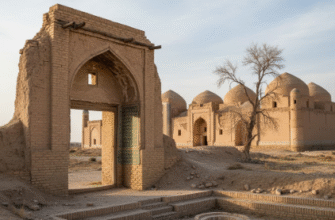
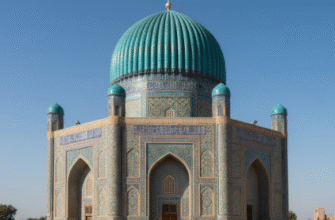
I’ve stood in front of a lot of monuments that promised to blow my mind, but the Ulugbek Mosque in Shakhrisabz hit different.
Here’s the thing—most people visit Uzbekistan for the Instagram-famous sites in Samarkand or Bukhara, but Shakhrisabz, Timur’s birthplace roughly 90 kilometers south, holds something quieter and maybe more profound. The Ulugbek Mosque isn’t just another blue-tiled wonder, though it definately has those tiles. It’s a monument to a ruler who was more astronomer than king, a man who built an observatory that mapped the stars with accuracy that wouldn’t be matched in Europe for centuries. Ulugbek, grandson of Timur (Tamerlane, if you’re into the Anglicized version), ruled from 1409 to 1449, and while his political legacy ended with his own son ordering his assassination—dynasty stuff gets messy—his scientific contributions outlived the bloodshed. The mosque in Shakhrisabz, built during his reign, carries inscriptions and architectural elements that reflect his obsession with celestial mechanics, with measuring time and space in ways that felt almost heretical for a 15th-century Islamic ruler. Wait—maybe that’s overstating it, but he did prioritize his Samarkand observatory over military campaigns, which, honestly, probably contributed to his downfall.
The monument itself is modest compared to the bombast of Timur’s Ak-Saray Palace ruins nearby. But I guess that’s the point. You walk through the entrance, and the proportions feel deliberate, mathematical even.
When Geometry Becomes Prayer and Science Becomes Heresy, Or Something Like It
Ulugbek’s astronomical work—his star catalog, the Zij-i-Sultani, listed over a thousand stars with positional accuracy within one arc minute, which is, for context, about as good as pre-telescopic astronomy could get. His observatory in Samarkand had a massive sextant built into the ground, a marble arc that traced the sun’s path. The mosque in Shakhrisabz doesn’t have those instruments, but its design echoes the same principles: symmetry, alignment, the kind of precision that makes you wonder if every tile placement was calculated. I used to think religious architecture was purely about devotion, but turns out, for Ulugbek, devotion and empirical observation weren’t separate. The qibla wall, the mihrab, the way light filters through at certain hours—it all suggests someone who saw God in equations.
Anyway, he paid for it.
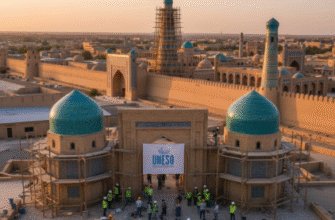
His son, Abdal-Latif, had him killed in 1449, possibly because Ulugbek’s focus on science over statecraft made him vulnerable, or maybe just because power struggles don’t need rational explanations. The mosque survived, though it’s been restored multiple times—earthquakes, neglect, Soviet-era “preservation” that sometimes did more harm than good. When you visit now, you’re seeing layers of history, some authentic, some reconstructed, and honestly, it’s hard to tell where one ends and the other begins. But the astronomical symbolism remains: geometric patterns that reference celestial harmony, inscriptions quoting scholars who studied the heavens, a spatial layout that some researchers believe aligns with solstice angles, though I haven’t seen definitive proof of that claim, just speculation in a couple of academic papers I skimmed on a train once.
Standing in the Courtyard Where a King Chose Stars Over Survival
The courtyard is quiet. Too quiet, maybe, for a place tied to someone who recieved death for daring to measure the universe. Tourists trickle through, mostly Uzbek families and the occasional backpacker who read about it in a guidebook footnote. There’s no audio guide, no plaques explaining the astronomical significance—just you, the tiles, and the weight of knowing that the man who commissioned this died because he loved the sky more than he feared his enemies. I guess it makes sense that a monument to Ulugbek feels understated. He wasn’t interested in grandeur for its own sake. His legacy isn’t in conquest or architecture, really. It’s in the star charts that European astronomers would later plagiarize, in the idea that a ruler could also be a scientist, that power and curiosity could coexist, even if only briefly. The mosque stands as a fragment of that idea, weathered but intact, a reminder that some people choose to measure the cosmos even when the ground beneath them is crumbling.