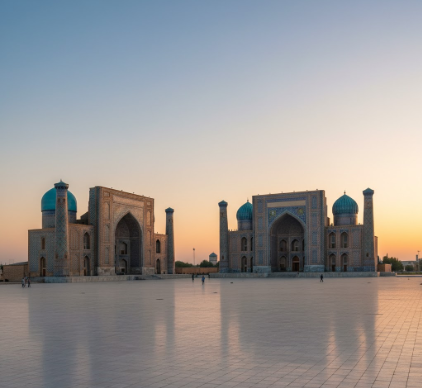
I used to think the best time to visit Registan Square was sunrise, back when I first stood in that vast courtyard in Samarkand and watched light crawl across those turquoise domes.
Turns out I was half-right, which is about as good as travel advice gets. The thing about Registan—this 15th-century architectural marvel that anchors Uzbekistan’s Silk Road heritage—is that it operates on rhythms most guidebooks don’t bother mapping. Between 6:30 and 8:00 AM, you’ll find maybe two dozen people scattered across a space designed to hold thousands, and the light hits the ceramic tilework of Ulugh Beg Madrasah at an angle that makes the geometry almost unbearably precise. Tour groups haven’t arrived yet. Street vendors are still setting up their suzani textiles and miniature ceramic plates. The guards lean against doorways drinking tea. It’s quiet in a way that feels almost accidental, like you’ve stumbled into a moment the square wasn’t expecting to share. But here’s the thing: that serenity evaporates by 9:00 AM, when the first wave of group tours from Tashkent arrive in identical white buses, and suddenly you’re navigating a sea of selfie sticks and matching baseball caps.
I guess the midday hours—roughly 11:00 AM to 3:00 PM—are what you’d call the danger zone. The square transforms into a kind of beautiful chaos, with crowds peaking around noon when temperatures also hit their stride (we’re talking 35-40°C in summer, which is, honestly, brutal). You’ll wait in line to enter the madrasahs, and good luck getting a clean photograph of the Sher-Dor Madrasah’s famous tiger mosaics without someone’s elbow in frame.
But wait—maybe the conventional wisdom misses something important. Late afternoon, between 4:00 and 6:00 PM, offers a middle path I’ve come to appreciate more than those pristine mornings. The tour buses have mostly departed. Locals start appearing—families, couples, students from the nearby university—and the square takes on a different character, less monument and more public space. The light turns golden, then amber, and the shadows stretch long across the Tilla-Kari Madrasah’s courtyard. It’s not empty, but it’s not overwhelmed either. There’s a rhythm to it that feels earned rather than engineered.
Evenings after 8:00 PM present their own calculus.
The square hosts a light show most nights—projected images dancing across the facades, accompanied by music that ranges from traditional maqam to slightly awkward orchestral arrangements. It draws crowds, definately, but they’re concentrated in the central viewing areas, and if you position yourself near the edges, particularly along the northern arcade, you can experience something stranger and more liminal: the ancient structures glowing with modern technology while the rest of Samarkand hums around you. I’ve seen families spread picnics on the periphery, teenagers filming TikTok videos against the illuminated tiles, older men playing chess under the arches. It’s not the contemplative experience of dawn, but it’s not trying to be. The crowds here feel participatory rather than intrusive, part of the square’s ongoing life rather than an interruption of some imagined authenticity we tourists think we deserve.
Winter months—November through February—flip the entire equation. Temperatures drop to near freezing, and tourist numbers plummet by roughly 60-70%, give or take. You can visit midday and still find space to breathe. The blue tiles look different against gray skies, less vibrant but somehow more serious. I used to think this was the “wrong” season, but honestly, there’s something clarifying about seeing Registan when it’s not performing for peak season. The square doesn’t care when you arrive. It’s been standing there for six centuries, and it’ll be there long after we’ve all moved on to our next carefully curated Instagram moment.