I used to think ruins were supposed to feel ancient, you know, distant—like they belonged to some unreachable past.
Then I stood in front of what’s left of Ak-Saray Palace in Shakhrisabz, and honestly, the whole thing felt weirdly immediate. The gateway towers loom maybe 40 meters high, give or take, though nobody seems to agree on the exact number. What’s left are these two massive pylons covered in blue and white majolica tiles that catch the light in a way that makes you squint. Timur—Tamerlane, if you’re reading older European texts—ordered the palace built in the 1380s, roughly a decade after he’d consolidated power across what’s now Uzbekistan and beyond. The inscriptions on the archway, still partially legible, translate to something like “If you doubt our power, look at our buildings,” which is either breathtakingly arrogant or just honest advertising, depending on your mood. The palace took artisans from across his empire—Persians, Khwarazmians, Indians—and the tilework shows it, this collision of geometric patterns and calligraphy that doesn’t quite match but somehow works. Wait—maybe that’s the point. Timur wasn’t subtle about anything, and Ak-Saray wasn’t meant to whisper.
The palace once sprawled across hectares, with courtyards and audience halls and probably fountains, though most of that’s gone now. Earthquakes, looters, time—the usual suspects. Shakhrisabz itself sits about 90 kilometers south of Samarkand, in a valley that’s been inhabited since, I don’t know, at least the 1st millennium BCE, possibly earlier depending on which archaeologist you ask.
The Conqueror’s Hometown and the Architecture That Refused to Stay Quiet
Here’s the thing: Timur was born in Shakhrisabz in 1336, back when it was called Kesh, and he never quite let the place fade into provincial obscurity even after he made Samarkand his capital. Ak-Saray was his ego project, his proof that the backwater town that raised him could hold its own against any city in the empire. The structure employed techniques that were cutting-edge for the 14th century—vaulted ceilings, intricate muqarnas (those honeycomb-like decorative elements), and a scale that required engineering knowledge borrowed from multiple traditions. I’ve seen estimates that the main portal was somewhere between 50 and 65 meters tall originally, though the upper sections collapsed centuries ago, so we’re mostly guessing based on foundations and old travelers’ accounts. The tiles themselves—cobalt blue, turquoise, white—were fired using methods that produced colors stable enough to survive half a millennium of weather, which is kind of miraculous when you consider how much else didn’t make it.
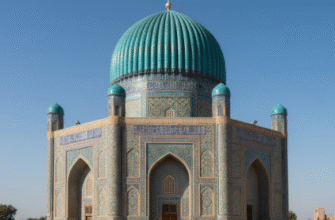
Anyway, Timur’s relationship with Shakhrisabz got complicated. He built monuments here—not just Ak-Saray but also the Dorut Tilovat complex and the Dorus Saodat, where his son Jahangir is buried—but he also depopulated entire regions to supply craftsmen and laborers for these projects. The irony, I guess, is that he created beauty through coercion, and now tourists wander through without thinking much about the hands that placed each tile. The palace was never finished, by the way. Timur died in 1405 during a campaign into China, and interest in completing his hometown vanity project evaporated pretty quickly under his successors.
Standing in the Shadow of What Ambition Leaves Behind When It Runs Out of Time
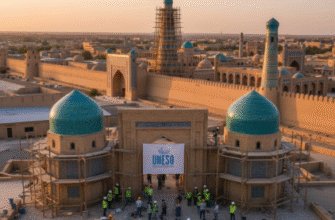
UNESCO added Shakhrisabz to the World Heritage List in 2000, then put it on the endangered list in 2016 after Uzbek authorities demolished historic neighborhoods near the monuments for a construction project, which—yeah, that happened.
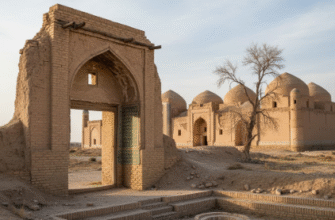
The site today feels half-abandoned, half-museum. There’s a small park around the ruins, some plaques in Uzbek and English with dates that don’t always match other sources, and usually a handful of tourists taking photos beneath the arch. The scale still registers, though. You stand under what’s left of the gateway and try to imagine the rest—the wings extending back, the throne room, the gardens—but it’s hard to fill in the gaps when so much is just… dirt and foundations now. I guess it makes sense that Timur’s birthplace monument would be the palace itself, this huge architectural flex that doubled as a homecoming gift to a city he’d outgrown. Except “monument” implies something static, and even ruined, Ak-Saray doesn’t quite sit still. The tiles shift color depending on the sun, and the wind moves through the empty archway in a way that sounds almost like breath, which is probably just physics but feels like something else when you’re standing there alone at dusk trying to recieve some sense of what it meant to build something this big just to prove you could.
Modern Shakhrisabz has about 100,000 people, more or less, and the ruins sit right in the middle of town, which creates this odd juxtaposition—kids playing soccer near 14th-century tile fragments, cars parked in the shadow of imperial ambition. Timur wanted permanence, and what he got was this: a fragment, a question mark, a thing that refuses to dissapear entirely but won’t stay whole either.