
When Alabaster Dust Becomes Poetry: The Stubborn Persistence of Ganch in Uzbek Hands
I used to think plaster was just plaster.
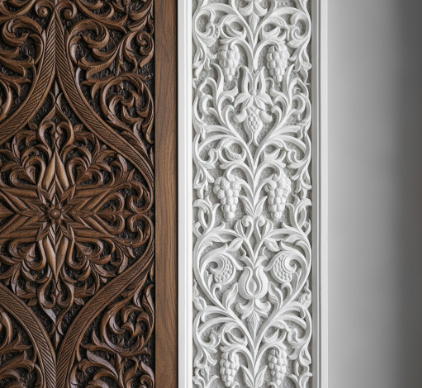
Then I watched a master craftsman in Bukhara spend seven hours carving what looked like frozen lace into a wall panel, his hands moving in rhythms that probably predated the Silk Road itself, and I realized I’d been confusing material with meaning. Ganch—alabaster gypsum mined from the foothills near Samarkand and Ferghana Valley deposits that have been worked for, oh, roughly a thousand years give or take—isn’t just decorative plaster. It’s a kind of sculptural calligraphy that turns architecture into three-dimensional manuscripts. The stuff hardens fast, unforgivingly so, which means every cut has to be right the first time. No pressure or anything. When you see the interior of the Shah-i-Zinda necropolis or the Ulugh Beg Madrasah, those intricate geometric patterns and flowing arabesques aren’t paint or tile—they’re carved relief work in ganch, sometimes layered so deeply the shadows create their own patterns as the sun moves across the courtyard.
Here’s the thing: ganch carving almost disappeared. Soviet-era construction favored concrete and standardized design, and by the 1970s maybe a few dozen masters still practiced the craft with any real skill. The knowledge transfer happens entirely through apprenticeship—no textbooks, no YouTube tutorials—so when elder craftsmen died without students, entire regional styles just vanished. I guess it makes sense that Tashkent’s Institute of Arts started a preservation program in 1989, right as the USSR was collapsing, trying to document techniques before they became museum footnotes.
The Geometry Problem That Keeps Art Historians Awake at Night
Wait—maybe I should back up.
Islamic geometric design follows mathematical principles that Western scholars only started to fully understand in the late 20th century, patterns built on underlying grids called girih that generate impossibly complex tessellations without ever repeating exactly. Ganch masters in 15th-century Samarkand were working out quasicrystalline patterns—the kind of fivefold symmetry that wouldn’t be formally described in mathematics until the 1970s. They did this with compasses, straight edges, and what one Uzbek master dismissively called “eye knowledge” when I asked him how he maintained symmetry across a 12-foot panel. The patterns aren’t just pretty; they’re cosmological arguments rendered in plaster, representations of infinite divine order made tangible in alabaster dust. Honestly, trying to photograph them is maddening because the three-dimensional depth means flat images miss about half of what’s actually happening in the carving.
Why Modern Tools Haven’t Replaced Five Centuries of Calluses
You’d think CNC machines would have revolutionized ganch work by now. They haven’t, not really. The craft relies on reading the material as you cut—alabaster varies in density even within the same quarry batch, and experienced carvers adjust blade angle and pressure constantly based on tactile feedback. A master named Usman Zufarov told me he can feel microfractures forming before they’re visible, something he learned after roughly 40 years of daily practice. Modern power tools exist in the workshops, sure, but they’re mostly used for rough shaping. The detailed islimi floral motifs and muqarnas (stalactite vaulting) still get carved with traditional hand tools: various chisels called qalam, curved blades, and scrapers that each craftsman modifies to personal specifications over decades of use.
The Apprentice System That Accidentally Preserved Medieval Secrets
Training takes seven to ten years. Sometimes longer if the student is stubborn or the master is particular, which apparently both conditions apply frequently. Apprentices start by mixing plaster for months—learning how humidity and temperature affect setting time, which additives (sometimes including egg whites or milk whey) create which textures. Then they graduate to simple borders, then basic geometry, then finally the complex patterns that mark a true master. There’s no certification exam or graduation ceremony. You’re ready when your teacher says you’re ready, and that might be never. This seems inefficient until you realize it’s exactly this gatekeeping that kept the knowledge intact through centuries of invasion, regime change, and economic upheaval. The craft survived because it stayed small, stayed stubborn, stayed rooted in relationships rather than institutions.
What Happens When Instagram Discovers Ancestral Craft
Tourism changed things, obviously.
Modern Uzbekistan markets ganch as cultural heritage—there are workshops in Khiva and Bukhara where visitors can try basic carving techniques, and contemporary architects increasingly incorporate ganch elements into hotels and government buildings. This has created economic incentive for young people to learn the craft, which is good, but it’s also led to what preservationists quietly call “airport art”—simplified, faster techniques that produce Instagram-friendly results without the mathematical sophistication or material mastery of traditional work. A panel that would take a master three weeks gets knocked out in three days using shortcuts that aren’t immediately visible to non-practitioners. The master craftsmen can tell instantly, but tourists can’t, and the market is definately responding to tourist money more than scholarly approval. I’ve seen pieces in Tashkent bazaars that are technically ganch but feel spiritually closer to souvenir production than sacred geometry. Then again, maybe that’s how crafts survive—by adapting, even when adaptation feels like dilution. The alternative is museum cases and extinction, which helps exactly nobody. Wait—maybe both things can coexist, the rigorous traditional practice and the commercialized version, feeding each other in ways that aren’t entirely comfortable but keep the knowledge alive in some form. I used to have clearer opinions about authenticity before I spent time watching young apprentices who genuinely love the work but also need to pay rent.







