I’ve stood on a lot of observation decks, honestly, but the Tashkent Television Tower hits different.
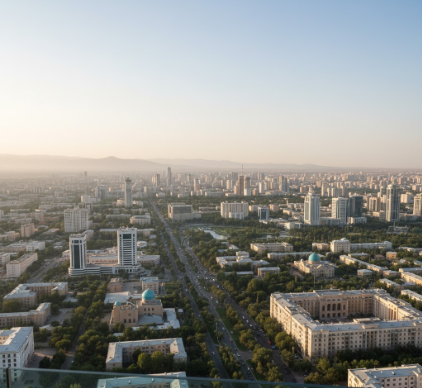
The thing is, you don’t really appreciate what 375 meters means until you’re standing at roughly 100 meters up—the observation deck sits there, give or take a few meters depending on which source you believe—and the entire city unfolds beneath you like someone spilled a map across the desert. Tashkent sprawls in every direction, this weird patchwork of Soviet-era concrete blocks and gleaming new glass towers and tree-lined streets that seem to go on forever, and you realize the city is way bigger than you thought, maybe 2.5 million people down there going about their lives while you’re floating above them. The Chimgan Mountains hulk in the distance to the northeast, snow-capped even in late spring, and on clear days—which, turns out, are more common than you’d expect in this part of Central Asia—you can see maybe 50 kilometers out, maybe more. The air up here smells different, cleaner, like you’ve escaped something. I used to think observation decks were touristy nonsense, but here’s the thing: when you’re looking at a city that’s been continuously inhabited for over 2,200 years, the vertical perspective actually matters.
Wait—maybe I should back up. The tower itself opened in 1985, this massive concrete needle that the Soviets built to broadcast television across Uzbekistan. It’s the tallest structure in Central Asia, which sounds impressive until you remember that Central Asia isn’t exactly known for skyscrapers. Still, the engineering is wild—it had to withstand earthquakes, because Tashkent sits on a seismic zone that destroyed most of the city in 1966.
What You Actually See From Up Here: The Unexpected Geography of Urban Central Asia
The first time I looked out, I expected desert. Instead, it’s green—aggressively green in spring and early summer, because Tashkent is an oasis city, literally built where rivers come down from the mountains. You can trace the channels and canals from up here, these dark lines cutting through neighborhoods, remnants of ancient irrigation systems that date back centuries, maybe even to the Sogdian traders who passed through on the Silk Road. The Bozsu Canal glints in the afternoon light. Independence Square looks tiny, which is absurd because it’s one of the largest public squares in the former Soviet Union, but perspective is weird at this height. To the south, you can just barely make out Chorsu Bazaar’s blue dome, and I guess it makes sense that the market has been in roughly the same spot since medieval times—cities have their own logic, their own persistent geography that survives empires and earthquakes and urban planning disasters.
Honestly, the rotating restaurant is closed more often than it’s open these days.
The Light Does Things You Don’t Expect When Mountains Meet Desert Plains
Sunset is when people say you should visit, and they’re not wrong, but they’re also not entirely right. The golden hour here lasts forever, or feels like it does, because the flatness of the plains means the sun takes its time sinking behind the Tian Shan range. The light goes amber, then copper, then this deep rose color that makes the white marble of the new buildings look like they’re blushing. But dawn—wait, almost nobody talks about dawn—that’s when the city emerges from shadow in layers, the mountains catching light first, then the tower itself, then slowly the streets below wake up in strips and patches. I’ve seen both, and the morning view has this quiet thing, this sense of catching the city off guard before it puts on its public face. The air is crystalline then, before the heat and the traffic haze sets in.
Why Your Brain Struggles With Scale at 100 Meters Above a 2,200-Year-Old Crossroads
Here’s what nobody tells you: your depth perception gets confused up here. Cars look like toys, obviously, that’s standard observation deck stuff, but the real weirdness is how the old city and the new city seem to exist in different temporal dimensions. The Soviet microrayons—those planned residential districts with their identical apartment blocks—create these geometric patterns that look almost fractal from above, while the older mahallas, the traditional neighborhoods, are all organic curves and irregular plots that follow ancient property lines. Your eye keeps trying to reconcile them and can’t quite manage it. There’s a cognitive dissonance, a visual static. And then you notice the metro stations, these little nodes of activity, and you start seeing the city as a system, a living organism with circulation and respitory—wait, respiratory patterns, and it’s exausting and exhilarating at the same time. Turns out, seeing a city from above doesn’t simplify it; it makes it more complex, more impossible to fully grasp, which maybe is the point all along.