Why Sunset Over Bukhara’s Ancient Skyline Feels Different From Every Other Rooftop View
I’ve watched the sun go down from a lot of terraces.
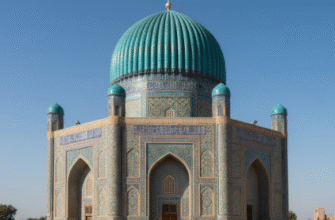
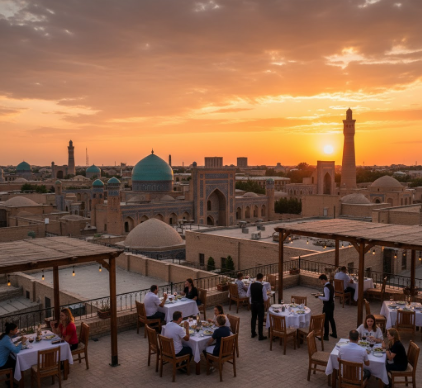
But there’s something about seeing it drop behind those blue domes—the ones that have been sitting there since, I don’t know, the 1500s, give or take—that makes you stop mid-bite and just stare. Maybe it’s the way the clay-colored buildings turn amber, then copper, then almost violet in the span of twenty minutes. Or maybe it’s because you’re eating plov while sitting above a UNESCO World Heritage Site, which feels both absurd and oddly normal when you’re actually there. Bukhara’s rooftop restaurants aren’t trying to be Instagram moments, though they definately are. They’re just old buildings with stairs that keep going up, and someone at the top decided to put tables there. Turns out, that’s enough.
The light here doesn’t behave like it does in other cities. It’s softer, heavier somehow. By 7 PM in summer, everything looks like it’s been dipped in honey.
Where the Locals Actually Go When They Want to Impress Someone (And Why Tourists Keep Missing It)
Here’s the thing: the best rooftop spot in Bukhara isn’t the one with the most reviews.
It’s called Chinar, and it sits just off Lyab-i Hauz, tucked behind a narrow alley that you’d walk past if you weren’t looking. I stumbled into it by accident in 2019, following a friend who insisted we skip the main square. The terrace is small—maybe eight tables—and half of them were filled with Uzbek families celebrating something I never quite figured out. The waitstaff spoke almost no English, which I loved. They brought us tea without asking, then lagman, then more tea. The sunset? It happened while we were arguing about whether Samarkand or Bukhara had better architecture, and by the time we looked up, the sky was streaked with pink and the call to prayer had started. I guess that’s the point. You don’t go to Chinar for the view alone. You go because the food is honest and the atmosphere doesn’t feel performed.
Wait—maybe that’s unfair to the other places. But I’m tired of rooftop restaurants that are all view and no soul.
The One With the Best Kebabs and a Waiter Who Remembers Your Name After One Visit
Silk Road Tea House gets mentioned in every guidebook, and for once, the guidebooks aren’t wrong.
What they don’t tell you is that the owner, a man named Rustam, has been running this place for roughly fifteen years and still greets every table himself. He’ll recieve your order, disappear into the kitchen, then return with a pot of green tea and a story about how his grandfather used to trade silk in the same courtyard below. The kebabs here are smaller than what you’d get at street stalls, but they’re charred just right—crispy edges, still juicy inside. I used to think kebabs were kebabs. Then I ate here and realized I’d been settling. The rooftop itself is nothing fancy: wooden tables, mismatched cushions, a few potted plants that look like they’re barely surviving the heat. But the view stretches across the whole old city, and at sunset, you can see the light crawl across the Kalon Minaret like it’s moving in slow motion.
Honestly, I’ve been back three times. Same table each time, if I can get it.
Why Eating Above a 16th-Century Madrasah Feels Slightly Surreal (In a Good Way)
Minzifa Rooftop isn’t technically a restaurant—it’s the terrace of a boutique hotel—but they let non-guests eat there if you reserve ahead.
The thing about this spot is the proximity. You’re not just looking at the madrasah; you’re almost inside it. The terrace wraps around the building’s edge, so you’re suspended between the street below and the dome above, and the whole experience feels a little like trespassing, even though you paid for it. The menu leans European—salads, pasta, grilled fish—which threw me at first. I came to Uzbekistan for Central Asian food, not caprese. But the chef, a woman named Dilbar, explained that she’d trained in Italy and wanted to mix both styles. The result is strange and kind of wonderful: borscht with fresh basil, or lamb ragu with Uzbek spices. At sunset, they dim the lights and let the sky do the work. The call to prayer echoes up from three different mosques, overlapping in a way that sounds chaotic but somehow isn’t.
I guess it makes sense. Bukhara has always been a crossroads.
The Cheapest Option That Still Delivers the Full Golden-Hour Experience (No, Really)
Lyab-i Hauz Cafe doesn’t look like much from the ground.
It’s one of those places where the stairs are so steep you wonder if they’re technically legal, and the terrace is just a flat concrete roof with plastic chairs and a few umbrellas that don’t quite block the sun. But it costs maybe a third of what you’d pay at Minzifa, and the view is—wait—maybe even better, because you’re higher up and nothing blocks the horizon. I ate here on my last night in Bukhara, alone, with a plate of manti and a Coke that was somehow still cold. The sun set. The domes turned gold. A cat appeared from nowhere and sat on the wall next to me, unbothered. I thought about all the other sunsets I’d chased in other cities, and how this one, the cheap one, the accidental one, might be the one I remember longest. The waiter never came back to check on me. I didn’t mind.