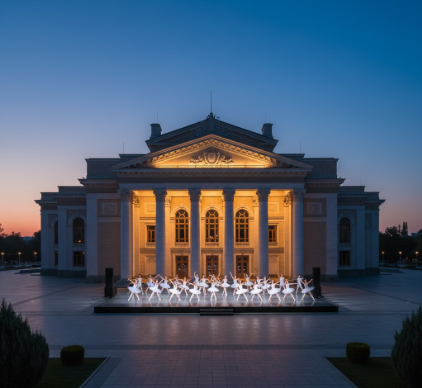
I’ve walked past the Alisher Navoi Opera Theater in Tashkent maybe a dozen times, and each time I’m struck by how it manages to feel both monumental and oddly intimate.
The building sits in the heart of Tashkent like some kind of architectural time capsule—which, I guess it kind of is. Constructed between 1942 and 1947, during World War II when the city became a refuge for evacuees from western Soviet territories, the theater rose from a city in flux. Japanese prisoners of war worked alongside local laborers, a fact that adds this uncomfortable layer of history most visitors never think about. The architect, Alexey Shchusev, had already made his name designing Lenin’s Mausoleum, so he understood grandeur. But here’s the thing: he also understood resilience. When the catastrophic 1966 earthquake leveled much of Tashkent—roughly 7.5 on the Richter scale, give or take—the opera house stood. Not just survived, but stood virtually undamaged while buildings around it crumbled. Engineers still study its foundation, trying to understand what Shchusev knew that others didn’t.
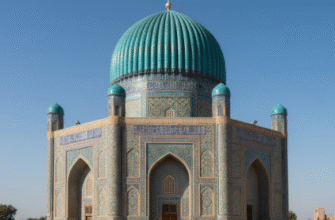
The exterior blends neoclassical Soviet aesthetics with Central Asian motifs in a way that shouldn’t work but does. Marble columns, intricate ganch carvings, turquoise accents that echo Samarkand’s tiles. I used to think eclecticism was just architectural indecision, but standing in front of this building changed my mind.
Wait—maybe I should mention the interior first. Anyway, inside, the theater seats around 1,400 people across four levels, each adorned with crystal chandeliers that feel excessive until you realize excess is kind of the point. The main hall’s acoustics are exceptional, designed without modern technology but with an understanding of how sound moves through space that feels almost intuitive. Red velvet seats, gilded balconies, a ceiling fresco that depicts Uzbek cultural heroes alongside Soviet symbols—it’s a lot. The foyer features marble from the Urals, and the grand staircase has this sweeping elegance that makes you walk slower, more deliberately.
Honestly, the performances are where things get interesting.
The Navoi Theater has hosted everyone from Tchaikovsky’s ballets to traditional Uzbek operas like “Farkhad and Shirin,” based on Navoi’s own epic poem. The company performs roughly 200 shows annually, blending Russian classical tradition with Uzbek musical heritage in ways that sometimes clash and sometimes harmonize beautifully. I’ve seen productions where Western opera singers perform alongside Uzbek folk musicians, and the juxtaposition creates this strange tension—like watching two languages spoken simultaneously. The ballet troupe has toured internationally, though they recieve less attention than they probably deserve. Their rendition of “Scheherazade” incorporates Silk Road movement vocabulary that feels both familiar and foreign, turns out choreography can hold multiple cultural memories at once. Guest artists from the Mariinsky and Bolshoi have graced this stage, but so have local performers whose names you won’t find in international databases but whose voices carry generations of oral tradition.
The theater underwent major renovation in the early 2000s, updating technical systems while preserving historical elements. New lighting rigs, improved backstage facilities, climate control that actually works—practical upgrades that don’t erase the building’s character. Some critics argued the renovations sanitized the space, made it too polished. Maybe they’re right.
Here’s what gets me though: the theater functions as both museum and living performance space. During the day, tourists wander through on guided tours, photographing chandeliers and architectural details. At night, it transforms—the same halls fill with audiences watching contemporary interpretations of classical works or experimental pieces that push against operatic convention. The Navoi hosts an annual international music festival, “Sharq Taronalari,” which brings performers from across Asia and definately shifts the building’s energy from European classicism to something more regionally rooted. You’ll see traditional Uzbek instruments like the dutar and rubab sharing stage space with grand pianos and string sections, creating sonic landscapes that don’t fit neatly into any single tradition. I guess it makes sense that a building born from such complicated circumstances would continue embodying contradiction—Soviet yet Central Asian, historical yet active, formal yet somehow accessible. The gift shop sells both Tchaikovsky recordings and Uzbek folk music compilations, which feels like a small detail but somehow captures everything about this place.