I used to think ancient walls were just piles of mud bricks that somehow survived because nobody bothered knocking them down.
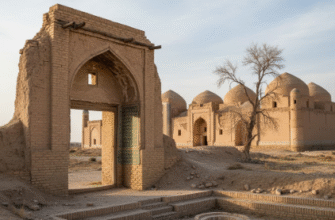
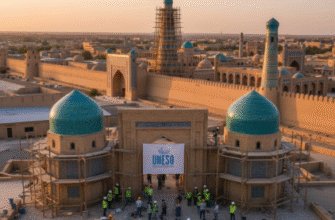
Then I spent three days in Bukhara, Uzbekistan, circling what’s left of fortifications that once stretched nearly 12 kilometers around one of Central Asia’s most strategically vital cities, and I realized how profoundly wrong I’d been. These weren’t passive barriers—they were breathing, evolving organisms of defense architecture that absorbed roughly two millennia of military innovation, from the early centuries CE through the Mongol invasions and beyond. The earliest sections, dating to somewhere around the 1st or 2nd century, were constructed from paksha—that’s rammed earth layered with reeds and straw, a technique so effective that segments still stand today despite receiving basically zero maintenance for centuries. By the time the walls reached their maximum extent in the 16th century under the Shaybanid dynasty, they’d grown to include eleven gates, each with its own tactical personality: some designed for rapid troop deployment, others for controlling merchant traffic, a few seemingly positioned just to mess with siege engineers.
Wait—maybe I’m getting ahead of myself. The thing about Bukhara’s fortifications is they never stayed still. Every conqueror who swept through—and there were many—left their architectural signature, layering new defensive concepts onto existing structures like geological strata.
The Brutal Geometry of Medieval Siege Defense That Still Makes Engineers Nervous
Here’s the thing: if you examine the gate structures that survived into the modern era—particularly the Talipach Gate remnants and the more famous Ark fortress entrance—you’ll notice they’re positioned at what seem like inconvenient angles.
Turns out, that’s entirely deliberate.
Medieval Bukharan architects understood enfilade fire centuries before European military academies formalized the concept. The gates forced approaching forces into narrow, zigzagging approaches where defenders on the walls could shoot arrows (and later, gunfire) along the entire length of the attacking column. I walked the approach to the reconstructed section near the old Samarkand Gate, and even without hostile archers overhead, the claustrophobic twisting pathway felt ominously tactical. The walls themselves rose to heights estimated between 10 and 16 meters depending on the section, with thickness varying from 6 to 8 meters at the base—wide enough that the upper ramparts functioned as elevated roadways for moving troops and equipment during sieges. Archaeological surveys conducted in the 1970s and 80s revealed that some sections contained hollow chambers within the wall structure itself, possibly for storing weapons or, in grimmer scenarios, for ambushing sappers who’d managed to tunnel inside.
What the Mongols Actually Did (And Didn’t) Destroy in 1220
Everyone knows Genghis Khan’s forces devastated Bukhara in 1220. What’s less discussed is how selectively they applied that devastation.
The Mongols were ruthlessly practical—they destroyed defensive capabilities, not necessarily entire structures. Examination of surviving wall sections shows evidence of systematic dismantling of crenellations and firing positions, while lower wall sections often remained intact. The invaders needed the city functional for taxation purposes, after all. Some gates were permanently sealed with rubble, their archways filled in so thoroughly that their locations were only rediscovered through ground-penetrating radar surveys in the 1990s. But other sections, particularly those facing less strategically important directions, show continuity of construction techniques from pre-Mongol through Timurid periods, suggesting they escaped the worst destruction. I guess it makes sense—why waste effort demolishing a wall facing empty desert when you could be plundering the city’s famous libraries instead?
The Vanishing Act: How Soviet Urban Planning Erased Kilometers of History
Honestly, the Mongols preserved more of Bukhara’s walls than 20th-century Soviet urban planners did.
Between the 1920s and 1960s, systematic demolition removed approximately 80-85% of the remaining fortifications to make way for roads, residential blocks, and that particularly grim style of administrative building that Soviet architects seemed to churn out with factory efficiency. I’ve seen photographs from 1910 showing intact wall sections with towers that, by 1975, had been replaced by apartment blocks whose residents probably had no idea they were living atop medieval foundations. A few segments survived purely by accident—one section near the former Khodja Nurabad Gate remained standing because it was incorporated into the back wall of a textile factory, its historical significance unrecognized until a 1982 survey. The most substanial surviving section, running about 850 meters along the southwestern edge of the old city, was preserved largely because the ground there was too unstable for heavy construction, a quirk of geology that accomplished what preservation orders couldn’t.
What You Can Actually See Today If You Know Where to Look (And What’s Genuinely Gone Forever)
The Ark fortress, while technically a citadel rather than part of the city walls proper, gives the best sense of what Bukhara’s fortifications once projected: that massive sloped entrance ramp, the imposing gate tower, walls that seem to grow organically from the earth beneath them.
For the actual city walls, you need to wander. The longest intact section runs along Khakikat Street, where you can still see the layered construction—darker earth from earlier periods, lighter material from later renovations, occasional brick reinforcements added during the Uzbek Khanate era. Near the former Sheikh Jalal Gate location, foundation remnants emerge from beneath modern pavement, visible in basement excavations of nearby buildings. What’s definately gone: the elaborate double-gate system at the Samarkand Gate, demolished in 1927; the entire northern wall section, which ran through what’s now a central park; and most tragically, the Karakul Gate’s decorative tilework, described in 19th-century accounts as featuring intricate geometric patterns in turquoise and cobalt blue. No photographs exist—it was dismantled before anyone thought to document it properly. I used to wonder why cities don’t preserve these things better, but after researching Bukhara’s economic desperation in the early Soviet period, I get it. When people need housing and roads, ancient walls become convienient building material. Still hurts, though.