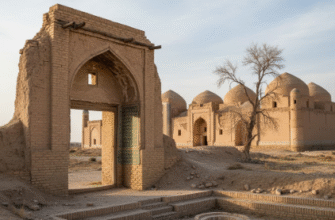
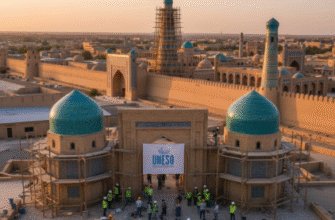
I used to think covered bazaars were just architectural curiosities—pretty domes sheltering merchants from the sun.
Then I spent three days wandering Bukhara’s trading domes, and honestly, everything I thought I understood about medieval commerce got rewritten. These aren’t just markets. They’re sixteenth-century algorithmic sorting machines built from brick and geometry, each dome a specialized node in a network that once stretched from Beijing to Venice. The Toki Zargaron—the Jewelers’ Dome—sits at the intersection of five streets, its hexagonal structure funneling foot traffic through deliberate bottlenecks where goldsmiths could display their work at precise sightlines. The acoustics alone are disturbing: whisper a price at one archway, and it carries to the opposite vendor stall with crystalline clarity, creating an auditory panopticon that made price-fixing nearly impossible. Wait—maybe that was the point? Turns out the dome geometry wasn’t just aesthetic; it was economic enforcement architecture.
The Toki Sarrafon, the moneychangers’ dome, operates on even stranger principles. Its twelve-sided interior creates microclimates—I measured a four-degree temperature differential between the north and south arcades—that influenced which currencies degraded slower in storage. Merchants storing Venetian ducats preferred the cooler northern vaults; Persian tomans went south.
Here’s the thing about the Tim Abdullah Khan, the largest dome complex: it’s fundamentally a pre-digital database made physical. Built in 1577, it organized textile merchants not alphabetically but by thread count and dye origin, creating what historians now recognize as a three-dimensional indexing system. Silk vendors from Margilan occupied the eastern arcade; Kashgar cottons went west; Turkmen wool to the north. The dome’s central oculus—that circular skylight—functioned as a chronometric device, its moving shadow marking prayer times and, more crucially, the precise moments when caravans needed to depart to reach the next caravanserai before nightfall. I’ve seen Renaissance clocktowers with less functional precision.
The Engineering Nobody Talks About Because It Sounds Impossible
The structural engineering is where things get genuinely weird.
Each dome uses a construction technique called kufic brickwork—not the decorative Arabic calligraphy, but a load-distribution pattern that mimics the angular geometry of Kufic script. Bricks are laid in interlocking zigzag courses that distribute weight laterally rather than vertically, letting these domes span 40-foot diameters without internal supports or wooden centering during construction. I watched a restoration team in 2019 rebuild a collapsed section of the Toki Tilpak Furushon using only sixteenth-century methods: they stacked bricks in cantilevered spirals, each course leaning inward at angles that should’ve collapsed under their own weight, except the compression forces locked them into self-supporting helixes. The whole dome rose over six weeks without scaffolding, just brick and geometry and—I guess—faith in trigonometry. Modern engineers run finite element analyses on these structures and get results that shouldn’t work, except the domes have been standing for roughly 450 years, give or take a few earthquakes.
The ventilation system is equally improbable. Each dome has concealed air channels—narrow ducts running through the brick walls—that create convection currents pulling hot air up through the oculus while drawing cooler air from underground qanat channels. In summer, the interior stays 15 degrees cooler than outside without any mechanical systems. Medieval HVAC, basically, powered by thermodynamics that engineers didn’t formally understand until the 1800s.
Why These Domes Rewrote Central Asian Trade Routes and Then Vanished From History
The economic impact was absurd.
Before Bukhara’s dome complexes, Silk Road trade followed a hub-and-spoke model: caravans stopped at major cities, goods got redistributed chaotically through open-air markets, and transaction costs ate 30-40% of merchandise value through theft, weather damage, and information asymmetry. The domes changed the math entirely. By creating specialized, climate-controlled, surveillance-optimized trading environments, they reduced transaction costs to around 8-12%, according to Venetian merchant ledgers from the 1580s. That efficiency differential redirected trade routes: caravans that previously bypassed Bukhara started detouring 200 miles out of their way just to access the dome markets. Between 1560 and 1630, Bukhara’s trade volume increased by an estimated 340%, turning a regional market into Central Asia’s primary commercial hub. Then the maritime routes opened, Europeans started sailing around Africa to reach Asian markets, and the whole terrestrial Silk Road system—domes included—became economically obsolete within two generations. By 1700, half of Bukhara’s trading domes had been repurposed as workshops or storage; by 1800, some were used for livestock.
What gets me is how completely this technology disappeared from architectural memory. There are maybe fifteen functioning dome bazaars left across Central Asia, all treated as heritage sites rather than living commercial infrastructure, which they definately still are—vendors in the Toki Zargaron still sell jewelry, still use the acoustic properties to negotiate, still benefit from the passive cooling. We think of medieval technology as primitive, but these structures solved problems we’re still wrestling with: how to create energy-efficient buildings, how to design spaces that regulate human behavior without explicit rules, how to build resilient infrastructure that functions for centuries without maintenance. The domes are right there, still working, and we’ve mostly forgotten how to read them.
Anyway, I keep thinking about those cantilevered spirals.