I’ve always thought medieval Islamic astronomy was some dusty footnote in textbook margins, you know?
Turns out—and this hit me when I was standing in Registan Square last spring, squinting at tilework older than Columbus—Ulugbek’s madrasah wasn’t just a school. It was basically the MIT of the 1400s, except instead of coding bootcamps they had actual observatories with instruments measuring star positions to within two arc minutes. The thing is, Ulugbek himself wasn’t some ascetic scholar locked in a tower; he was the grandson of Timur (yeah, Tamerlane), a literal prince who could’ve just partied his way through life but instead became obsessed with whether Ptolemy got the ecliptic angle right. He built this place in 1420, right on the western edge of what would become Central Asia’s most famous square, and staffed it with mathematicians who’d argue for hours about whether the solar year was 365 days, 5 hours, 49 minutes, or maybe 15 seconds longer. They were that precise. It’s exhausting just thinking about the calculations they did by hand, using tools we’d now call laughably primitive, yet they compiled a star catalogue—the Zij-i Sultani—that listed 1,018 stars with coordinates more accurate than anything Europe wouldn’t match for another century and a half.
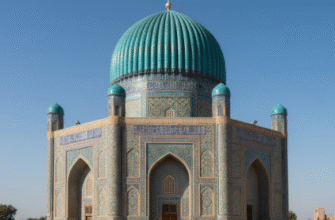
Honestly, the architecture tells you everything about Ulugbek’s priorities. The madrasah’s facade is this riot of geometric mosaics—stars, hexagons, ten-pointed rosettes—that aren’t just pretty. They’re mathematical proofs rendered in ceramic. Walk through the iwan (that big arched portal) and you used to find lecture halls where students studied the Almagest alongside the Quran, because for Ulugbek science and faith weren’t opposing teams. The curriculum was brutal: algebra, spherical trigonometry, observational astronomy, all taught in Arabic and Persian by guys like Qadi Zada al-Rumi and Ali Qushji, who were kind of the rock stars of their field.
When Princes Build Observatories Instead of Palaces, Things Get Weird
Here’s the thing—Ulugbek didn’t just fund this school and wander off to hunt leopards.
He built a separate three-story observatory just northeast of Samarkand (not on the square itself, common misconception) around 1428, and it housed a massive sextant sunk into a trench, roughly 40 meters radius, give or take. I guess it makes sense: you can’t exactly measure celestial meridian transits from a madrasah courtyard with tourists milling around. The observatory operated for maybe 30 years before Ulugbek’s own son had him assassinated in 1449—because apparently political ambition and filial piety don’t always overlap—and then religious hardliners dismantled the place brick by brick. By 1500 it was just rubble and rumors. Soviet archaeologists didn’t rediscover the foundations until 1908, which is its own kind of tragedy: an entire scientific legacy nearly erased because some people thought studying Jupiter’s moons was heretical.
The Madrasah That Taught Students to Question Everything (Including Aristotle)
Wait—maybe the wildest part is what they actually taught inside those blue-tiled walls. Students weren’t just memorizing tables; they were recalculating planetary orbits, challenging Greek assumptions about Earth’s centrality, developing new trigonometric functions because the old ones didn’t cut it for spherical astronomy. One of Ulugbek’s students, Ali Qushji, later moved to Istanbul and influenced Ottoman science for generations. Another, Ghiyath al-Din Jamshid, worked on decimal fractions and computed π to something like 16 digits. These weren’t just scribes copying ancient texts. They were innovators.
The teaching method was confrontational in a way modern universities would recognize: a master astronomer would present a problem—say, predicting the exact moment of a lunar eclipse—and students would have to work through the math publicly, defending every assumption.
Why a 600-Year-Old School Still Makes European Renaissance Scholars Look a Little Late to the Party
I used to think the Scientific Revolution was this purely European thing, Copernicus to Newton, clean narrative.
Then you read that Copernicus probably encountered Latin translations of Islamic astronomical texts during his time in Italy, and you start wondering how much of his heliocentric model was “original” versus synthesized from Tusi couples and other techniques developed at places like Ulugbek’s madrasah decades earlier. The Zij-i Sultani was translated into Persian, Turkish, Arabic—it circulated. When European astronomers finally started making systematic observations in the 1500s, they were often just catching up to what Samarkand had already mapped. Ulugbek’s measurement of the sidereal year (365 days, 6 hours, 10 minutes, 8 seconds) differs from modern calculations by less than a minute. With fifteenth-century tech. That’s not luck; that’s institutional rigor.
Standing in Registan Today, You Can Still Feel the Intellectual Hunger (and the Tragic Irony)
The madrasah’s still there, obviously, flanked now by two later buildings (Sher-Dor and Tilla-Kari, built in the 1600s) that turned the square into this symmetrical postcard everyone Instagrams.
But Ulugbek’s is the one with the faded inscription over the entrance: “The pursuit of knowledge is the duty of every Muslim.” Which feels pointed when you remember he was killed partly because his scientific work threatened religious authorities. The irony is thick enough to choke on. Tourists wander through, snapping photos of the mosaics, maybe not realizing they’re standing in what was essentialy the Harvard of medieval astronomy, a place where the motion of stars mattered more than the opinions of princes—until, of course, the opinions of princes (and mullahs) caught up with you. The observatory itself is just a museum now, a curved trench in the ground with explanatory plaques, but if you close your eyes you can almost hear the scratch of reed pens on paper, someone muttering about whether they should recalibrate the astrolabe again, whether the universe might be just a little stranger than anyone dared to admit.
Anyway.