I used to think Uzbekistan was just another stop on the Silk Road tour circuit, all samey blue tiles and tourist crowds.
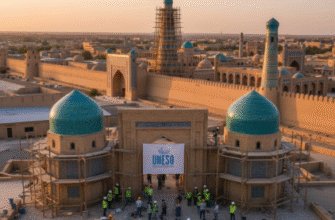
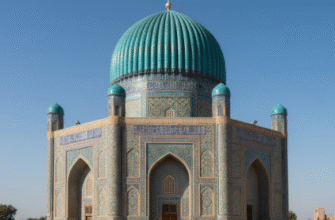
Turns out I was spectacularly wrong—and I mean that in the best way possible. The first time I pointed my camera at the Registan Square in Samarkand around golden hour, I realized I’d been carrying around this completely inadequate mental image of what Central Asian light could do to ancient architecture. The way the setting sun hits those turquoise domes and intricate mosaics creates this almost overwhelming saturation that your sensor struggles to capture without blowing out highlights, and you find yourself bracketing exposures like crazy, trying to preserve both the deep shadows in the iwans and the brilliant cobalt of the tile work. I’ve shot maybe two hundred frames there across different visits, and honestly, I’m still not sure I’ve nailed it. The crowds thin out around 7 PM in summer—give or take thirty minutes depending on tour bus schedules—and that’s when you get those clean shots without someone’s selfie stick invading your frame. Here’s the thing: the scaffolding comes and goes unpredictably because restoration work never really stops, so managing expectations is part of the game.
Wait—maybe I should back up and talk about why the light here feels different. The elevation in cities like Samarkand and Bukhara sits around 700 meters, the air’s got this particular dryness that creates insane clarity, and the dust suspended in the atmosphere during late afternoon produces these warm, almost amber-toned highlights that I’ve rarely seen elsewhere.
The Fortresses That Time Forgot and Photographers Definitely Shouldn’t
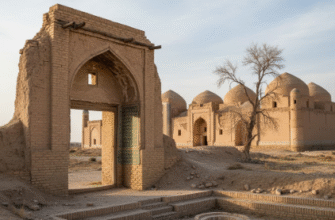
The Ayaz-Kala fortress complex in Karakalpakstan doesn’t get nearly enough attention, probably because it requires a fairly brutal drive through the desert and most photography guides skip right over it. I guess it makes sense from a logistics standpoint—you’re looking at roughly five hours from Khiva, the roads alternate between decent and “is this even a road,” and there’s basically no infrastructure once you arrive. But the payoff is genuinely remarkable: you get these ancient clay fortresses perched on desert hills with virtually zero tourists, the kind of empty, windswept landscapes that feel almost Martian at midday. I shot there in April, and the morning light was this cool, bluish thing that emphasized every texture in the eroded walls, while by 3 PM the whole scene transformed into warm ochres and deep shadows that created almost painful contrast. The locals who sometimes appear with camels for photo ops are—I’ll be honest—a bit of a cliché, but if you’re shooting for stock or travel magazines, clients still eat that stuff up, so I’m not judging.
Bukhara’s Backstreets Where the Real Texture Lives and Breathes
Everyone photographs the Kalyan Minaret because, well, it’s basically impossible not to—it dominates the skyline and the 12th-century brickwork is genuinely stunning. But I’ve found the more interesting images hiding in the residential mahallas southeast of the old town, where you’ve got these narrow lanes with actual daily life happening: old men playing cards in courtyards, women hanging laundry against walls with peeling plaster that reveals layers of paint from different eras, kids who haven’t yet developed that camera-wary expression you see in over-photographed areas. The trick is going early, like 6:30 AM early, when the light’s still soft and people are just starting their routines, before the heat drives everyone indoors and the streets empty out into this dead zone that lasts until evening. I definately recommend bringing a 35mm or 50mm prime for these tight spaces—zooms make you lazy, and you miss the moments that require you to actually engage with your surroundings instead of standing back like some documentary filmmaker.
The Fergana Valley’s Ceramic Workshops Where Color Becomes Almost Violent in Its Intensity
The Rishtan ceramics workshops aren’t exactly unknown, but most visitors treat them as a shopping stop rather than a photographic opportunity, which is their loss, honestly.
The process of creating those traditional blue-and-white patterns involves these massive vats of mineral pigments that photograph like pools of liquid turquoise and cobalt, surrounded by clay-dusted workshops where artisans work in dim light that streams through small windows creating these perfect, directional beams you’d normally need strobes to replicate. I spent maybe three hours at one workshop run by this fifth-generation potter named Alisher—or possibly Akbar, my notes are a mess—and he let me shoot the entire process from clay preparation through firing, didn’t even ask for payment though I obviously left something because that’s just basic decency. The challenge is white balance: tungsten bulbs mixed with daylight mixed with the glow from kilns creates this color temperature nightmare, and I ended up shooting RAW and fixing it in post because trying to nail it in-camera was making me exhausted. The finished pieces stacked in the yard outside, waiting for distribution, create these geometric compositions that feel almost abstract when you isolate them with a longer lens, and the imperfections—the slightly uneven glazing, the kiln scars—are what make them feel authentic rather than factory-produced. Anyway, if you’re there during summer, the heat inside those workshops is genuinely oppressive, so hydration isn’t optional, it’s survival.