I’ve walked through a lot of palaces, but Tash Hauli hits different.
Built between 1830 and 1838 by Allakuli Khan in Khiva—now Uzbekistan—this wasn’t just some administrative building where bureaucrats shuffled papers and pretended to care about irrigation schedules. It was a deliberate, almost obsessive architectural statement: a place where the khan could actually live separately from the older, cramped Kuhna Ark fortress while still projecting absolute power. The name literally means “Stone Courtyard,” which sounds modest until you realize the whole complex sprawls across roughly 6,800 square meters and contains something like 163 rooms organized into three distinct courtyards—each with its own rhythm, its own rules, its own secrets. Tash Hauli was where the messiness of governance, the theater of diplomacy, and the uncomfortable realities of harem life all collided in one place, wrapped in some of the most intricate tilework Central Asia has ever produced. And honestly, the more you learn about it, the weirder it gets.
The Harem Courtyard Where Architectural Beauty Masked Deep Inequality and Isolation
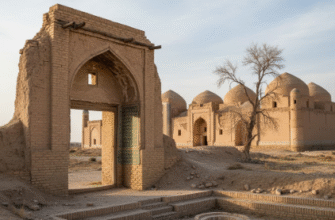
Here’s the thing: the harem wasn’t a single room. It was an entire self-contained universe—the largest of Tash Hauli’s three courtyards, with around 80 rooms arranged in a rectangle. The khan’s four official wives each got their own two-story house (Islamic law capped him at four), plus there were quarters for concubines, servants, children, eunuchs. Wait—maybe “house” undersells it. These were aiwans, open-pillared verandas stacked on top of each other, dripping with majolica tiles in blues and whites and turquoises, geometric patterns so dense they almost vibrate. I used to think harems were just about control, which they definately were, but walking through the ruins you also feel this strange tension: the architecture is breathtaking, almost tender in its detail, yet it functioned as a gilded cage where women spent entire lives barely seeing the outside world.
The walls were high. The only entrance was through the ishrat-hauz courtyard, guarded obsessively. And yet—the tilework. The craftsmen (probably enslaved or coerced, let’s be real) carved wood, painted ceilings, inlaid ceramic with a precision that suggests someone cared deeply about beauty even in a space designed for confinement. Turns out Allakuli Khan imported artisans from across his khanate, maybe even from Persia, to achieve those patterns. The harem courtyard had its own well, its own kitchen, its own bath—everything needed so the women never had to leave.
Diplomatic Theater and the Courtyard Where Khans Performed Power for Foreign Envoys
The second courtyard—the arz-hauz, or “courtyard of official recieptions”—was where Allakuli Khan met ambassadors, settled disputes, maybe executed people, who knows.
This was smaller, more focused: a rectangular space dominated by the throne room (the reception hall proper), which sat elevated on the eastern side with its own summer and winter chambers. The summer aiwans opened outward, catching breezes; the winter rooms were enclosed, warmed by coal braziers. Envoys from Bukhara, from Russia, from Persia—they’d wait in that courtyard, staring up at tilework that screamed wealth and permanence, before being ushered in to negotiate trade routes or hostage exchanges or whatever grim diplomacy the 19th-century Silk Road required. I guess it worked, because Khiva stayed independent (barely) until the Russians finally annexed it in 1873, decades after Tash Hauli was finished. The arz-hauz was performance space as much as governance center, every tile and column calibrated to intimidate.
And honestly, it probably smelled terrible—hundreds of people, minimal plumbing, Central Asian summer heat.
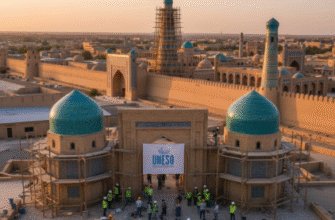
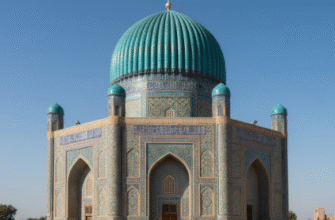
The third courtyard, the ishrat-hauz (“courtyard of pleasure”), was theoretically for festivals and celebrations, but by most accounts it also served as a buffer zone between the public and private realms, a kind of architectural airlock. Smaller than the other two, it had a pool (hauz means pool), some gardens, maybe some pavilions where the khan could relax without fully retreating into the harem. But even here, the tile motifs—endless arabesques, Kufic script, florals—reinforced hierarchy. Nothing was accidental. Every sightline, every doorway, every shade pattern was a choice. Visiting Tash Hauli today, you’re walking through a three-dimensional argument about power, gender, and aesthetics, frozen in ceramic and brick. The palace outlasted the khanate, outlasted the Soviets, and now it’s a museum where tourists like me wander around, taking bad photos and trying to imagine what it felt like when the courtyards were full of people whose names we’ll never know.
Anyway, the tiles are still incredible.