I used to think mosques were all about delicate minarets and quiet prayer halls.
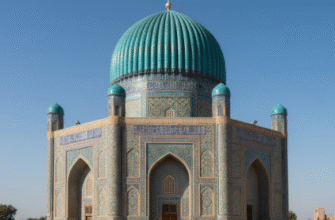
Then I stood in front of Bibi Khanym in Samarkand, and honestly, the sheer scale of the thing made my chest tighten in a way I didn’t expect. This wasn’t some hushed spiritual retreat—this was Timur’s ego made manifest in turquoise tile and crumbling brick, a monument so audacious it started falling apart almost immediately after construction finished in 1404. The main dome, roughly 40 meters high (give or take a meter, the records are messy), was supposed to dominate the entire Registan plaza, a visual scream that said I conquered half of Asia and here’s the receipt. Timur—known in the West as Tamerlane, a bastardization of Timur-i-Leng, “Timur the Lame”—commissioned this Friday mosque after returning from his Indian campaign, where he’d sacked Delhi and apparently decided Samarkand needed something bigger than anything in Persia. The architect, possibly Persian, possibly from Shiraz (sources conflict and I’ve seen three different names attributed), was supposedly executed or fled because the dome started cracking within decades. Wait—maybe that’s apocryphal, but the cracking part is definately real.
Here’s the thing: Bibi Khanym wasn’t just a mosque, it was a logistical nightmare made beautiful. Elephants hauled marble from quarries hundreds of kilometers away. Craftsmen from Damascus, Isfahan, and Delhi worked alongside local artisans, creating this weird hybrid style that doesn’t quite fit into neat art history categories. The courtyard could hold 10,000 worshippers during Friday prayers, which sounds impressive until you realize the acoustics were apparently terrible and the imam’s voice got lost in all that open space. The entrance portal still towers over you like a frozen wave of geometric patterns—stars within stars within stars, the kind of recursive Islamic design that makes your eyes vibrate if you stare too long.
The Legend That Probably Never Happened But Everyone Tells Anyway
Locals will tell you the mosque is named after Timur’s favorite wife, Saray Mulk Khanum, called Bibi Khanym (“Elder Princess”). The legend goes that she commissioned it as a surprise while Timur was off conquering, and the architect fell so madly in love with her that he demanded a kiss before completing the dome. She agreed, the kiss left a mark, Timur noticed, architect fled or died or turned into a bird depending on who’s telling the story. Turns out this is almost certainly romantic fiction invented centuries later—most serious historians think Timur himself commissioned it and the “Bibi Khanym” name got attached later through folk etymology and wishful storytelling. But the legend persists because, I guess, people need their monuments to have love stories attached.
How Earthquakes and Soviet Restoration Teams Both Tried to Save It and Kind of Failed
By the 1800s, the mosque was basically a ruin.
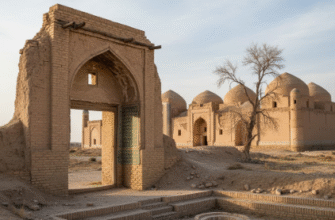
Seismic activity in Central Asia doesn’t mess around—Samarkand sits near active fault lines, and tremors in 1897 and 1903 knocked down what time and neglect had already weakened. The main dome collapsed entirely at some point (accounts vary on exactly when, maybe 1700s?), leaving just the drum and these massive ribbed sections pointing at the sky like broken teeth. Russian imperial scholars documented it as a picturesque ruin, all very romantic and Orientalist. Then the Soviets decided to restore it in the 1970s, which involved a lot of concrete and somewhat questionable interpretations of what the original looked like. I’ve seen photos from before the restoration, and honestly, the ruined version had a certain haunted majesty the rebuilt one lacks—though I get why they did it, cultural heritage preservation and all that.
What the Tilework Tells Us About Medieval Trade Networks and Artistic Egos
The tile mosaics are where things get interesting for me, probably because I’m a nerd about material culture. Analyses of the pigments show lapis lazuli from Badakhshan (in modern Afghanistan), cobalt from Kashan in Persia, and local clays mixed with imported glazes. Each tile is cut and fitted like a tiny puzzle piece—banai technique, where you cut fired glazed tiles into shapes and assemble them into patterns, as opposed to the earlier mosaic style where you paint before firing. The calligraphy bands quote Quranic verses about paradise and divine glory, executed in monumental Kufic script that’s almost architectural itself. Some sections show hasty work, probably because Timur wanted it done before he died (spoiler: he didn’t quite make it, dying in 1405 just after it was finished). You can see where different workshop teams had slightly different interpretations of the same geometric pattern, little inconsistencies that reveal the human hands behind the divine aspiration.
I guess what strikes me most is how the mosque embodies this contradiction—imperial power trying to capture eternity, and failing almost immediately because physics and hubris don’t mix well. The thing that was supposed to last forever started crumbling before Timur’s grandkids were grown. And yet, six centuries later, even in its partial ruin and awkward restoration, it still makes you stop and stare and feel something uncomfortable and awe-adjacent in your chest. Which maybe was the point all along.